How to Use Conditional Rewards in Loyalty Programmes
24 min to read
Published: January 10, 2024
Updated: September 18, 2026
Not every customer deserves the same reward, and not every reward earns its keep. Conditional rewards fix both problems at once by putting a string on the prize. Get that string right and you drive the exact behaviour your business needs.
Mark Camp
CEO & Founder at PropelloCloud.com
Contents
Key Takeaways
Conditional rewards unlock only when a customer takes an action that matters, so you shape the behaviours that build loyalty.
A reward matched to what a customer actually wants earns engagement; a generic one gets ignored.
Gamified mechanics and thresholds work only when customers can see the finish line and believe they'll reach it.
Clear levels give customers something to aim for, and status they won't want to lose.
People need to see exactly what unlocks a reward and trust it will pay out.
Blend immediate with long-term, and money-off with experiences, so you cover the whole journey without training customers to expect discounts.
Track engagement, redemption, retention and ROI, and refine as customer behaviour changes.
What Are Conditional Rewards?
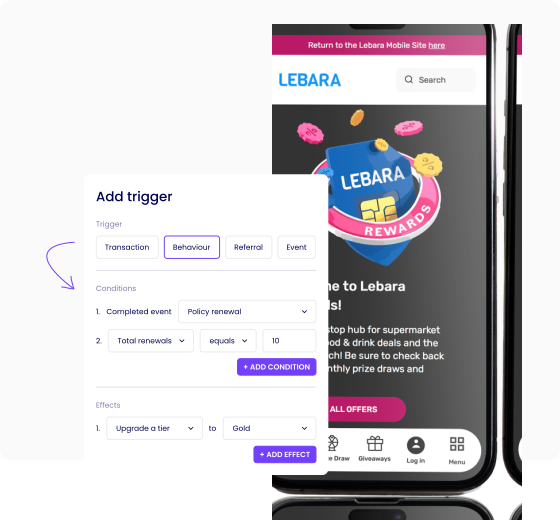
A conditional reward is one a customer earns only by meeting a specific condition or completing a set behaviour: renewing a contract, referring a colleague, climbing a tier, or clearing a spend milestone. Do X, and Y is yours. That single condition is what separates a loyalty programme from a giveaway.
The reward isn’t really the point. The behaviour it unlocks is. Think of the “Y” less as a prize and more as an incentive system, one built to line up with what actually motivates your customer. It could be the pull of climbing a membership tier or an offer tailored so closely it feels personal.
However, the reward still has to clear two bars: it has to be relevant, and it has to be meaningful. Miss either and you’re back to bribing people with discounts they’ll take and forget.
That distinction makes all the difference. Redpoint Global’s 2022 survey of over 1,000 US consumers, conducted by Dynata, found 74% agree that their loyalty to brands is driven by feelings of recognition and value, not loyalty perks and discounts.
Read that back. Nearly three-quarters of your customers are telling you the generic voucher isn’t what keeps them.
Conditional rewards are how you act on it. Tie the reward to where a customer actually sits in their relationship with you, and the incentive stops reading as a transaction and starts reading as recognition.
How Have Customer Loyalty Strategies Evolved?
Loyalty has travelled a long way from the punch card. What began as a blunt nudge to get people buying again has turned into something far more deliberate: data-driven systems that read customer behaviour and shape it.
Today a loyalty programme is less a discount scheme and more an engine for growth, segmentation and brand differentiation.
The early versions ran on extrinsic motivation alone. Buy ten, get one free. Discounts and freebies for repeat custom. It worked for a while, but it was thin, the same offer for everyone, with no room to build a relationship that lasted.
Modern customers won’t settle for that. They expect to be treated as individuals, and modern programmes answer with an intricate read of the customer journey, using data to drive personalised offers, tiered structures and behavioural incentives that respond to what someone actually does.
Technology is what made the shift possible. CRM integration and reward programme automation let brands run tiered benefits, gamification and conditional offers at scale, without piling on operational overhead.
And it isn’t finished. Customer expectations keep moving, and the next phase is already taking shape around experiential rewards and AI-driven segmentation.
The brands rethinking their approach now are the ones who’ll own it.
How Do Conditional Rewards Drive Customer Engagement?
Conditional rewards drive engagement by giving customers a reason to act, then making the act worth doing. Tie a reward to a behaviour that already sits close to what someone wants, and taking part stops being a chore and starts being a pull.
I’ve seen what challenges and tiered benefits do to a customer base. When the mechanic lines up with what people actually care about, they lean in.
Point systems, reward thresholds and time-based challenges tap into intrinsic motivation, so engagement feels like a game worth playing rather than a transaction to endure.
Exciting only gets you halfway, though. It has to be relevant too.
Customers engage far more readily with rewards built for them, and customer data is what makes that possible: conditional offers shaped around real preferences and real behaviour. That is the line between a customer who shows up once and one who keeps coming back.
What Are the Benefits of Conditional Rewards?
The benefits of conditional rewards come down to precision. Instead of rewarding everyone the same way, you reward the behaviours that actually move your business, so every pound of incentive works harder. The payoff shows up in five places: lifetime value, cost efficiency, retention, engagement, and the flexibility to keep adapting.
Increased Lifetime Value
Conditional rewards lift lifetime value by paying out for the behaviours that build it. Tier upgrades, perks for a contract renewal, a bonus for a referral: each one pulls a customer in deeper instead of discounting what they’d have bought anyway.
The mechanism is simple. When a reward speaks to what a customer actually wants, they’re far more likely to clear the condition you set.
Do that consistently and you get the two things every retention line needs: customers who stay, and revenue that holds.
Accenture’s research into retail loyalty programmes put the gap at 12% to 18% more revenue from members than non-members. That’s the difference between a customer base you maintain and one that quietly grows itself.
Cost Efficiency
Conditional rewards optimise your incentive budget by tying every reward to a measurable outcome.
A blanket discount goes to everyone, including the people who’d have bought anyway. A conditional reward only fires when a customer hits the spend threshold or behaviour milestone you actually care about.
That keeps spend pointed at the customers driving the most value. And it gets more efficient again when brand partnerships come into play, with partners helping offset the cost of the reward itself, so the programme stays sustainable as it scales.
Customer Retention
Of every benefit on this list, retention is the one I’d stake the most on. Meeting a condition to unlock a reward turns a routine purchase into something the customer has invested in. And people are far slower to leave a brand they’ve built standing with than one waving a discount they could find anywhere.
Increased Engagement
Conditional rewards turn a flat transaction into something with a bit of pull. The mechanic is anticipation: when a customer can see the reward and knows what it takes to reach it, the next purchase stops being a decision and becomes a target.
Progress bars, spending milestones, a challenge with the finish line in sight, they all work on the same instinct to close a gap once you can see it.
That’s what brings people back between purchases, not just at the till. Every step toward the reward is a reason to engage again.
Flexibility and Adaptability
Markets shift and customers change, and a fixed reward scheme ages badly. Conditional rewards don’t.
Because the reward is tied to a condition you set, you can move that condition: raise a threshold, swap an offer, pivot for a seasonal push, all without rebuilding the programme.
The same flexibility lets it scale. New tiers, new segments, new markets slot in as you grow, without the whole thing losing its shape.
What Are the Types of Conditional Rewards?
Conditional rewards aren’t one thing. The label covers any reward gated behind an action, so the type really comes down to which action you choose to reward, and how. The ones worth knowing split across performance, spend and engagement, personalisation, gamified mechanics and tiers.
Performance-Based Rewards
Performance-based rewards attach the prize to a measurable action: a referral, a contract renewal, a specific product bought. You’re not rewarding presence, you’re rewarding a result, which makes this the type to reach for when you want to steer customers toward outcomes that matter to the business.
The craft is in the target. Set it against something the customer can clearly see and actually reach, and the reward does the nudging for you.
Spend-Based Rewards vs Engagement-Based Rewards
This is the fork most programmes hit early. Spend-based or engagement-based, and the right answer depends on what you’re trying to move.
Spend-based rewards
Engagement-based rewards
Rewards
Money spent
Non-monetary actions
Typical mechanics
Cashback, tiered discounts, spend thresholds
Referrals, app activity, joining a challenge
Best for
Lifting average order value and revenue
Building the relationship and holding attention
Works fastest on
Customers already spending
Customers you want to keep active
The trade-off
Says nothing to a customer who isn’t buying right now
Slower to show up in revenue
The strongest programmes I’ve seen run both. Reward the spend milestone and the engagement that leads to it, and you cover the whole journey instead of half of it.
Personalised Offers
Personalisation is where a conditional reward stops feeling like a promotion and starts feeling like it was built for one person.
Generic incentives wash over people. A reward shaped by what someone actually buys, browses or ignores tells them you’ve been paying attention.
That’s the mechanism. When a customer feels seen, meeting your condition, hitting a threshold, or trying a new product feels less like jumping a hoop and more like being handed something they wanted anyway.
The data does the work: purchase history and behaviour tell you what to offer and to whom, so the reward lands where it counts.
Gamification Elements
Gamification adds a layer of play to the reward, turning earning into something a customer enjoys rather than endures.
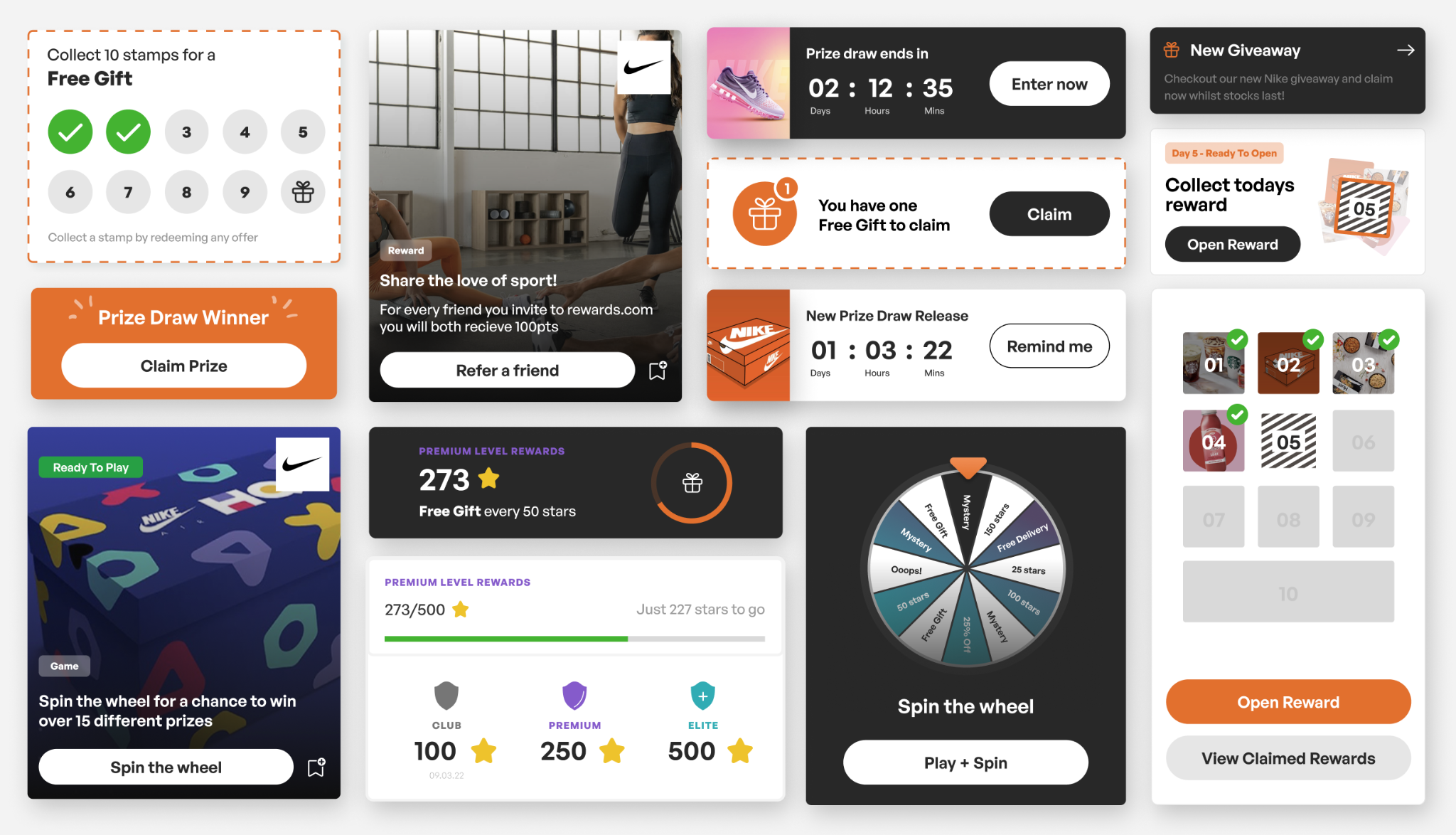
The mechanics are familiar because they work: stamp cards and progress bars that show how close the next reward is, point milestones, prize draws and spin-to-win moments, tiered levels that climb from one status to the next.
But every one of them lives or dies on the same thing: the goal has to be reachable.
Set the bar where a customer can see it and believe they’ll clear it, and the game pulls them in. Bury it under rules nobody follows, or set it too high, and you get a customer who shrugs and walks.
Tiered Benefits
Tiers turn loyalty into a climb. Split rewards into levels and you give customers a ladder: reach one rung and the next comes into view, each better than the last. That forward pull is the engine, because there’s always a reason to keep going.
It works on two instincts at once. The pull up is aspiration, the desire to reach the status and perks the next tier holds, sharpened by a fear of missing out (FOMO) on what others already have. The pull to stay is loss aversion: once a customer has earned a high tier, walking away means giving up something real, and people hold on to what they’ve worked for.
A premium or paid-for tier stacks this higher again, with VIP access, personalised experiences and exclusive perks customers work to reach and then work to keep.
How Do You Implement Conditional Rewards Effectively?
Implementing conditional rewards well comes down to three things working together: a clear structure, the right technology, and real customer insight. Get those aligned and the rest is execution. Here’s how to approach each stage.
Loyalty Programme Structure and Reward Thresholds
Get the thresholds right and much of the rest follows. A threshold is simply the bar a customer clears to earn a reward: a minimum spend, a points milestone, an engagement target. Set it well and it pulls people forward. Set it badly and it does nothing, or worse, it irritates.
The balance to strike is achievable but not trivial. Entry-level rewards for small wins keep newcomers moving, while premium benefits held back for sustained spend give the committed something to aim for.
Above all, thresholds have to be fair and transparent. A customer needs to see exactly what unlocks a reward and trust the programme will pay out when they reach it. The fastest way to lose someone isn’t a bar set too high. It’s one they don’t understand, or don’t believe.
How to Design Conditional Rewards: A Step-by-Step Guide
Ten steps, four phases. Plan it, build it, launch it, then keep sharpening it.
Phase
Steps
What you’re doing
Plan
1–3
Set objectives, segment the audience, pin down the behaviours to reward
Build
4–5
Design the reward structure and choose rewards people actually want
Launch
6–8
Communicate the rules, add gamification, put the technology behind it
Optimise
9–10
Track the metrics, then refine as behaviour and the market shift
Define your objectives. Start with the behaviour you want more of: higher purchase frequency, referrals, upgrades, renewals. Tie every objective to a business goal like retention or lifetime value, and if a reward doesn’t serve one, it doesn’t belong in the programme.
Segment your audience. Use your customer data to group people by behaviour and preference, then tailor rewards to each group. High-value customers respond to exclusive tiers, occasional buyers to gamified nudges. One reward for everyone is the thing you’re moving away from.
Pin down the target behaviours. Name the exact actions that count: a completed purchase, an app session, a referral, a renewal. Vague goals produce vague rewards. The tighter you define what earns the reward, the harder the reward works.
Design the reward structure. Build conditions that are clear and reachable, and mix the time-frames. Immediate rewards like a discount give instant payoff, longer-term ones like a tier upgrade keep people invested. Together they cover both the quick win and the reason to stay.
Choose rewards that actually land. Pick rewards your audience genuinely wants, and balance their perceived value against what they cost to deliver. Tangible perks like discounts work, experiential ones like early access build emotion. A reward nobody wants is budget spent for nothing.
Communicate the rules plainly. Spell out what unlocks each reward and how to claim it, across the channels people actually use: email, app, SMS. A welcome message setting out the thresholds, then progress nudges along the way, keeps expectations clear and momentum up.
Add gamification where it fits. Layer in progress bars, badges or time-limited challenges to make earning visible and a bit more fun. Keep the goals winnable: a mechanic people can see themselves clearing pulls them in, one they can’t pushes them away.
Put the technology behind it. Automate tracking, delivery and redemption so the programme runs without manual effort, and connect it to your CRM so customer data lands in one place. That integration is what turns raw behaviour into the insight your next round of rewards is built on.
Track the right metrics. Watch engagement, redemption, retention and ROI so you can see what’s working. If referrals jump after a new incentive, that’s your signal it landed. The KPIs that matter get their own section below.
Optimise as you go. No programme is right first time. Use feedback and the numbers to refine thresholds, rewards and messaging, and adjust as behaviour and market conditions shift. The programme that keeps working is the one that keeps changing.
How Do You Measure the Success of Conditional Rewards?
You measure a conditional reward programme by tracking a handful of metrics that show whether it’s changing behaviour and paying for itself. Watch the right ones and you can see what to double down on and what to fix.
Which KPIs Should You Track for Conditional Rewards?
KPI
What it measures
What a weak number is telling you
Engagement rate
How actively members take part
Your rewards aren’t landing with the audience
Redemption rate
Share of earned rewards actually claimed
Rewards feel irrelevant, or the conditions are too hard
Customer retention rate
How well the programme keeps customers over time
The programme isn’t giving people a reason to stay
Referral rate
Members bringing in others off the back of rewards
Your incentive to refer is too weak, or too hidden
Cost per reward redemption
What each redeemed reward costs against its impact
The economics are off, spend isn’t tracking to value
None of these mean much in isolation. Read together, they tell you whether the programme is earning its place or just costing you money.
Assessing Impact on Customer Lifetime Value
The clearest read on impact is a comparison: how do customers in the programme behave against those who aren’t? Track spend, frequency and retention across both groups and the gap is the value your rewards are adding.
That number does double duty. It tells you what’s working, and it’s the figure that justifies the next round of investment when someone upstairs asks what the programme is actually returning.
Done Right, Conditional Rewards Drive Retention and Lifetime Value
Conditional rewards work because they change the deal. Instead of paying everyone the same and hoping for loyalty, you reward the behaviours that build it, and customers stay because staying is worth something to them.
Get the mix right, personalised offers, gamified mechanics, tiers worth climbing, and you have a programme that keeps customers coming back and grows what each one is worth over time.
FAQs
What are conditional rewards in loyalty programmes?
Conditional rewards attach the reward to a specific action or milestone, so it only unlocks when a customer does something you’ve defined, such as renewing, referring, or reaching a spend threshold. The aim is to steer particular behaviours rather than reward spending in general.
What types of conditions can you set for a conditional reward?
Conditions usually fall into a few groups: spend-based (reaching a value threshold), behaviour-based (renewing a contract, upgrading, buying a specific product), engagement-based (referrals, app activity, completing a challenge), and event-based (a birthday, an anniversary, or a set date). Most programmes combine several, so different customers each have a relevant way to earn.
Why is personalisation important in conditional rewards?
Personalisation ensures rewards resonate with individual preferences and behaviours. By analysing customer data, businesses can craft hyper-relevant conditional offers, increasing the likelihood of customer engagement, reward redemption, and overall programme success.
How do you set a reward threshold that's neither too easy nor too hard?
Make the first reward reachable early, so new members get a win within their first few purchases, then set higher-value rewards further out for sustained engagement. If the first goal feels distant, people disengage before they start; if everything is too easy, the reward loses meaning. Your redemption rates will tell you whether the thresholds are pitched right.
Can conditional rewards work for B2B and subscription businesses, not just retail?
Yes. They suit any business with repeat relationships, including telecoms, insurance, memberships, subscriptions and financial services. In these settings the rewarded action is often a renewal, an upgrade, a referral or continued engagement rather than a retail purchase, but the mechanic is identical: define the behaviour that matters and attach a reward to it.
What are the most common mistakes with conditional rewards?
The frequent ones are overcomplicating the rules so customers cannot tell what unlocks a reward, setting thresholds too high, offering rewards nobody actually wants, and giving everyone the same reward regardless of behaviour. Over-relying on discounts is another, since it can train customers to wait for deals. Clear conditions, relevant rewards and regular review head off most of these.
Do conditional rewards risk training customers to expect discounts?
They can, if the programme leans on blanket discounts. When every reward is money off, customers can start to see the discount, rather than the product, as the reason to return. Tying rewards to specific behaviours and mixing in non-monetary options such as exclusive access, experiences or status reduces that risk and reinforces the brand instead of eroding its pricing.
How are conditional rewards different from surprise-and-delight rewards?
A conditional reward is earned: the customer knows the condition and works toward it. A surprise-and-delight reward is unexpected, given without a stated condition to create a moment of goodwill. Both have a place, conditional rewards drive planned behaviours while surprise-and-delight builds emotional connection, and many programmes use the two together.
How do you stop conditional rewards from being gamed?
Set clear rules for how and when rewards can be earned, and build in sensible limits, such as caps on referrals or eligibility conditions on qualifying actions. Tracking behaviour through your loyalty platform helps you spot unusual patterns early. Well-defined conditions are the main defence, since most abuse comes from vague or exploitable rules.
What technology do you need to run conditional rewards?
At minimum, a way to track qualifying actions, deliver and redeem rewards automatically, and connect that to your customer data. A dedicated loyalty platform handles this, and integrating it with your CRM keeps customer information in one place so rewards can be personalised and measured. Automation matters most, because manual tracking rarely scales.
Mark Camp
Mark is the Founder and CEO of Propello Cloud, an innovative SaaS platform for loyalty and customer engagement. With over 20 years of marketing experience, he is passionate about helping brands boost retention and acquisition with scalable loyalty solutions.
Mark is an expert in loyalty and engagement strategy, having worked with major enterprise clients across industries to drive growth through rewards programmes. He leads Propello Cloud’s mission to deliver versatile platforms that help organisations attract, engage and retain customers.
Start your customised Propello Cloud journey today
Explore the platform’s scalability, features and customisation options and get answers to your unique questions.