How to Increase Gym Membership Sales: 5-step Process
27 min to read
Published: July 25, 2024
Updated: October 19, 2026
To increase gym membership sales, make joining easy and staying worthwhile. Five steps do the work: frictionless sign-up online and on the gym floor, personalisation at every touchpoint, upgrades sold alongside the core membership, retention treated as a long game, and a loyalty and referral programme that encourages members to recruit others.
Mark Camp
CEO & Founder at PropelloCloud.com
Contents
Key Takeaways
Gyms grow membership sales fastest when they make joining easy and give members visible reasons to stay.
Most membership losses trace back to fixable problems, from untrained sales staff and dated websites to rigid pricing and neglected equipment
A short online sign-up and a structured gym tour are the two moments that decide whether a prospect becomes a member.
Personalisation works best when gyms use the booking and check-in data they already hold to tailor offers, classes and recognition.
Upsells land when they match how a member already trains, and free trials of premium services make the upgrade an easy yes.
Retention depends on steady habits such as monthly challenges, rewards for progress and a quick check-in when attendance drops.
A loyalty and referral programme ties the whole process together by rewarding commitment and turning satisfied members into recruiters.
Gyms used to bank on the member who pays and never shows. That model is fading. Members notice what leaves their account each month, budget gyms and home workouts sit one tap away, and the lapsed payer cancels instead of forgetting.
So growth has to come from somewhere sturdier.
I see the same pattern in membership businesses every week: the ones growing fastest sell the membership well, then give people a reason to keep it. The five-step GAINS process below covers both, with JD Gyms as the proof.
Why Do Gyms Struggle to Keep Members?
Gyms lose members for five fixable reasons: rewards and referral programmes that barely exist, staff trained in fitness but not sales, dated websites and communication, rigid pricing and schedules, and tired equipment. Each one pushes members out the door. Each one is also where the strongest gyms pull ahead.
Issue
What it costs you
Where to start
Rewards and referral programmes rarely used
Regulars see no reason to stay, and no member-led pipeline brings new people in
Step 5: a loyalty and referral programme
Weak sales skills and digital presence
Prospects lost on the tour or before they ever visit
Step 1: sign-ups and socials
Outdated communication and tech
The gym gets judged by a dated website, and members can’t self-serve
Steps 1 and 2: frictionless sign-up and personalisation
Rigid pricing and schedules
Members pay for what they don’t use, then leave
Step 3: tiered memberships and upsells
Poor equipment condition
Safety worries, poor perceived value and bad word of mouth
A maintenance schedule, fast repairs and rolling replacement
1) Rewards and referral programmes are rarely used
Most gyms reward the act of joining and then go quiet. A member who turns up four times a week for three years gets the same treatment as one who signed up in January and vanished by March. That commitment goes unrecognised, and unrecognised commitment is easy to walk away from.
The numbers show the cost.
The Health & Fitness Association’s 2025 Fitness Industry Benchmarking Report, drawn from 175 operators running more than 17,000 facilities across 27 countries, puts average annual member retention at 66.4%. Roughly one member in three gone within a year.
The same report found net membership still grew 5.5% on average, which tells you how hard the front door is working to cover the back one. That is an expensive way to grow.
Every lost member is a sales slot to refill, an induction to repeat and a relationship to rebuild from scratch.
Rewards and referral programmes attack the problem from both ends. Rewards give regulars a reason to stay, because effort that earns something feels different from effort that disappears into a direct debit. Referrals turn those same regulars into recruiters, and people who join through a friend arrive with a reason to show up.
Few gyms run either well. That gap is the opportunity.
2) Lack of sales experience and digital presence
Most gym teams are hired for their training knowledge, and selling memberships sits outside the job description. Personal trainers and floor staff know fitness inside out, and the role rarely asks for more.
The gap shows up at the moment it matters most: a prospect on a tour, asking about price, deciding whether to sign.
In my experience, the gyms that convert well treat everyone on the floor as part of the sales process. Not pushy. Just able to explain clearly why this gym is worth the money, to this person, for this goal.
Then there is the digital front door.
Plenty of prospects will have scrolled your Instagram, checked your reviews and judged your website before they set foot inside. A gym with a dead social feed and a tired site looks closed, even with a full car park.
Prospects compare you with the gym down the road from their sofa, and an empty feed loses that comparison without you ever knowing it happened.
Both gaps are fixable, and neither needs a big budget:
Train the whole team in basic sales, not just the membership manager.
Write a short sales playbook that matches your gym’s values and tone.
Make online sign-up quick enough to finish on a phone.
Post consistently: member wins, coach tips, new kit, the atmosphere on a busy evening.
Use challenges and free trials to give prospects a taste before they commit.
Every post and every conversation on the gym floor is a sales opportunity. Too many gyms let both slip.
3) Outdated means of communication and digital tech
Your members track every rep, step and calorie on their phones. Then they try to book a class on your website and hit a PDF timetable from last spring.
That gap costs you before anyone walks through the door.
A study by Gitte Lindgaard and colleagues at Carleton University, published in Behaviour & Information Technology, found people rate a web page’s visual appeal within 50 milliseconds, and those snap ratings closely match the ones they give after a longer look.
A dated site gets judged as a dated gym, and a prospect on their sofa has no reason to look twice.
The fix starts with the basics:
A fast, mobile-friendly site with clear prices and an easy way to join
Class booking, progress tracking and account changes members can handle from their phone
Reviews, FAQs and feedback pages that answer questions before they become objections
Member and staff stories that show prospects who they will be training alongside
Communication matters as much as the tech. Newsletters, FAQs and feedback loops are a direct line to members and prospects, and too often gyms use them to broadcast instead of listen. Ask what members want, act on it and tell them you did.
Keeping up with expectations is the floor. The gyms that pull ahead make every digital touchpoint feel easier than the alternative.
4) Rigid pricing and schedules
Rigid timetables and one-price-fits-all memberships belong with neon leg warmers. Your members are juggling work, childcare and everything else, and they want a gym that fits around their week rather than one more fixed commitment to squeeze into it.
Start by looking at your offer from their side of the desk. A free class sounds generous on paper, but who is it for? If the 11am weekday slot is empty because your target members are at work, it serves nobody, however good the instructor.
Smart scheduling means knowing who each class is for, when they can actually come and what they would pay for it.
Freelance instructors deserve the same scrutiny. They bring variety and expertise, but if their availability dictates the timetable instead of your members’ availability, you end up with a gym full of top-class coaching that nobody can attend.
Flexibility is the fix, on price and on time:
Offer on-demand or virtual classes members can join whenever suits them.
Build tiered memberships so people pay for what they actually use.
Use attendance data from your gym management software to move classes to when members turn up.
The aim is not to cram more into the timetable. It is to build a fitness routine that slots into members’ lives without friction. Members who can fit the gym around their life have far fewer reasons to leave.
5) Equipment condition and quality of service
Your equipment is the product members see every visit. Worn cables, a row of out-of-order treadmills or a rack of mismatched dumbbells tell people more about how you run the gym than any brochure.
Poor kit pushes members away in three ways:
They worry it is unsafe, and nobody trains hard on a machine they don’t trust.
The gym looks dated and cheap, so the monthly fee starts to feel like poor value.
It stops them progressing towards their goals, which is the reason they joined.
The out-of-order sign does the real damage. One broken machine is a fault. A machine left broken for a week tells members nobody is paying attention, and that impression spreads across the whole gym floor.
It spreads beyond your walls too.
Members talk about their gym to friends, colleagues and anyone who asks where they train. Well-kept, well-chosen kit turns that word of mouth in your favour. Neglected kit turns it against you.
Good kit keeps the members you have and gives prospects on a tour something worth signing up for. Maintenance schedules, fast repairs and a rolling replacement plan cost money. Losing members to the gym down the road with better kit costs more.
What Is the 5-Step Process for Increasing Gym Membership Sales?
The GAINS process for increasing gym membership sales has five steps: Get sign-ups and socials on form, Always go heavy with personalisation, Incentivise upsells alongside core services, Never forget retention is a marathon, and Set up a loyalty and referral programme.
The first wins members, the middle three keep them spending, and the last turns them into recruiters.
Step #1: Get sign-ups and socials on form
Most membership sales are won or lost before the contract appears. Prospects need an easy way to raise their hand online and a tour that sells the gym once they walk in. Those two moments decide whether everything after them gets a chance.
Online sign-up and social media
Your website needs a short form that captures a prospect’s details and lets them book a visit or a call in a couple of taps. Every extra field and every extra page is a chance for them to give up, so cut the process to the minimum and test it on your own phone.
Social channels do the same job for prospects who never reach your site. Keep them active and give people a reason to follow:
Special offers and joining deals
Members’ personal achievements
Good causes the gym supports
Health and fitness tips from your coaches
Staff spotlights that show their experience
New equipment and facilities
The face-to-face sales process
When a prospect walks in, they should be met by someone trained to sell. A sales playbook gives every team member the same structure:
Step
What to do
Why it works
1
Greet regulars by name during the tour
Shows the prospect that people keep coming back and that there is a community worth joining
2
Ask about their goal early
Losing fat, building muscle, training for an event or just feeling better: the answer shapes the rest of the tour
3
Let them talk
Their questions tell you what they care about most
4
Match the pitch to what they said
If they want to build muscle and ask about personal training, introduce the coach best qualified to help
5
Show every facility included in the basic membership
The pool, sauna, studios and courts all add to the value they are weighing up
6
Finish somewhere with visible testimonials and results
Ends the tour on proof from people like them
7
Offer flexible options, including a monthly rolling membership
Commitment feels like a choice rather than a trap
8
Invite them into your loyalty programme at sign-up
Rewards start from day one, so the first month already feels like good value
When the prospect is in the building, close the sale in person. Plenty of members start online, and that route should stay easy, but a face-to-face conversation is your best chance to show what the membership is worth.
Step #2: Always go heavy with personalisation
Personalisation means treating each member as the person behind the direct debit: their goal, their schedule, their progress. It is also where most gyms leave the easiest gains on the table, because the data is already sitting in their systems.
Use the data you already have
Sign-up forms, class bookings and check-ins tell you what each member wants, when they train and what they keep coming back for. Use that to segment members and send them content that fits, so the 6am lifter and the Saturday yoga regular stop getting the same newsletter.
Recognise members beyond the inbox
Recommend classes based on what someone already books. Mark milestones, from a 50th visit to a first unassisted pull-up. Small, specific recognition tells members someone noticed, and members who feel noticed are harder to lose.
Let a loyalty programme do the matching
A loyalty and reward programme makes personalisation work at scale. Personalised offers and member benefits can be served based on individual preferences, and conditional rewards nudge each member towards the right next step:
A class pack for the regular who only ever does spin
A membership upgrade for the member who keeps paying for extra sessions
A free PT session for the member whose attendance has started to slip
Turn member stories into content
Your members are setting goals, hitting PRs and changing their lives on your gym floor, and many are already posting about it. Spotlight those stories and reward the members who share them. You get content, they get recognition, and prospects see proof from people just like them.
Personalisation extends to the service itself too. Flexible class times, varied programmes and training plans built around individual goals all tell members the gym is adapting to them, rather than the other way round.
Generic fitness is everywhere. A gym that knows its members by name, goal and habit is much harder to replace.
Members now expect more than a room full of kit. Specialist classes like HIIT, yoga and spin, personal training and recovery services all give them reasons to spend more with you, as long as each one fits around their week.
The core membership gets them through the door. Everything layered on top grows what each member is worth.
Gym management software shows which classes fill up at which sites, so you can put resources where demand actually is and spot the members most likely to want more.
Tiered loyalty programmes are the natural home for upsells. Bundling free classes or PT sessions into higher tiers gives members a visible reason to move up, and something concrete to lose if they move back down.
What’s in your vending machine matters
Even the vending machine sends a message. A gym that preaches progress and then sells fizzy drinks and chocolate at the exit undermines its own pitch. Stocking protein snacks, low-sugar drinks and decent coffee turns a small touchpoint into a revenue line that matches what members came for.
Use engagement data to time the upsell
Every booking, check-in and class attended tells you something. The member who books three spin classes a week is a candidate for an unlimited class pass. The one who keeps asking coaches for form tips is a PT client in waiting.
Upsells land when they match behaviour, and fall flat when they arrive as a generic email blast.
Let members try before they upgrade
Free trials of premium services take the risk out of saying yes. A complimentary PT session or a week of premium class access lets members feel the value for themselves, which makes the upgrade conversation far easier.
Upsells done this way lift revenue per member, and they deepen the relationship too. Members who use more of what you offer have more reasons to stay.
Step #4: Never forget: retention is a marathon not a sprint
A strong retention strategy is the step most gyms skip, because it pays out slowly. Most people want quick wins from fitness, and most gyms want them from marketing. Retention works like training: consistent effort, results that build month on month.
Most new members arrive with a short-term goal. The gyms that keep them help that goal become a habit, and the habit become a sense of belonging.
Everything covered so far feeds into that: easy sign-up, personal attention, offers that fit. Put together, they turn a gym into a community hub, and the members who feel part of it become your best ambassadors.
Retention tactics that build on the basics
Six tactics that work together:
Monthly fitness challenges: Launch and track them through your gym management software or member app, and share the leaderboard in the gym and on social media.
Rewards for progress: Offer prizes members actually want, such as PT sessions, kit or tickets to fitness events, so effort earns something visible.
Local influencer partnerships: Invite local fitness creators to train with you and share their honest take. Their audience already trusts them.
Your own content: A podcast, video series or newsletter featuring your coaches and standout members gives people value between visits.
Check-ins at the right moment: A quick message when a member’s attendance drops catches them before they drift, rather than after they cancel.
Value-added services: Nutrition planning or form feedback through your app adds depth to each member’s fitness journey.
Retention rewards the same things strength training does: consistency, patience and a plan you stick to. The gyms that commit to it stop relying on January to refill the membership list.
Step #5: Set up a loyalty and referral programme to do the heavy lifting
A loyalty and referral programme ties the first four steps together. It rewards the behaviour you want, captures the data that makes personalisation possible and turns satisfied members into a source of new ones.
The hard part is choosing incentives that matter to people whose main goal is getting fitter.
Choose rewards that serve the goal
The best rewards push members further along their fitness journey.
A free PT session at renewal, premium class access for members who extend their subscription or a body composition scan at a milestone all reward commitment with progress.
Partnerships with local businesses also widen what you can offer without adding cost to the gym floor. Deals at a health food shop, a physio clinic or a sports retailer give members more reasons to stay active in your community, and give partners access to an engaged local audience.
Use referrals to smooth out January
Every gym knows the pattern: a rush of New Year sign-ups, then a sharp drop by spring. It strains cash flow and leaves the gym chasing the next intake.
A strong referral programme flattens that curve. Satisfied members bring in friends all year round, and people who join through someone they know arrive with a training partner and a reason to keep showing up.
Make referring easy, reward both sides and recognise every referral, every time.
The right software keeps all of this in one place. Loyalty platforms like Propello Cloud run points, tiers, partner rewards and referral tracking together, so sign-ups, referrals and upsell offers all feed the same member record.
Built on trust and on benefits members can feel, a loyalty programme becomes the engine behind steady, member-led growth.
How Did JD Gyms Use a Loyalty Programme to Grow Membership Value?
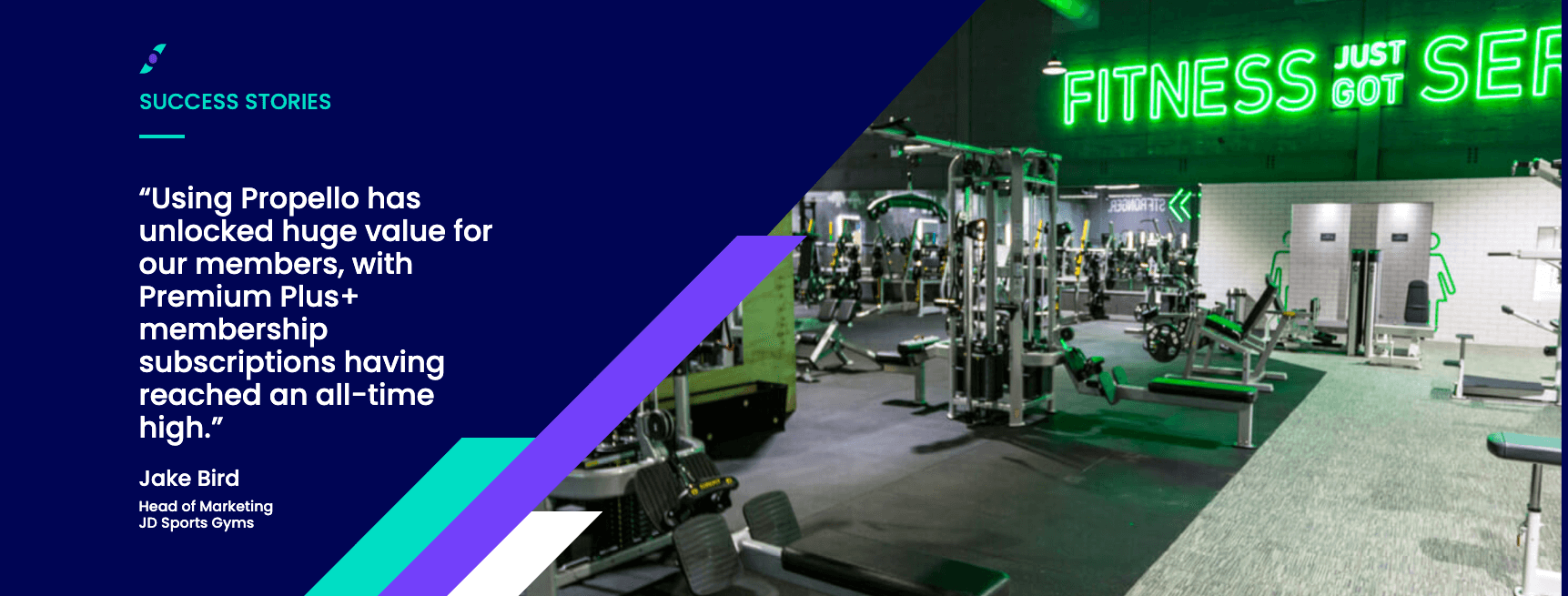
JD Gyms partnered with Propello Cloud to build a conversion programme that showed members more value for their money. Rewards reached beyond the gym into JD’s sportswear and fashion brands, cross-sells justified price increases, and members moved onto the higher-tier in strong numbers.
Where it started
JD Gyms already had the fundamentals: good equipment and a full timetable of classes for every level. But members could still churn for all the usual reasons, and once a member cancels, winning back the direct debit is hard work.
Costs were rising too. Energy bills and wages push every gym’s outgoings up, and sometimes prices have to follow.
A higher fee with no visible extra value hands wavering members a reason to leave.
What we did
We built a conversion programme on the Propello Cloud platform designed to show members more value for their money. Cross-sells and added benefits made the case for each price increase before members had a chance to question it.
The rewards reached beyond the gym.
The programme generated referrals into other parts of JD’s business, including its sportswear and fashion brands, and promoted a broader approach to health and lifestyle.
Members saw a gym that offered more than access to equipment.
The result
JD Gyms saw exceptional uptake of its higher-tier membership with an expanded set of benefits. Members moved up a tier because they could see exactly what the extra money bought.
The lesson travels to any gym under cost pressure. When members can see the value, a price increase looks like an upgrade instead of a reason to cancel.
Grab Your Copy of our Gym Membership Engagement and Acquisition Guide
Growing gym membership sales comes down to two jobs done well: making it easy to join, and giving people reasons to stay. GAINS covers both.
Win prospects with frictionless sign-up and a tour that sells. Keep them with personalisation, upsells that match their habits and a retention plan built for the long haul. Then let a loyalty and referral programme turn your happiest members into recruiters.
And if you’d rather talk it through, we’ll walk you through how gyms like JD Gyms put it into practice.
FAQs
How quickly should a gym follow up with a new lead?
As quickly as possible, ideally within minutes and certainly the same day. Interest is highest when someone has just enquired, and a slow reply gives them time to book a visit elsewhere. Automated acknowledgements help, but a personal call or message from a staff member is what turns an enquiry into a booked visit.
What is a good lead-to-member conversion rate for a gym?
There is no reliable industry-wide benchmark. Published figures vary widely and mostly come from software vendors using their own customer data. The more useful number is your own: track how many enquiries book a visit, how many visits sign up, and which lead sources convert best, then improve the weakest stage first.
How can a gym win back members who have cancelled?
Start by understanding why they left, then segment former members by reason and tenure. Recent leavers who cancelled over cost may respond to a flexible or lower tier, while those who drifted away may respond to new classes or facilities. Keep in touch after cancellation, lead with what has changed and make rejoining simple.
How many members does a gym need to be profitable?
It depends on the business model. A simple way to estimate break-even is to divide monthly fixed costs by the average net revenue each member brings in. Low-cost gyms need large numbers of members to cover their costs, while boutique studios with higher prices can break even with far fewer.
When is the best time of year to sell gym memberships?
January is traditionally the busiest month, as New Year resolutions drive a surge in sign-ups. September is often a second peak as routines restart after summer, and the run-up to summer brings another lift. Quieter months are better spent on referrals, retention and win-back campaigns rather than heavy discounting.
How do you calculate a gym's churn rate?
Divide the number of members who cancelled during a period by the number of members at the start of that period, then multiply by 100. A gym that starts the month with 1,000 members and loses 40 has a monthly churn rate of 4%. Track it monthly and by how long members have been with you.
Should gyms use discounts to increase membership sales?
Sparingly. Heavy discounts can bring in a spike of sign-ups, but they tend to attract price-sensitive members who leave when the offer ends. Added value usually works better than a lower price, such as a free PT session, a guest pass or loyalty rewards that start from the first month.
How should gym staff handle price objections?
Acknowledge the concern, then bring the conversation back to the prospect’s goal and what the membership includes. Comparing cost per visit, pointing out the facilities and classes in the price, or offering a lower tier or rolling monthly option often works better than an immediate discount. The aim is to show value, not win an argument.
How can an independent gym compete with budget gyms?
By competing on experience rather than price. Independent gyms can offer more coaching, a stronger community, specialist classes and personal recognition that high-volume budget chains struggle to match. Clear positioning matters too: be specific about who the gym is for, and make that value visible from the first enquiry onwards.
Can corporate memberships help increase gym sales?
Yes. Partnering with local employers to offer discounted or subsidised memberships for their staff can bring in several new members through a single relationship, and colleagues who join together have a built-in reason to keep training. Agree clear terms on pricing, minimum numbers and how the employer will promote the offer internally.
Mark Camp
Mark is the Founder and CEO of Propello Cloud, an innovative SaaS platform for loyalty and customer engagement. With over 20 years of marketing experience, he is passionate about helping brands boost retention and acquisition with scalable loyalty solutions.
Mark is an expert in loyalty and engagement strategy, having worked with major enterprise clients across industries to drive growth through rewards programmes. He leads Propello Cloud’s mission to deliver versatile platforms that help organisations attract, engage and retain customers.
Start your customised Propello Cloud journey today
Explore the platform’s scalability, features and customisation options and get answers to your unique questions.