The Role of Customer Lifecycle Marketing in Building Brand Loyalty
26 min to read
Published: May 23, 2024
Updated: August 24, 2026
Customer lifecycle marketing meets people where they actually are in their journey, not where a blast campaign assumes they are. Here are the stages, the strategy, and where loyalty rewards earn their keep.
Mark Camp
CEO & Founder at PropelloCloud.com
Contents
Key Takeaways
Customer lifecycle marketing is essential for driving long term business growth and building lasting customer relationships.
Understanding the unique stages of the customer journey allows you to create personalised, engaging experiences that resonate with your audience.
Lifecycle marketing offers numerous benefits, including increased customer lifetime value, better marketing ROI, improved retention, and enhanced brand advocacy.
Developing a comprehensive lifecycle marketing strategy involves tailoring your approach to each stage of the funnel and leveraging the most effective tactics and content for each touchpoint.
Staying ahead of future trends, such as hyper-personalisation, smart automation, and data privacy, is crucial for success in the evolving landscape of lifecycle marketing.
Constantly measuring, analysing, and optimising your lifecycle marketing efforts based on data-driven insights is key to continuous improvement and growth.
What is Customer Lifecycle Marketing?
Customer lifecycle marketing is the practice of tailoring your messaging to where each customer actually sits in their journey with you, from first click to repeat purchase to referral.
Most marketing still runs on broadcast. One message, fired at everyone, hoping a fraction sticks. Lifecycle marketing does the opposite. It reads behaviour, preference and stage, then shows up with the thing that fits.
That means pulling every channel into one view. Email, social, your loyalty programme, post-purchase nurture, all steering the customer the same way: from awareness to consideration to purchase, and on to the part most brands neglect, advocacy.
Right message, right place, right time. That is the whole discipline. Do it well and you create those “wow” moments that make your customers feel valued, understood, and excited to keep interacting with your brand.
What Are the Stages of the Customer Lifecycle?
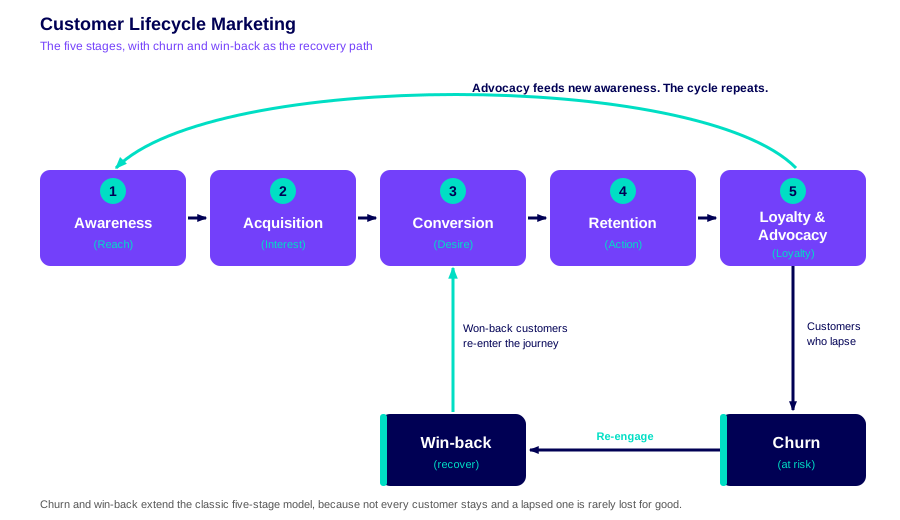
The customer lifecycle has five core stages: awareness (reach), acquisition (interest), conversion (desire), retention (action), and loyalty and advocacy. Two further stages matter for any customer base that lapses over time: churn and win-back.Map these before you build anything. Skip the map and every campaign fires blind, the welcome email and the win-back email doing the same generic job when they should be doing opposite ones.
Awareness (Reach). First contact. Someone discovers the brand exists, and the job is to earn attention and enough curiosity to look closer.
Acquisition (Interest). They lean in. They subscribe, follow, browse. Now you are building a relationship, not just visibility.
Conversion (Desire). They are weighing you against the alternatives. Make the value obvious and the decision easy.
Retention (Action). The sale is not the finish line. Onboarding, support and follow-through decide whether a first purchase becomes a habit.
Loyalty and Advocacy (Loyalty). The outcome worth chasing: customers who stay, spend more, and bring others in.
Most lifecycle models stop there. Real customer bases don’t. Some customers drift no matter how good the experience, which is why two more stages earn their place.
Churn. The customer goes quiet or leaves. Knowing why, whether a poor experience, thin value, or a better offer elsewhere, is what turns a loss into something you can fix.
Win-back. A lapsed customer is not a lost one. Targeted re-engagement usually costs less than chasing a stranger, and this one already knows your name.
Map your own customer loyalty ladder and you learn how people actually think and feel at each step. That is what makes the messaging land: the right thing, at the right moment, every time.
What Are the Benefits of Customer Lifecycle Marketing?
Lifecycle marketing raises customer lifetime value, sharpens marketing ROI, improves retention, deepens engagement, and turns satisfied customers into advocates. The through-line is efficiency: you spend on the right customer at the right moment instead of broadcasting to everyone.
This is the gap it exists to close. In Propello Cloud’s Loyalty Uncovered 2025 report, based on 100 enterprise brands, 83% say customer engagement is a challenge, the single most-cited struggle in the report.
Meeting customers stage by stage is how you get on the right side of that number.
Increased Customer Lifetime Value
Relevant, personalised touchpoints keep customers coming back. Retention and repeat spend push lifetime value up, which is where the real margin sits.
Better Marketing ROI
Target by journey stage and you stop paying to reach people who were never going to convert. The right message to the right person beats another expensive acquisition blast every time.
Improved Customer Retention
When customers feel understood, they stay. Meeting evolving needs stage by stage builds the kind of relationship a rival’s discount can’t easily prise loose.
Increased Customer Engagement
Timely, relevant communications earn the attention that generic broadcasts lose. Show up usefully often enough and engagement becomes a habit.
Enhanced Customer Experience
A unified journey feels coherent instead of chaotic. That consistency lifts how the brand is perceived and separates you from competitors still firing scatter gun.
Brand Advocacy and Word-of-Mouth Marketing
Exceed expectations and customers tell their networks for free. Word of mouth stays the cheapest and most trusted growth channel there is.
How Do You Build a Customer Lifecycle Marketing Strategy?
Build a lifecycle marketing strategy by matching tactics to each stage of the funnel: attract at awareness, nurture at acquisition, convert at desire, deliver at retention, and reward at loyalty. Loyalty programme incentives run through all five, giving customers a reason to move to the next stage.
Stage #1: Awareness (Reach)
The job here is simple and hard: get noticed by people who have never heard of you. Earn organic reach with content built around the questions your audience is already typing, and borrow other audiences through co-marketing with complementary brands or creators.
A loyalty programme widens the top of the funnel two ways. Referral rewards turn current members into a distribution channel, and a sign-up bonus gives a stranger a concrete reason to raise their hand.
Stage #2: Acquisition (Interest)
Attention is cheap. A relationship is the thing you are actually building. Segment by behaviour and interest, then nurture with content that fits: webinars that tackle a real problem, re-targeting that stays useful rather than creepy, and case studies that show a prospect someone like them who chose you and won.
This is where a loyalty programme starts earning engagement before a sale exists. Points for signing up, challenges and badges, exclusive previews, all of it gives people a reason to keep interacting while they decide.
Stage #3: Conversion (Desire)
By now they are ready to buy, they just need the decision made easy. Answer objections before they harden with comparisons, demos and FAQs, and let a free trial do the convincing that copy can’t.
A loyalty programme is a quiet tiebreaker at this stage. A welcome incentive for choosing you over a competitor, or a member-exclusive product or price, turns a close call into an easy yes.
Stage #4: Retention (Action)
The sale is the start, not the finish. Deliver on the promise with onboarding that gets people to value fast, support that answers before frustration sets in, and product guidance that makes the most of what they bought. Then keep proving you know them, with recommendations that feel hand-picked rather than blasted.
A loyalty programme makes retention tangible. Always-on rewards give members instant reasons to stay engaged, and a tiered structure turns “I bought once” into “I want the next level”.
Stage #5: Loyalty and Advocacy (Loyalty)
You have won the business. Now you win the relationship. This is where a one-time buyer becomes someone who spends more and brings others in. Exclusive perks, insider access and genuine recognition make loyal customers feel seen, and upsell or cross-sell offers grow the account without a fresh acquisition cost.
A loyalty programme is the engine of advocacy. Reward social sharing, referrals and user-generated content, and you turn goodwill into a measurable channel: happy customers doing your marketing for you.
Stage #6: Churn
Some customers cool off no matter how good the experience. The classic funnel ignores them. You shouldn’t, because this is the norm, not the exception.
According to our Loyalty Uncovered 2025 report, 80% of brands reported difficulties with churn management. Four in five businesses are wrestling with this, which is exactly why it deserves a stage of its own.
Watch engagement for the early signals, a longer gap between purchases or a drop in opens, and act while the relationship is bruised rather than broken. When someone does slip, ask why, because churned customers will tell you exactly what to fix.
Here a loyalty programme doubles as an early warning system. Falling points activity flags who is drifting, and a well-timed bonus gives them a reason to stay before they are gone.
Stage #7: Win-back
A lapsed customer is not a lost one, and winning them back usually costs far less than finding a stranger. This one already knows your name. Personalise the approach to their history, show them what has changed since they left, and make the offer worth returning for: bonus points, an exclusive discount, a gift card.
Persistence pays here in a way most marketers miss. Validity found that 45% of subscribers who receive a win-back email go on to read future emails from the brand, even when they ignored the win-back itself. Translation: one quiet email restarts a conversation you had written off.
What Are the Key Differences Between B2B and B2C Lifecycle Marketing?
The principles hold across both, but the execution splits. Business-to-business (B2B) lifecycle marketing works longer sales cycles across multiple stakeholders and leans on trust and partnership. Business-to-consumer (B2C) moves faster, with shorter cycles, a single decision-maker, and a heavier pull on emotion.
Aspect
B2B Lifecycle Marketing
B2C Lifecycle Marketing
Focus
A rational, problem-led case for what your product solves.
An emotional, desire-led pull towards the product or service.
Relationship
Building long term partnerships.
One-to-one relationships with individual customers.
Sales Cycle
Often a long sales cycle involving multiple stakeholders.
Typically a shorter sales cycle with a single decision-maker.
Purchase Type
Often involves larger budgets and long-lasting collaborations.
Usually involves one-off purchases of products or services.
Key Priorities
Building trust and delivering lasting value.
Driving loyalty and repeat purchases through personalisation and engagement.
Approach
Deeply understanding the customer’s unique needs and challenges.
Capturing and holding attention across a fast-moving, crowded market.
Nurturing
Nurturing relationships over an extended period.
Focusing on providing a seamless customer experience across all touchpoints.
The pattern underneath is straightforward. B2B is a considered, relationship-led sale you nurture over months, sometimes years, across a buying committee. B2C is quicker and more emotional: one person deciding, loyalty won through personalisation and repeat experience.
So pick your plays to fit. Match the tactics to how your audience actually buys, and you build journeys that guide real people to a decision rather than a persona through a funnel stage.
How Do You Measure Customer Lifecycle Marketing Success?
Start by tracking the metrics that map to each stage: conversion rate, retention rate, customer lifetime value, churn rate and engagement. Then read the patterns underneath the top-line numbers with cohort analysis, and keep testing as customer behaviour shifts.
Data is what separates lifecycle marketing from guesswork. It tells you where customers stall, where they thrive, and whether the last change you made actually worked.
Track the Right KPIs
Start with the numbers that tie directly to outcomes: conversion, retention and lifetime value. These tell you whether campaigns are hitting the objectives you set, or quietly missing them.
The point of tracking is not the dashboard. It is the decision the dashboard forces: which channel to feed, which campaign to fix, where the spend is earning its keep.
Identify Patterns and Trends in Behaviour
Top-line figures hide the story. To find it, compare how different groups of customers behave over time. Cohort analysis is the tool here, and it surfaces things a headline average buries.
You might spot that customers acquired during one promotion carry higher lifetime value than the rest, or that engagement reliably drops off at a specific point in the journey. Those are the insights worth building the next campaign around.
Test and Optimise Over Time
Customer behaviour never sits still, so neither can the strategy. Use what the data shows to run new experiments, sharpen the messaging, and add journeys that plug the gaps you find.
This is the habit that keeps a programme alive: brands that treat every result as a prompt to learn stay agile, and agility is the whole point of working the lifecycle rather than a single funnel.
How to Avoid the Most Common Mistakes in Customer Lifecycle Marketing
The five that trip up most teams: building a full funnel all at once, weak segmentation, siloed customer data, selling instead of nurturing, and going quiet after the purchase. Even experienced marketers fall into these. Here is how to spot them early and work your way out.
Set Realistic Expectations
The classic misstep is building a full-funnel campaign from day one. Don’t. Find the stage that leaks worst, fix that bottleneck first, and give slower channels like SEO and organic social the time they need to show.
Vague goals are the other trap. Set measurable targets, a specific number of clicks, conversions or sign-ups, and then build campaigns aimed squarely at hitting them.
Embrace Segmentation & Personalisation
One message for everyone is the fastest way to reach no one. Segment properly by behaviour, preference and demographics, and tailor the content so each group gets something relevant.
That depends on actually knowing the journey. Research it, gather feedback, map the pain points, then let automation and your CRM deliver the right message at the right moment instead of a generic blast.
Break Down Data Silos
The biggest blocker to all of this is a fractured view of the customer. When data sits in separate tools that never talk, segmentation and personalisation become guesswork.
Integrate your platforms and centralise on a CRM. Collect from real sources, surveys, site analytics, purchase history, and work with your analytics team to join it up. The insight is already in your data. Silos are just keeping it from you.
Focus on Nurturing, Not Selling
Talk about your product constantly and customers tune out. Lead with value instead: education, community, entertainment, and rewards that give people a reason to stay close.
A loyalty programme carries this naturally. Incentivise a first purchase, and the reward cycle keeps nurturing from there, moving someone from first-time buyer to repeat buyer to advocate without a hard sell in sight.
Keep Up Your Efforts Post-Purchase
Is post-purchase goodbye, or the start of the real relationship? Focus only on acquisition and onboarding and you cap your own growth.
Keep delivering after the sale: personalised tips, recommendations for what to buy next, community content that rewards sticking around. That is what builds long-term relationships and a point of difference a competitor can’t copy on price.
What Are the Future Trends in Lifecycle Marketing?
Three forces are reshaping lifecycle marketing: personalisation at scale powered by AI, smart automation triggered by real customer behaviour, and data privacy as a trust differentiator rather than a compliance box.
Personalisation at Scale
AI has moved personalisation from segments to individuals. The promise is real: predict what each customer wants, then shape content and timing around it.
It is already where the money goes. In Loyalty Uncovered 2025, 84% of brands named personalisation a priority. The intent is not in doubt. The execution is where most are still catching up.
But the fancy algorithm is only half of it. The other half is experiences that adapt in real time, content that shifts based on how someone is interacting with you right now. Done well, it feels less like a campaign and more like a brand that pays attention.
Smart, Behaviour-Triggered Automation
Personalisation sets the what. Automation handles the when. This is a long way from the robotic email sequence that fires on a calendar and ignores the human on the other end.
The version worth building triggers on behaviour: the right message prompted by what a customer actually just did. The appetite is there; 62% of brands are investing in AI and machine learning to power exactly this (Loyalty Uncovered 2025).
The gap now is not ambition, it is the data plumbing underneath, which is where most automation quietly stalls.
Data Privacy as a Trust Differentiator
As personalisation and automation grow, so does the volume of customer data behind them. That raises the stakes on how you handle it, and GDPR compliance is the floor, not the ceiling.
Privacy is now a business advantage. Switching costs have never been lower and choice has never been wider, so trust is what holds a relationship together. Be transparent about what you collect and why, and you earn the permission that every hyper-targeted touch-point quietly depends on. Get it wrong and none of the clever personalisation matters.
Loyalty Is Built Stage by Stage
No single campaign builds loyalty. A system does. Show up with the right message at each stage, from the first hello to the win-back that pulls someone back, and you stop chasing conversions and start compounding relationships.
That is the shift customer lifecycle marketing asks for, and rewards are what power it end to end. It is the work we do every day with brands who want loyalty that lasts, and we would happily walk you through it.
FAQs
What is customer lifecycle marketing?
Customer lifecycle marketing is a strategic approach that focuses on engaging and nurturing customers throughout their entire journey with a brand, from initial awareness to post-purchase loyalty and advocacy. It involves tailoring marketing efforts to each stage of the customer lifecycle.
What are the key stages of the customer lifecycle?
The customer lifecycle typically consists of five key stages: awareness, consideration, purchase, retention, and advocacy. Each stage represents a unique phase in the customer’s journey and requires targeted marketing strategies to effectively engage and guide them towards the next stage.
How can I create a customer lifecycle marketing strategy?
Start by mapping out the customer journey and identifying key touchpoints at each stage. Develop targeted content and campaigns for each stage, leveraging personalisation and automation tools to deliver relevant, timely messages. Integrate loyalty programmes to incentivise engagement and retention.
What are some effective tactics for the awareness stage?
In the awareness stage, focus on attracting potential customers through targeted content marketing, social media advertising, influencer partnerships, and search engine optimisation (SEO). Create compelling blog posts, videos, and infographics that address pain points. Use incentives to encourage referrals.
How can I nurture leads in the consideration stage?
Provide valuable content that helps them evaluate their options and make informed decisions. Offer webinars, case studies, product demos, and comparison guides that highlight your product’s benefits and address common objections. Personalise communication and targeted offers based on member interests.
What strategies work best for the purchase stage?
Focus on creating a seamless and personalised checkout experience. Offer multiple payment options, provide clear shipping and return policies, and use abandoned cart emails to recover potential lost sales. Leverage loyalty programmes to offer discounts and free shipping to increase conversion rates.
How can I improve customer retention post-purchase?
Prioritise onboarding and customer support. Provide personalised welcome emails, product tutorials, and resources to help customers get the most value from their purchase. Offer loyalty programmes, exclusive perks, and personalised recommendations. Deliver personalised thank you messages and how-to guides.
What role does personalisation play in customer lifecycle marketing?
Personalisation is crucial in customer lifecycle marketing, as it enables brands to deliver targeted, relevant experiences at each stage of the customer journey. Leveraging customer data and marketing automation tools, businesses can tailor their messaging, content, and offers to individual preferences and behaviours.
How can I turn customers into brand advocates?
Focus on delivering exceptional customer experiences and fostering emotional connections. Encourage user-generated content, such as reviews and social media posts, and showcase customer success stories. Reward members for social sharing, referrals or generating user-generated content through loyalty programmes.
What metrics should I track to measure the success of my customer lifecycle marketing efforts?
Track customer acquisition cost (CAC), customer lifetime value (CLV), retention rate, churn rate, engagement rate, and net promoter score (NPS). Also, use cohort analysis to gain deeper insights into customer behaviour and preferences and monitor loyalty initiatives to gauge their impact at each lifecycle stage.
Mark Camp
Mark is the Founder and CEO of Propello Cloud, an innovative SaaS platform for loyalty and customer engagement. With over 20 years of marketing experience, he is passionate about helping brands boost retention and acquisition with scalable loyalty solutions.
Mark is an expert in loyalty and engagement strategy, having worked with major enterprise clients across industries to drive growth through rewards programmes. He leads Propello Cloud’s mission to deliver versatile platforms that help organisations attract, engage and retain customers.
Start your customised Propello Cloud journey today
Explore the platform’s scalability, features and customisation options and get answers to your unique questions.