
A membership acquisition strategy attracts new members by combining targeted marketing, a compelling value proposition, and engagement tactics that resonate with prospects, converting them into members.
In this article, we’ll cover 10 proven membership acquisition strategies, explaining their impact on potential members, how to implement them, and the organisational benefits they create.

These membership acquisition strategies help you build trust, increase conversion rates, and create sustainable growth. Finally, you’ll discover how these strategies connect in the Membership Acquisition Cycle, a step-by-step framework showing how different tactics fit together to create a complete, repeatable acquisition process.
 |
Propello Cloud is proud to be a MemberWise Recognised Supplier, trusted by leading membership organisations including NASUWT, The Ivors Academy, ISM, and the Royal College of Surgeons of Edinburgh.
Our white-label loyalty and reward platforms help membership bodies drive retention, boost member engagement, and deliver added value through personalised, benefit-led experiences. |
Membership acquisition is the process of attracting and converting prospects into active members. For organisations looking to grow and generate steady revenue, treating acquisition as a strategic priority rather than a reactive campaign builds more resilient revenue streams, stronger communities, and a network of advocates who promote you organically.
The foundation is understanding which channels and incentives actually move people to join.
A membership acquisition strategy is critical for organisations because it fuels consistent growth and protects against stagnation. Without a deliberate approach to bringing in new members, even strong retention eventually leads to stagnation.
By expanding your audience, you improve margins, reduce reliance on one segment, and strengthen trust and credibility across your market.
An expanded member base also increases influence. Larger audiences create a network effect, giving your organisation greater visibility and authority. That influence ensures you can replace churned members and maintain steady growth, rather than losing momentum to natural attrition or competitive pressures.
How do member acquisition and retention strategies work together?Acquisition and retention are most effective when they run as a single, joined-up strategy rather than separate workstreams. An acquisition strategy brings prospective members into your organisation, while retention strategies build long-term loyalty. Together, they form a continuous cycle. New members join, receive value through engagement, and are encouraged to stay, which reinforces both revenue and credibility. |
What is the right balance between membership acquisition and retention?The right balance depends on your current churn rate and growth targets, but the principle is consistent: acquisition without retention is expensive, and retention without acquisition is fragile. MGI research from 2024 found that the median membership renewal rate sits at 85%, meaning most organisations need a steady flow of new members just to maintain their current base, let alone grow it. Best practices for striking a balance include:
External conditions, including economic pressures, shifts in members’ needs, and competitors’ activity, should also inform how you prioritise each side of the strategy at any given time. |
Your member value proposition (MVP) is a clear statement that explains why someone should join your organisation, what they will gain, and how you are different from alternatives. If your MVP doesn’t resonate with your target audience, it will fail to capture attention and drive growth.
A strong MVP does more than describe your offering. It sets expectations, signals credibility, and gives prospects a concrete reason to act.
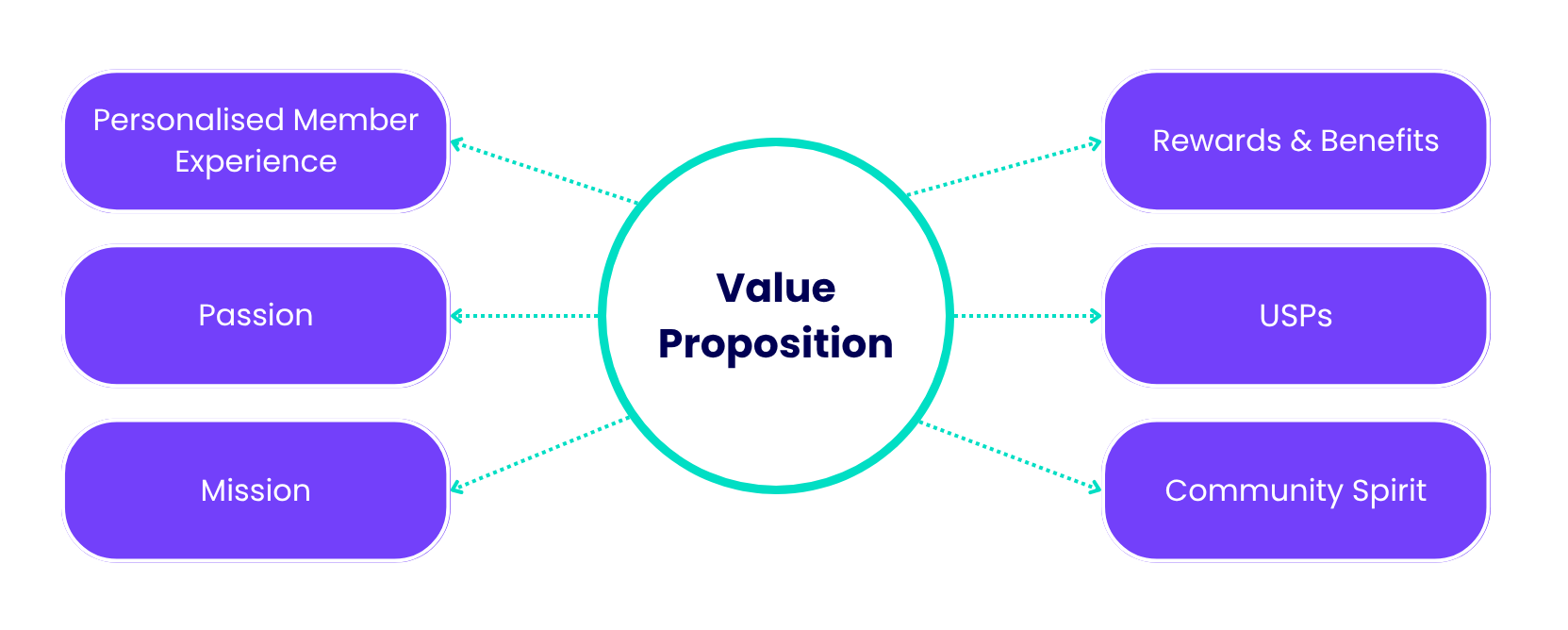
A strong member value proposition is built on five core components: a unique selling point, tangible member benefits, a defined target audience, proof of value, and a compelling reason to join now rather than later.
Vague claims about “community” or “support” are less persuasive than specifics such as:
Each point should stand on its own. A prospective member reading any one of them should immediately understand what they are gaining.
The 10 tactics below are drawn largely from Propello Cloud’s 2025 Membership Trends Report, which surveyed membership organisations on the approaches they are prioritising this year and beyond.
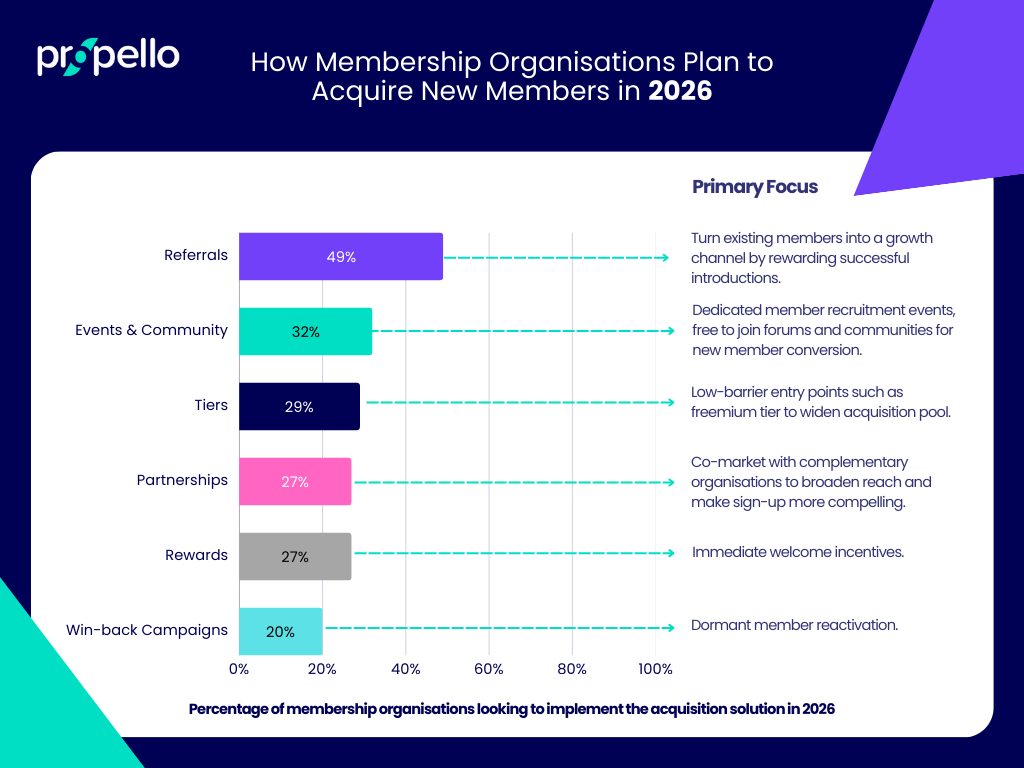
Note: The report lists rewards separately, but we’ve woven them through the tactics below rather than giving them a standalone section.
Referral programmes are among the highest-converting tactics in membership acquisition. People are more likely to join an organisation when recommended by someone they trust, which means referral leads arrive pre-qualified and cost significantly less to convert than prospects from paid channels.
According to Propello Cloud’s 2025 Membership Trends Report, 49% of membership organisations are currently reviewing or investing in their referral programmes, reflecting a broader shift toward engineered acquisition rather than passive organic growth.
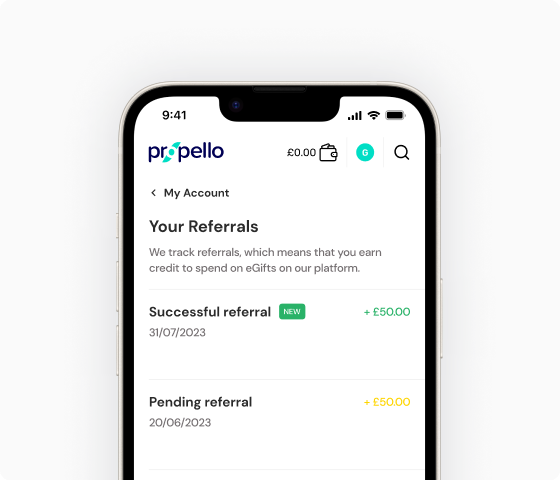
Referrals are a natural starting point for organisations with strong retention but sluggish acquisition. They leverage member satisfaction to scale growth without increasing marketing spend.
The most successful referral programmes use dual-sided rewards, where both the referring member and the new recruit receive benefits. This approach increases participation from existing members while reducing friction for prospective ones.
Rewards should be meaningful but balanced. Generous enough to excite newcomers, yet fair to longstanding members. Structuring incentives carefully avoids resentment while ensuring referrals feel valuable and worthwhile for everyone involved.
Events give prospective members direct, firsthand experience of your organisation’s value. That lived experience builds trust faster than any campaign, because prospects are not being told what membership feels like; they experience it themselves.
According to the 2025 Membership Performance Benchmark Report, 52% of membership organisations cite events and meetings as their top-performing recruitment strategy.
Propello Cloud’s 2025 Membership Trends Report also shows that 32% of membership organisations plan to increase events and community initiatives, reflecting sustained confidence in the channel even as digital tactics grow.
How can hybrid event formats expand your membership reach?Hybrid events that combine in-person and virtual components offer both flexibility and scalability. Providing a virtual option removes barriers for remote or time-constrained prospects, while in-person attendance delivers the richer networking experience that typically drives conversion. |
What tactics convert event attendees into members?The most effective tactics fall into two stages.
These tactics streamline the path from event interest to member engagement and boost conversion rates by reinforcing the immediate value of joining |
Membership tiers improve acquisition by removing cost barriers that stop prospects from committing. A single high price point loses people who see the value but can’t justify the outlay.
Tiers solve this issue with structured entry points that match different budgets, circumstances, and career stages. This mirrors the freemium shift seen across consumer services: prospects experience value before committing to full membership.
In the Propello Cloud 2025 Membership Trends Report, 29% of membership organisations are evaluating tiered structures specifically to improve acquisition. This trend reflects the freemium business model shift in consumer services, where free or low-cost entry points demonstrate value before full commitment.
How do members benefit from tiers?Tiers allow a single organisation to serve members at very different life and career stages without diluting its core value proposition. A senior professional and an early-career joiner have different budgets and priorities, and a single price point underserves at least one of them. A well-designed tier structure might look like this:
Each level becomes an aspirational target for the one below, driving both acquisition and upward progression. |
How do tiers drive member sign-ups?Beyond affordability, tiers work through scarcity and aspiration. A time-limited trial of a higher tier, say a two-week taster of mentorship access, lets prospects experience premium value before paying for it. When it ends, targeted follow-up that highlights limited availability, like a countdown of remaining mentor slots, reinforces urgency without aggressive selling. That mix of access, aspiration, and scarcity makes tiers a conversion tool as much as a retention one. |
Strategic partnerships extend your reach by providing access to pre-qualified audiences through channels your prospects already trust.
Instead of competing for attention in crowded ad spaces, partnerships place your offer in front of people already engaged in your field, via employers, universities, media platforms, or complementary service providers.
Our 2025 Membership Trends Report shows that 27% of membership organisations plan to increase their partnership activity. Even so, many underinvest, put off by the perceived complexity of relationship management and legal agreements, which leaves the channel underused relative to its potential.
The most effective partnership structures reduce friction and add tangible value at the point of joining. Four formats consistently perform well:
Each format works the same way: it lowers the perceived risk of joining while raising the perceived value of becoming a member.
The examples below show how established membership organisations turn institutional relationships into a steady pipeline of new members.
| Membership Organisation | Partner/s | What they do together | Link |
| CIPS (Chartered Institute of Procurement & Supply) | Accredited universities | Work with universities so students on approved courses automatically get CIPS affiliate membership, helping them start their professional journey early. | CIPS Accredited Universities |
| ACCA (Association of Chartered Certified Accountants) | IIM Visakhapatnam | Signed an agreement so students can access ACCA qualifications and membership opportunities as part of their studies, linking education directly to professional status. | ACCA–IIMV MoU |
| Royal College of Nursing (RCN) | Torchbox (digital agency) | Partnered on a digital recruitment campaign that increased awareness and delivered significant new member sign-ups. | RCN x Torchbox |
| CIM (Chartered Institute of Marketing) | Universities & study centres | Works with universities offering accredited degrees so students can gain exemptions and fast-track to CIM membership. | CIM Accredited Degree Universities |
| IEEE (Institute of Electrical and Electronics Engineers) | University student branches | Supports student-run university branches that promote IEEE activities, helping students transition into full professional members after graduation. | IEEE UK & Ireland Student Branches |
Win-back campaigns target former members who already know your organisation’s value but may have left due to cost, timing, or shifting priorities. Because these people have prior experience, they convert faster and cost less than campaigns aimed at cold prospects.
Even so, Propello Cloud’s 2025 Membership Trends Report found that only 19% of membership organisations are currently considering win-back, making it one of the most underused tactics available.
Two barriers explain the situation: limited data visibility and a bias toward chasing new members. Teams that track exit reasons, renewal drop-off points, and inactivity patterns are far better placed to know which lapsed segments to target and when.
A structured win-back approach works in four steps:
Your website is the only recruitment tool that works around the clock without extra resources. A high-performing membership site combines trust signals, frictionless registration, and clear calls-to-action into one conversion journey. Credibility encourages clicks, streamlined forms reduce drop-off, and well-placed CTAs close the gap between interest and sign-up.
How can you optimise the member registration and onboarding experience?A smooth first interaction sets the tone for the whole relationship. The basics are simple:
Beyond that, progress indicators, multiple payment options, and single sign-on (SSO) cut cognitive load and signal that you’ve invested in the member’s experience. |
How do you build lead capture forms that convert prospects to members?Ask only for what’s essential at the first touchpoint. For most organisations, that’s name and email, nothing more, since every extra field is another reason to abandon the form. Where you need more, a dropdown on member interests or goals personalises follow-up without the friction of open text. You’ll cut bounce rates and gain useful segmentation data. |
How do you write CTAs that attract new members?A strong call-to-action is specific, action-led, and paired with a reason to act now. Phrases like “Get Started” or “Join Today” build momentum. Pairing them with trust signals like security badges or social proof like testimonials adds credibility, and a lead magnet, trial, or webinar offers extra value in exchange for details. |
Why should you test your membership sign-up forms?Testing keeps forms optimised for conversion. Shorter ones generally perform better, especially with critical fields and CTAs above the fold. Regular testing also gives you empirical data to refine design, copy, and structure over time. |
Research by Emarsys shows that 81% of SMBs cite email as their primary acquisition tool. For membership organisations, it’s both versatile and cost-effective.
Its core advantage is combining scale with precision. You can reach thousands of prospects at once while tailoring content to specific segments, which makes it one of the few channels that works equally well for large national associations and small specialist communities.
Personalisation is what separates high-performing campaigns from generic broadcasts. An email that speaks to a prospect’s career stage, interests, or pain points converts better than a one-size-fits-all message because it signals you understand what they need.
That sense of alignment is often what tips a prospect from considering membership to committing to it.
A single email rarely converts a prospect. The most effective strategies use sequenced campaigns that move people through awareness, consideration, and decision over time. A typical nurture sequence should:
Give each email one primary objective and one call-to-action. Trying to cram multiple objectives into one stage reduces the likelihood of conversion.
Search Engine Optimisation (SEO) and content marketing work together to make your organisation discoverable at the moment a prospect is looking for what you offer. SEO decides whether your content appears in search results; thought leadership decides whether it builds enough trust to convert.
Authority comes from consistently creating credible, useful content. Google’s E-E-A-T framework (Experience, Expertise, Authoritativeness, Trustworthiness) is a useful benchmark. Content that shows real experience and cites verifiable sources proves to search engines and prospects that you know your field.
For membership organisations, that means grounding content in member feedback, proprietary research, and sector insight rather than generic commentary.
Use a mix of formats matched to different stages of the prospect journey:
No single format does everything. The strongest strategies combine them deliberately, matching each to the stage it serves best.
A strong social media presence creates powerful opportunities for membership acquisition. Communities are at the heart of most membership organisations, and showcasing them online demonstrates your authenticity. Photos celebrating achievements, members sharing event memories, and milestones posted publicly all act as proof that your organisation values people.
User-generated content (UGC) is one of the most trusted forms of marketing, especially among Millennials and Gen Z, who make up a growing share of most membership bases.
When prospects see you actively engaging with content from real members, they recognise an authentic community and want to be part of it.
Sharing insights, hosting discussions, and responding publicly to members positions your organisation as a credible authority. Prospects who encounter this kind of engaged, knowledgeable presence are more likely to trust your expertise and consider membership.
Automation allows membership organisations to scale acquisition across multiple channels at once. SEO, PPC, email, and social campaigns can all work around the clock, nurturing prospects regardless of location or time zone.
Research shows that these structured marketing workflows can generate 50% more sales-qualified leads, accelerating the journey from initial interest to conversion.
Once a campaign shows results, scaling it means refining messaging and targeting based on performance data rather than starting over.
Which automation tools can nurture prospective members?The right tools depend on your strategy, but most membership organisations benefit from three layers:
Automated social media management sits alongside these, keeping a consistent presence without daily manual input. |
How do you build acquisition systems that support long-term growth?Best practices for long-term acquisition include:
Tools without cohesive workflows add complexity rather than reducing it. Standardised workflows bring channels and tools together into campaigns that are easier to maintain and replicate. |
Measuring member acquisition means tracking whether your efforts are generating genuine growth or simply replacing members lost to churn.
Campaigns need to be monitored, tested, and refined continuously, and the KPIs below are the ones that tell you whether your acquisition strategy is actually working.
| KPI | Why? |
| Cost Per Acquisition (CPA) | Tells you how much it costs to acquire new members, so you accurately assess the ROI of campaigns. |
| Lead-to-Member Conversion Rate | The percentage of prospects who become paying members shows the effectiveness of your acquisition funnel. |
| Churn Rate | While a retention metric, it reveals whether acquisition is offsetting losses and contributing to net growth. |
| Net Member Growth Rate | New members gained minus members lost in a given period; shows whether your acquisition strategies are simply replacing members lost due to natural churn or actually demonstrating net growth. |
| Marketing Qualified Leads (MQLs) | The number of leads that meet predefined quality criteria e.g., cold, warm or hot, helps with segmentation, tracking, and targeting with specific marketing materials. |
| Sales/Join Cycle Length | Knowing the average time it takes for a lead to become a member helps you identify points of friction to improve or reiterate better processes that lead to shorter cycles. |
| Channel-Specific Conversion Rates | How different acquisition channels (email, PPC, referrals, events) perform comparatively allows you to improve budgeting and resource allocation, further reducing traditionally high acquisition costs. |
| Engagement Rate of Prospects | Assessing interactions with emails, landing pages, or events shows how well you’re warming leads pre-conversion. |
| Return on Marketing Investment (ROMI) | Revenue generated from acquisition campaigns versus costs keeps you in budget. |
| Referral Conversion Rate | Knowing the percentage of referred prospects who join allows you to make improvements accordingly to your core referral strategy. |
Data analysis replaces guesswork with evidence, allowing membership organisations to identify what is working, what is causing drop-off, and where to focus improvement efforts.
The right software makes it easier to track trends, understand prospect behaviour, and act on insights that directly improve acquisition performance.
Effective acquisition measurement draws on five categories of data:
Acting on these data points allows you to refine the user experience with precision. For example, if analytics show high drop-off rates at the sign-up stage, you can streamline forms or remove unnecessary steps.
Analytics reveal what’s resonating and what isn’t. Heatmaps show where prospects engage with your value proposition on a landing page; split-tested emails identify which subject lines drive opens and clicks.
According to Harvard Business Review, 70 to 90% of acquisition strategies fail, a figure that reflects how many organisations still rely on instinct rather than evidence when making strategic decisions.
Membership acquisition succeeds when you reach the right people, not the widest possible audience. That starts with defining your Ideal Member Persona (IDP): going beyond demographics to capture aspirations, pain points, and motivations, then aligning them with your mission.
Here’s what a well-defined IDP could look like for a wildlife conservation association:
“Our ideal member believes the local wildlife in and around our urban centres is a key part of our national ecology, identity and history.
While they may understand the necessity of urbanisation and expanding infrastructure, the disruption it causes to habitats, migration routes, and the natural behaviours that support ecosystem balance (such as pollination, seed dispersal, and pest control) is a major concern for them.
Our ideal member aspires to protect urban green spaces, restore natural habitats, and safeguard the species and behaviours that keep our local ecosystems thriving.”
It works because it connects a specific concern to a clear aspiration, which maps directly onto the organisation’s mission.
Segmentation makes acquisition more precise by matching each prospect group to messaging relevant to where they are in their journey:
According to research, 80% of companies that segment their audiences report increased sales, a sign of how much targeting precision matters for conversion.
The member acquisition cycle unfolds in three phases:
Done well, the cycle turns prospects into engaged, long-term members.
| Phase 1: Lead Generation & Initial Contact | |
| Key Actions
|
|
| Key Actions Summary:
|
Main Objectives:
|
| Phase 2: Nurturing the Lead | |
| Key Actions
|
|
| Key Actions Summary:
|
Main Objectives:
|
| Phase 3 – Optimise Conversions & Onboarding | |
| Key Actions
|
|
| Key Actions Summary:
|
Main Objectives:
|
The acquisition cycle highlights how prospects progress from awareness to membership.
Together, these steps improve conversion rates and ensure new members start with positive momentum.
Converging pressures, maturing digital channels, rising costs, and rapid technology adoption will keep reshaping member acquisition. Organisations that adapt will find real opportunity; those that don’t will find acquisition increasingly expensive and ineffective.
AI-Powered PersonalisationAI is automating personalisation at scale, from tailored content recommendations to chatbots that engage prospects around the clock. According to Gartner, 70% of customer interactions already involve AI, and that share will grow. As prospects come to expect experiences tailored to their interests, AI-driven journeys are becoming the standard rather than a differentiator. |
First-Party Data & PrivacyWith third-party cookies in decline, first-party data is now the foundation of effective targeting, and Nielsen research finds nearly 90% of marketers consider it critical. For membership organisations, this means prioritising transparent data practices and clear consent, both to meet regulations and to build the trust that underpins conversion. |
Rising Acquisition Costs (CAC)Acquisition costs are climbing across most channels, making targeting efficiency and conversion optimisation more important than ever. Streamlined onboarding and well-designed tiers, both covered earlier, are among the best tools for lowering cost per acquisition and improving lifetime member value. |
Community & Referral-Based GrowthReferrals cut acquisition costs by around 13% and benefit from the community structures that membership organisations already have. Encouraging members to share experiences and invite peers turns existing engagement into a cost-effective, self-sustaining growth channel. |
Hybrid & Virtual EventsWebinars, virtual conferences, and mobile apps will stay core acquisition tools, with over half of associations saying hybrid or virtual events will remain central to engagement. Pairing online accessibility with memorable in-person experiences will be key to attracting prospects at the top of the funnel. |
Hybrid & Virtual EngagementWebinars, virtual conferences, and mobile apps will remain core tools for acquisition. Over half of associations say hybrid or virtual events will stay central to engagement strategies. Combining online accessibility with memorable in-person experiences will be key for attracting prospects at the very top of the funnel. |
Start by clarifying who you’re trying to reach and whether your current channels and messaging are set up to reach them. The five-step checklist below guides you from foundational concepts to execution:
A strong acquisition strategy combines several approaches: digital channels for visibility, referrals and partnerships for cost-effective reach, and data-driven personas to make sure your messaging connects with the right people.
Start with your Ideal Member, refine your value proposition around their aspirations, and use the right technology to tie your acquisition cycle together and run it at scale.
A membership acquisition strategy attracts new members by combining targeted marketing, a compelling value proposition, and engagement tactics that resonate with prospects, converting them into members.
Define your Ideal Member by combining demographic, psychographic, behavioural, and lifecycle data. Look at existing member engagement patterns, feedback, and shared values. Align their needs and aspirations with your organisation’s mission and core “Big Idea.”
The most effective channels are a mix of SEO, PPC, email marketing, referral programmes, social media, and partnerships. Using multiple channels widens reach, strengthens engagement, and leads to a more resilient acquisition pipeline.
Your MVP should clearly state the benefits, speak to member needs, align with your mission, and highlight your USP. Highlight unique perks, community value, and impact. Keep it adaptable to changing trends, and promote it across all acquisition channels.
Dual-sided incentives benefit both the referrer and new member. Keep the process simple, actively promote it, and celebrate referrals publicly. This builds trust, rewards loyalty, and turns members into motivated advocates for your organisation.
Ensure sign-up forms are short, mobile-friendly, and fast-loading. Use clear calls-to-action, trust signals (like badges), and social proof (testimonials). Reduce friction with multiple payment options and single sign-on (SSO) for a smooth, seamless registration process.
Data analysis is crucial for improving member acquisition strategies. It helps identify trends, measure the success of different initiatives, and understand member behaviour. Use analytics to track key performance indicators (KPIs) like conversion rates and engagement levels.
Social media engagement can boost member acquisition by increasing brand visibility and fostering community. Share valuable content, interact with followers, and showcase your organisation’s culture and achievements. Use targeted ads to reach potential members. Encourage user-generated content to build trust.
Cost-effective member acquisition strategies for small organisations include leveraging email marketing, optimising SEO, and encouraging member referrals. Focus on content marketing to establish thought leadership without significant investment. Use social media platforms for organic reach and engagement.
Evaluate and update your member acquisition strategies regularly, ideally on a quarterly basis. However, monitor key metrics monthly to identify any immediate issues. Conduct a more comprehensive annual review to align strategies with long-term goals. Stay flexible and adjust tactics based on member feedback.
Explore the platform’s scalability, features and customisation options and get answers to your unique questions.