Membership organisations of all kinds, from professional associations to trade bodies, face the familiar challenge of keeping members. Attracting new members feels exciting, but the real driver of sustainable growth is membership retention. Retaining existing members is more cost-effective, builds loyalty, and creates long-term value.
Mark Camp
CEO & Founder at PropelloCloud.com
Contents
Key Takeaways
Retention is more cost-effective than acquisition. Consistency in communication, benefits, and experience keeps members engaged and loyal.
Retention drives financial stability and long-term value; members who stay renew more often, engage more deeply, and cost far less than constant acquisition.
Shifting expectations, weak value propositions, and inconsistent engagement make retention harder than acquisition. Ignoring them accelerates churn.
Mapping both the lifecycle and the value chain reveals where members need support and how rewards reinforce loyalty at every stage.
Measuring retention, engagement, advocacy, and business impact gives a complete view of what’s working and where to improve.
Successful organisations combine tactics like onboarding, personalisation, networking, and loyalty programmes to reduce churn and increase renewals.
Automating processes, segmenting members, enabling self-service, and keeping leaders visible turns strategy into day-to-day reality.
Real-world results from ISM and Hagerty show how retention strategies increase engagement, strengthen value, and drive higher renewal rates
Consistent value delivery is the key to effective retention. When your communication, benefits, and member experience are reliable and relevant, members feel recognised and supported. That’s when renewal becomes the easy choice, not a decision they have to be persuaded into.
In this blog, we’ll share 12 proven membership retention strategies. You’ll discover how to increase renewal rates and reduce churn with practical tactics, engagement best practices, and real-world retention examples from membership organisations.
Propello Cloud is proud to be a MemberWise Recognised Supplier, trusted by leading membership organisations, including NASUWT, The Ivors Academy, ISM, and the Royal College of Surgeons of Edinburgh.
Our white-label loyalty and reward platforms help membership bodies drive retention, boost member engagement, and deliver added value through personalised, benefit-led experiences.
What Is Membership Retention and Why Does It Matter?
Membership retention is an organisation’s ability to keep its members over time. You can measure it using two metrics: retention and churn rate. High retention signals loyalty and financial stability, but high churn erodes both.
Your retention rate is the percentage of members who renew within a given period
Your churn rate is the percentage of members who leave.
Retained members are significantly more cost-effective than new acquisitions. Research by Bain & Co. suggests it costs six to seven timesmore to recruit a new member than to keep an existing one. Loyal members also deliver predictable renewals, renew regularly, engage more, and have higher lifetime value.
Predictable renewals create a reliable revenue stream, giving your organisation the confidence to invest in better benefits, events, and member experiences. Far from being just another metric, retention is the foundation of sustainable growth for any membership organisation.
According to Propello Cloud’s 2025 Membership Trends Report, 78% of membership organisations rank retention as a high priority, while 20% name it their single biggest priority.
Here’s how retention compares to the other priorities highlighted in our research:
Priority
Critical*
High Priority
Rank
Member Engagement
26%
86%
1
Member Acquisition
24%
82%
2
Member Retention
–
78%
3
Member Value
12%
72%
4
Revenue Diversification**
10%
66%
5
Tech Integration
–
64%
6
Personalised Member Experience
–
58%
7
* The primary focus for the organisation (organisations can have several high priorities)
What Are the Key Challenges Organisations Face When Retaining Members?
The main retention barriers organisations face are shifting member expectations, weak value propositions, poor communication, and declining event engagement. Each one quietly erodes loyalty until renewal feels like a risk to members.
Why Is Member Satisfaction Harder to Maintain Than Acquisition?
Acquiring new members is often easier than keeping them. That’s because acquisition campaigns create excitement, but sustaining that initial momentum requires consistent value.
Without clear benefits and ongoing engagement, satisfaction declines. The result is often lower retention rates and rising churn rates, and organisations spend more time and money replacing lost members than growing loyalty.
How Are Shifting Expectations Affecting Membership Benefits?
Today’s members compare your offering not only with similar organisations but also with brands that deliver seamless digital experiences, personalised communication, and immediate value.
If your membership benefits feel outdated or irrelevant, members quickly question their renewal. Expectations evolve fast, and organisations that fail to keep pace risk falling behind.
What Happens When Value Propositions and Communication Miss the Mark?
A member value proposition (MVP) is the promise your organisation makes to members: the benefits, opportunities, and outcomes they can expect in return for joining.
If that promise isn’t backed by meaningful engagement, it rings hollow. Generic messaging or a lack of personalised communication makes members feel invisible. Over time, weak value propositions and generic outreach undermine trust and erode loyalty.
How Does Poor Event Engagement Drive Member Churn?
Events are meant to bring members together and strengthen your community. Yet when attendance drops, some organisations respond by cancelling events altogether.
This short-term fix removes key opportunities for connection, leaving members disengaged. Over time, the loss of events accelerates dissatisfaction, making renewal decisions even harder.
How Does the Member Journey Shape Retention?
The member journey shapes retention because loyalty isn’t built in a single moment. It’s developed at every stage, from the moment members join to long-term renewal.
Two frameworks help organisations to map and strengthen this journey:
The Member Lifecycle, which tracks the stages through which members move, and
The Membership Value Chain, which shows how to reinforce value and reward members at each stage.
Where the lifecycle tells you where a member is, the value chain tells you what to do about it.
What Is the Member Lifecycle?
The member lifecycle is the traditional way of mapping a member’s relationship with your organisation. It runs step by step: acquisition, onboarding, engagement, renewal, and loyalty.
Each stage brings its own risks, which could include poor onboarding that leaves members confused or inconsistent engagement that causes them to drift. Addressing these pain points is critical to improving retention.
What Is the Membership Value Chain?
The Membership Value Chain is a framework that shows how member value can be reinforced through rewards at every stage of the journey. Unlike the linear lifecycle, the value chain is circular, highlighting how each stage feeds the next.
The stages run as follows: Acquisition → Engagement → Retention → Insights → Back to Acquisition (often via Referrals). That final return to acquisition is what makes the value chain so powerful. Loyal, well-rewarded members become advocates for your organisation.
By aligning the membership value chain with the lifecycle, organisations can see not only where members are in their journey but also how to reward and recognise them along the way.
Which Metrics and KPIs Should You Track to Measure Membership Retention Success?
The most important metrics for measuring membership retention fall into four categories: retention and churn, engagement, advocacy, and business impact.
As your programme matures, you can expand the KPIs you track. But for now, these will see you through launch and early growth.
Metric/KPI
Formula
Retention Indicators
Renewal Rates (%) year-on-year
Renewal Rate = (Number of Members Renewed ÷ Number of Members Eligible for Renewal) × 100
Churn rate (%) of members leaving
Churn Rate = (Number of Members Lost in Period ÷ Number of Members at Start of Period) × 100
Average member tenure
Average Tenure = Total Length of Membership for All Members ÷ Total Number of Members
Engagement Signals
Monthly active members on the rewards platform
MAM = (Active Members on Platform in Month ÷ Total Members) × 100
Reward redemption rate
Redemption Rate = (Number of Rewards Redeemed ÷ Number of Rewards Issued) × 100
Event attendance uplift from reward-linked campaigns
Sharing Rate = (Number of Members Who Shared Benefits ÷ Total Members) × 100
(or track raw number of posts/shares with campaign hashtags)
Business Impact
Member Lifetime Value (MLV)
MLV = (Average Annual Revenue per Member × Average Tenure in Years) – Average Cost to Serve per Member
ROI (revenue or retention value vs. programme costs)
ROI (%) = [(Programme Revenue or Retention Value – Programme Costs) ÷ Programme Costs] × 100
Net Promoter Score (NPS)*
Identify promoters, passives and detractors within your member base using this question:
“On a scale of 0 to 10, how likely are you to recommend [organisation/membership programme] to a friend or colleague?”
Members are then grouped based on their score:
Promoters (9–10): Very satisfied and likely to recommend.
Passives (7–8): Neutral — satisfied but not enthusiastic.
Detractors (0–6): Unhappy members who may discourage others from joining.
What Retention Strategies Actually Work for Membership Organisations?
Improving membership retention depends on more than a single tactic. The most successful organisations combine proven strategies that build trust, deliver consistent value, and strengthen connections across the member journey.
From onboarding and engagement through to renewals and advocacy, these 12 strategies can help reduce churn and boost long-term loyalty.
Premium Tiers
Loyalty & Rewards Programmes
Partnerships
Events & Community
Onboarding
Member Feedback
Personalised Communication
Exclusive Content
Membership Calendars
Regularly Refreshed Content
Exclusive Member Perks
Referral Programmes
These strategies and the stats behind them draw on our discussions with membership organisations, captured in the 2025 Propello Cloud Membership Trends Report.
1) Do Premium Tiers Improve Member Retention?
Creating clear, value-based tiers gives members room to grow with you. When needs change, an upgrade path keeps them invested, and cancelling looks far less appealing when there’s a better option in front of them.
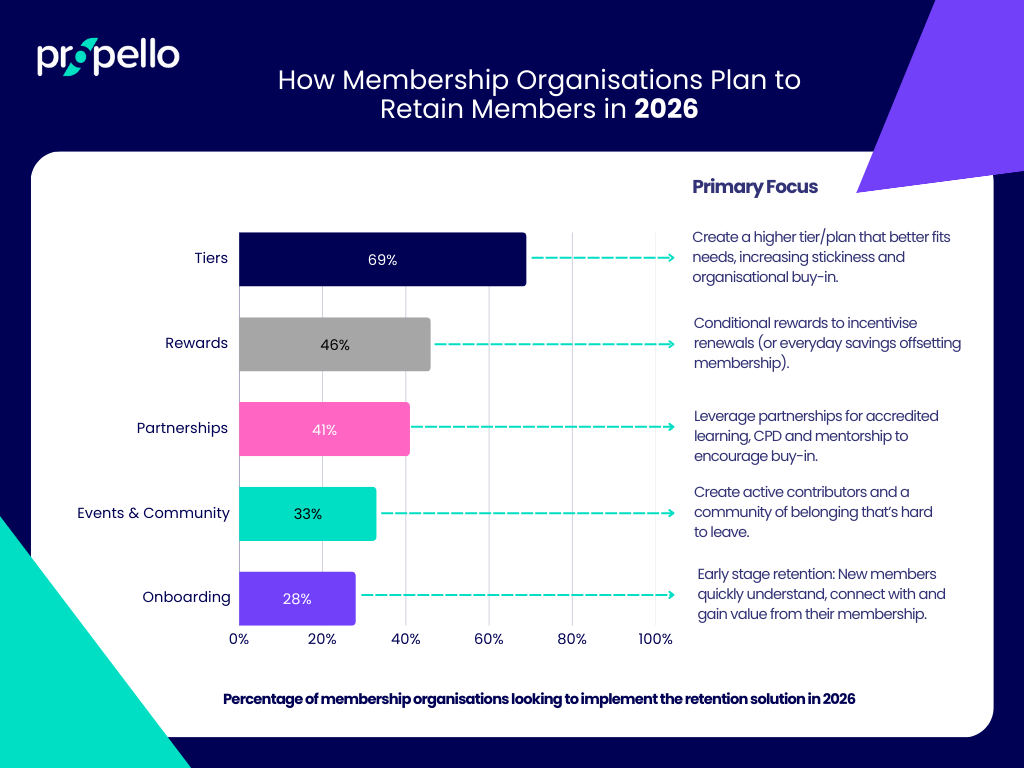
According to the 2025 Membership Trends Report, 69% of organisations plan to deploy higher tiers, increasing stickiness and buy-in to turn at-risk members into advocates.
2) Do Loyalty & Rewards Programmes Really Increase Membership Renewals?
Well-designed loyalty programmes are proven to improve membership renewal rates. By offering timely, relevant rewards and recognising contributions, they create consistent value that goes beyond core benefits.
According to our report, 46% of organisations want programmes that use points, discounts, or recognition milestones that strengthen emotional connection and make renewal the natural choice.
3) How Do Partnerships Increase Member Retention?
Strategic partnerships add high-impact benefits you don’t have to build yourself. Think accredited learning, CPD, and mentorship that directly advance members’ goals, benefits they would otherwise pay more for elsewhere.
Data from Propello Cloud’s2025 Membership Trends Report shows 41% of organisations are focusing on forming partnerships (especially when credentials are co-branded and easy to redeem) to drive buy-in and higher renewal rates.
4) How Do Events & Community Drive Member Retention?
Networking opportunities are a major reason people join membership organisations. Hosting mixers, mentoring programmes, or hybrid events helps members form valuable connections.
33% of membership organisations plan to use Events & Community as their main retention drivers, according to our research. A calendar of regular, inclusive events keeps members active and committed to your community.
5) How Does Onboarding Shape Long-Term Member Loyalty?
A smooth, personalised welcome builds confidence and reinforces the decision to join. Confusing steps or vague communication do the opposite, sowing doubt before the relationship has had a chance to develop
In Propello Cloud’s 2025 Membership Trends Report, 28% of membership organisations said they plan to improve their onboarding process using personalised welcomes and clearer communication of value to help new members feel supported from day one.
6) How Can Member Feedback Improve Retention?
Member feedback is one of the most reliable ways to keep your organisation relevant. Surveys, polls, and exit interviews reveal what’s working and what isn’t.
Acting on this insight builds trust and demonstrates transparency. A simple “you said, we did” approach helps members feel heard, valued, and more likely to stay engaged.
7) How Can Personalised Communication Build Stronger Communities?
Generic messaging undermines connection. Personalised communication, from tailored emails to event invitations that reflect members’ interests, makes individuals feel recognised. Coupled with community spaces for peer-to-peer connection, it deepens member engagement and reduces churn.
Consistency is key: timely, relevant messages create trust and belonging.
8) How Does Exclusive Content Increase Retention?
Exclusive content gives members something they can’t find elsewhere. Priority event booking, behind-the-scenes access, or professional development resources combine practical utility with a sense of insider status.
When members feel they’re receiving unique benefits, they’re more engaged, more satisfied, and more likely to renew.
9) How Do Membership Calendars Boost Engagement?
A membership calendar boosts engagement by giving your organisation a structured, year-round rhythm of activity that keeps members connected between renewals.
Planning seasonal campaigns, networking opportunities, and recognition moments across the calendar year ensures members stay active and have opportunities to network.
10) Why Should Membership Content Be Regularly Refreshed?
Static content leads to disengagement. Members want to see fresh resources, events, and offers that reflect their evolving needs.
A continuous improvement loop, where you retire stale content and introduce new campaigns, signals that your organisation is dynamic and attentive, keeping members engaged and invested over time.
11) Can Exclusive Member Perks Drive Everyday Engagement?
Offering everyday value through partner discounts, savings, or lifestyle perks keeps your organisation top of mind even long after renewal season. Members who experience tangible value year-round are more satisfied, more active, and less likely to lapse.
The goal is to make membership feel like something members use, not just something they pay for.
12) How Do Referral Programmes Boost Both Member Retention and Acquisition?
Referral programmes reward members for advocating on your behalf, turning their loyalty into growth. When members refer others, they strengthen their commitment to your organisation, reducing the likelihood of churn.
Dual-sided rewards, where both the referrer and new member benefit, also build fairness and trust. Recognising top referrers through leaderboards or spotlights further enhances engagement, while helping you attract new members at a lower cost.
What Are the Benefits of Improving Membership Retention?
Improving membership retention increases revenue predictability, reduces acquisition costs, and deepens the member relationships that drive long-term organisational growth.
Here are the most significant benefits in detail.
Benefit
Why?
1) Higher retention & lower costs
Keeping members is 6–7x more cost-effective than replacing them.
2) Year-round engagement
Consistent participation builds stronger communities and more loyal relationships.
3) Increased member lifetime value
Loyal members renew more often, spend more, and contribute more over time.
4) Better data and personalisation
Tracking behaviour helps you tailor communications, offers, and rewards.
5) Stronger advocacy
Engaged members are more likely to refer friends and share positive experiences.
6) Competitive differentiation
A compelling retention strategy makes you stand out beyond just pricing.
7) Support for volunteering and contribution
Recognition motivates members to give back to the community.
8) Professional development support
Rewarding progress adds value to training and CPD.
9) Improved event ROI
Higher attendance and engagement drive stronger outcomes for events.
10) Emotional connection
Recognition makes members feel valued, boosting loyalty and belonging.
How Do You Put Your Membership Retention Strategy Into Action?
A retention strategy only works if it’s embedded into day-to-day operations. That means making retention proactive instead of reactive, and using the right tools and practices to scale.
Here are four practical ways to turn strategy into measurable results:
Focus Area
How It Improves Retention
Automation
Automate renewal reminders, reward triggers, and feedback requests to save staff time and keep members consistently engaged.
Member Profiles & Segmentation
Use profiles to segment members by interests or behaviours, ensuring communication feels relevant and personalised.
Self-Service
Provide easy access for members to update details, redeem rewards, and book events — reducing frustration and boosting satisfaction.
Visible Leadership
Keep leadership present in communications and events to strengthen trust, belonging, and alignment with organisational values.
Which Membership Organisations Have Successfully Improved Retention?
The two case studies below show how ISM and Hagerty used personalisation, rewards, and consistent value delivery to improve member engagement, increase renewal rates, and strengthen long-term loyalty across very different contexts.
ISM
The Independent Society of Musicians (ISM) improved member engagement and renewal intent by making its benefits more relevant to members’ everyday lives.
ISM tailored its communications and added everyday savings, including discounts on groceries and dining, to extend membership value beyond the core offering. Real-time redemption data showed exactly what members were using, letting ISM keep refining rewards and personalisation over time.
Outcome: ISM achieved 10x higher engagement, stronger perceived value among members, and a marked increase in intent to renew.
Hagerty Driving Club
Hagerty Driving Club (HDC) strengthened loyalty by expanding its proposition beyond insurance, building a membership programme that gave people reasons to engage year-round.
Members gained VIP event access, exclusive content, curated partner offers, and a richer, more tangible membership experience.
Crucially, rewards were built directly into the renewal process, making membership feel stickier at the moment it mattered most. Engagement stayed consistent across touchpoints, reinforcing value throughout the member lifecycle.
Outcome: Hagerty attracted 3,000 new members in the first year (with projected retention rates of 75%+ for HDC and 90% for insurance) and increased its Net Promoter Score.
Now It’s Your Turn to Switch on Your Loyalty Growth Engine
Strong member retention never happens by accident. It’s the end result of building towards an ecosystem of consistent value-adds and engagement. The right strategies e.g., personalised communication, data-informed loyalty programmes, and meaningful community-building efforts, lead to widespread satisfaction and long-term retention.
But remember, retention is an ongoing process that requires regular attention and a willingness to adapt. Stay close to your members’ evolving needs, keep delivering value, and focus on creating a sense of belonging. Start small, track your progress, and refine as you go.
When you make retention a priority, you’re actively protecting your organisation’s future and strengthening its impact. With the strategies and practical steps we’ve covered, you should have the tools to turn retention from a challenge into one of your most powerful growth engines.
FAQs
Why is membership retention important?
Membership retention is important because retaining members is more cost-effective than attracting new members. High retention rates reduce churn, increase loyalty, and create predictable revenue. For membership organisations, this stability supports long-term growth and investment in better member benefits.
What is a good retention rate for membership organisations?
A strong retention rate varies by sector, but most membership organisations aim for 75–90%. The higher your retention, the more members stay loyal. Tracking churn rate alongside renewals gives a clearer picture of whether members feel engaged, valued, and supported over the long term.
How does the onboarding process affect member retention?
The onboarding process is critical for retention because it sets the tone for the member journey. A clear, personalised onboarding experience ensures members feel welcomed, supported, and aware of benefits. Weak onboarding increases churn risk before members fully engage with the membership model.
How can member feedback improve retention strategies?
Member feedback highlights what existing members value and where improvements are needed. Surveys, polls, and exit interviews help organisations refine benefits, communications, and events. Acting on feedback builds trust, making members feel heard and increasing loyalty, satisfaction, and renewal rates.
What role does member engagement play in retention?
Member engagement is the foundation of retention. Engaged members attend events, use rewards, and connect with the community. When members feel active and recognised, they’re more likely to stay. Low engagement signals dissatisfaction, often leading to higher churn and fewer membership renewals.
How can membership organisations reduce churn?
Membership organisations can reduce churn by offering consistent value, personalising communication, and providing relevant member benefits. Retention strategies like loyalty programmes, onboarding improvements, and feedback loops ensure members feel connected, supported, and motivated to renew long term.
What are cost-effective ways to retain members?
Cost-effective retention strategies include personalised communication, always-on partner discounts, referral programmes, and digital self-service. These approaches strengthen loyalty without heavy spending. Retaining members is far cheaper than attracting new members, making small, consistent actions highly impactful.
How do membership renewals impact financial stability?
Membership renewals create predictable revenue streams that support financial stability. When members renew consistently, organisations can plan budgets, invest in engagement strategies, and deliver better benefits. Strong renewal rates signal loyalty, reduce acquisition costs, and underpin long-term sustainability.
How does a sense of community influence retention?
A strong sense of community encourages members to stay engaged and loyal. Networking events, forums, and peer recognition make members feel valued and connected. Membership organisations that nurture belonging see higher engagement, stronger retention rates, and more advocacy from existing members.
What retention strategies work best long term?
The most effective long-term retention strategies combine onboarding, member feedback, personalised communication, and loyalty programmes. These approaches strengthen value propositions, keep members engaged, and reduce churn. By investing in consistency, organisations build loyalty and improve member lifetime value.
Mark Camp
Mark is the Founder and CEO of Propello Cloud, an innovative SaaS platform for loyalty and customer engagement. With over 20 years of marketing experience, he is passionate about helping brands boost retention and acquisition with scalable loyalty solutions.
Mark is an expert in loyalty and engagement strategy, having worked with major enterprise clients across industries to drive growth through rewards programmes. He leads Propello Cloud’s mission to deliver versatile platforms that help organisations attract, engage and retain customers.
Start your customised Propello Cloud journey today
Explore the platform’s scalability, features and customisation options and get answers to your unique questions.