10 Clever Partnership Marketing Examples to Inspire Your Campaigns
25 min to read
Published: November 2, 2022
Updated: March 19, 2026
Partnership marketing is a strategy where two or more brands collaborate to achieve shared business goals, such as lead generation, customer acquisition, and brand awareness. By pooling audiences and resources, each partner gains access to new customers it would struggle to reach alone. The best partnerships create genuine value for customers, not just for the brands involved.
Mark Camp
CEO & Founder at PropelloCloud.com
Contents
Key Takeaways
Successful partner programmes prioritise shared target audiences rather than simply chasing big brand names.
Digital partnerships consistently outperform traditional print collaborations by offering greater flexibility and measurable results.
Strategic partnerships can effectively bypass ad fatigue and ad blockers by creating genuine value for customers.
Small brands can rapidly build credibility by partnering with established companies in complementary sectors.
The most successful partnerships create seamless customer experiences rather than feeling like separate brands bolted together.
Cross-sector partnerships, like Spotify and Uber, often deliver the most innovative and memorable customer experiences.
Partnership marketing works best when it solves a genuine customer need rather than just combining marketing budgets.
Your partnership programme should evolve based on data insights and changing customer preferences.
We’ve put together 10 real-world partnership marketing examples, including some from brands we work with directly, to show what great brand collaboration looks like in practice.
Why Do Businesses Invest in Partnership Marketing?
Businesses invest in partnership marketing because it delivers results that are difficult to achieve through solo marketing efforts. Access to a partner’s audience, shared costs, and increased brand credibility are the headline benefits. According toPropello Cloud’s 2025 Customer Loyalty Report, 84% of enterprise brands now rank strategic brand partnerships as a top investment priority, equal to personalisation.
What types of partnership marketing are most common?
There are many differenttypes of partnership marketing, from affiliate marketing and co-branding to loyalty programme partnerships and event sponsorships. The most popular model involves affiliate marketing partners promoting a brand’s products or services in exchange for a commission on sales or leads generated.
Businesses often launch partner programmes to access a broader network of relevant partners, rather than managing individual relationships one at a time. A structured partner network maximises the ROI of every collaboration.
Why are strategic brand partnerships growing in importance?
Ad fatigue is real. Usage of ad blockers has grown consistently, particularly on mobile. Partnership marketing bypasses this problem entirely by embedding your brand into an experience customers already trust.
A well-chosen strategic alliance also reinforces brand identity. When a smaller brand partners with a larger, established one, both benefit. The established brand gains access to a more targeted audience segment; the smaller brand gains credibility and distribution reach it could not build alone.
How Does Brand Partnership Marketing Add Value to Customers and Partners?
Brand partnership marketing adds value by giving customers access to relevant products, services, or experiences they would not receive from either brand alone. For the brands involved, it expands reach, reduces customer acquisition costs, and builds long-term loyalty. The key is selecting partners whose audiences and values genuinely align with your own.
Does partnership marketing improve conversion rates?
Yes. Users who discover your brand through a partner are already pre-qualified. They trust the partner who referred them, which means they arrive with a higher intent to engage or purchase. Timing matters too. If you align your campaign with your partner’s customer buying cycle, you reach prospects at exactly the right moment.
How do brand partnerships create additional customer value?
The most effective partnerships give customers something they actually want. Consider a meal kit brand partnering with a gym: the gym offers discounted memberships to food service customers, while gym members receive recipe access as part of their sign-up. Both brands deliver a relevant, tangible benefit to a shared lifestyle audience.
This is what separates a strong brand collaboration from a logo swap. High-quality partners offer each other’s customers relevant incentives. The result is stronger loyalty on both sides.
Partnership benefit
What it means in practice
Audience expansion
Access to a pre-qualified customer base you don’t currently reach
Brand credibility
Association with a trusted brand lifts perception by proxy
Cost efficiency
Shared marketing budgets reduce cost per acquisition
Customer value
Relevant partner offers increase perceived programme value
Conversion uplift
Referred customers convert at higher rates due to existing trust
10 Examples of Successful Brand Partnerships
The best partnership marketing examples share a common thread: they work because both brands serve the same customer, even if they operate in completely different sectors. Here are ten brand collaborations that demonstrate what great partner marketing looks like in practice.
1) Spotify + Uber: How does a cross-sector partnership improve customer experience?
The partnership: Spotify offered “Soundtrack for Your Ride” in collaboration with Uber, allowing passengers to connect their Spotify account and control the music during their journey.
These two brands operate in entirely different sectors, but they share a digitally native, experience-driven customer base. The co-marketing campaign gave both brands a reason to be top of mind during a daily routine.
Why it works: If a customer knows they can listen to their own playlist during every Uber ride, they are more likely to choose both Uber and Spotify over alternatives. This is cross-promotion at its most seamless. Neither brand feels bolted on to the other.
2) Spotify + Starbucks: What does a content partnership look like in a retail setting?
The partnership: Starbucks and Spotify created a “music ecosystem” co-branding partnership. Starbucks employees receive a premium Spotify membership, allowing them to curate in-store playlists accessible to customers via the Starbucks mobile app.
Why it works: Starbucks reinforces its premium café identity through music curation. Spotify gains consistent exposure to millions of daily coffee shop visitors. Both brands expand their customer bases without diluting what makes them distinctive.
3) Airbnb + Flipboard: How can a content partnership drive personalised customer experiences?
The partnership: Airbnb partnered with news aggregator Flipboard to launch “Experiences,” a feature providing guests with personalised lifestyle content based on their interests. This later evolved into “Trips,” allowing guests to find and book activities with hosts who share their interests.
Why it works: This content partnership goes beyond a standard marketing collaboration. It uses data to personalise the customer experience, which is exactly what84% of enterprise brands are now prioritising as a loyalty investment. Relevant content influences purchase decisions more effectively than broad advertising.
4) Mastercard + Apple: What happens when a product partnership solves a real customer problem?
The partnership: When Apple launched Apple Pay, it needed credit card companies to adopt the technology. Mastercard was the first major provider to support Apple Pay’s card storage feature, giving it an early-mover advantage in digital payments.
Why it works: This is a product integration partnership built on mutual necessity. Apple needed payment infrastructure; Mastercard needed to signal relevance to a younger, tech-first customer base. The partnership solved a genuine customer problem: paying without a physical card. That is the foundation of any durable strategic alliance.
5) American Express + Amazon: How do co-branded financial products create loyalty?
The partnership: Amazon partnered with American Express to develop a co-branded credit card designed specifically to help small businesses sell more effectively through the Amazon marketplace. The card provided improved spending insights and easier purchasing.
Why it works: Both brands share a commitment to small business success. The joint venture created practical value for a specific customer segment, not just a marketing story. Co-branded financial products are one of the most durable forms of brand collaboration because the customer uses them daily.
6) Balmain + H&M: What makes a luxury co-branding partnership successful?
The partnership: Swedish retailer H&M partnered with luxury fashion house Balmain in 2015 to release a co-branded limited-edition apparel line. Both online and in-store queues formed immediately on launch day.
Why it works: The pricing gap between the two brands is exactly what makes this work. H&M gains aspirational brand positioning; Balmain gains exposure to an entirely new, mass-market audience. Limited-edition scarcity drives urgency. This is co-branding that creates genuine excitement, not just awareness.
7) Apple + Nike: How does a long-term product partnership evolve into a platform?
The partnership: Apple and Nike have collaborated since the early 2000s, beginning with Nike+iPod fitness trackers and evolving into the Nike+ ecosystem, which integrates Apple’s iPhone apps with wearable activity trackers built into Nike sportswear.
Why it works: This is one of the most enduring product partnerships in modern marketing. It began with a single use case (music during workouts) and grew into a full fitness tracking platform. The partnership deepened because it kept solving new problems for the same customer. That is the hallmark of a strategic alliance with long-term value.
8) H&M + Alexander Wang: Can opposing brands benefit from a limited-edition collaboration?
The partnership: H&M collaborated with luxury designer Alexander Wang to produce a limited-edition branded collection. An Alexander Wang bag typically retails at around £300; the H&M version brought that aesthetic to a fraction of the price.
Why it works: The pricing gap is the product. H&M positions itself as contemporary and accessible; Alexander Wang gains exposure to a mass market that will eventually aspire to his full-price range. Limited-edition scarcity creates urgency and press coverage that neither brand could generate alone.
9) JD Gyms: What does a multi-partner loyalty programme look like in practice?
The partnership: JD Gyms, one of the UK’s leading low-cost gym chains, worked with Propello Cloud from early 2020 to build the JD Gyms Plus+ programme. The programme uses hyper-relevant brand partnerships to deliver exclusive rewards across health, fitness, fashion, and meal prep to premium members.
Why it works: The results speak directly to what makes partnership-led loyalty programmes effective. According to Propello Cloud’s 2025 Customer Loyalty Report, JD Gyms saw a 5,700% increase in premium subscription uptake after launching the Plus+ programme. The programme also generates thousands of affiliate referrals into the wider JD Group brand ecosystem, making it a revenue driver as well as a retention tool.
The key insight: Hyper-relevant rewards, aligned to a member’s lifestyle, are what drive tier upgrades. Customers do not upgrade for discounts. They upgrade when the value feels personal.
10) HelloFresh: How does digitising a partner programme unlock scale?
The partnership: HelloFresh, the world’s number one meal kit provider, previously ran its brand-to-brand distribution partnerships entirely in print format. Operational constraints meant the number of concurrent partnerships was limited and required extensive advance planning.
By working with Propello Cloud to digitise the programme, HelloFresh transformed what was possible. As Louise Branth, Head of Commercial Partnerships at HelloFresh, put it:
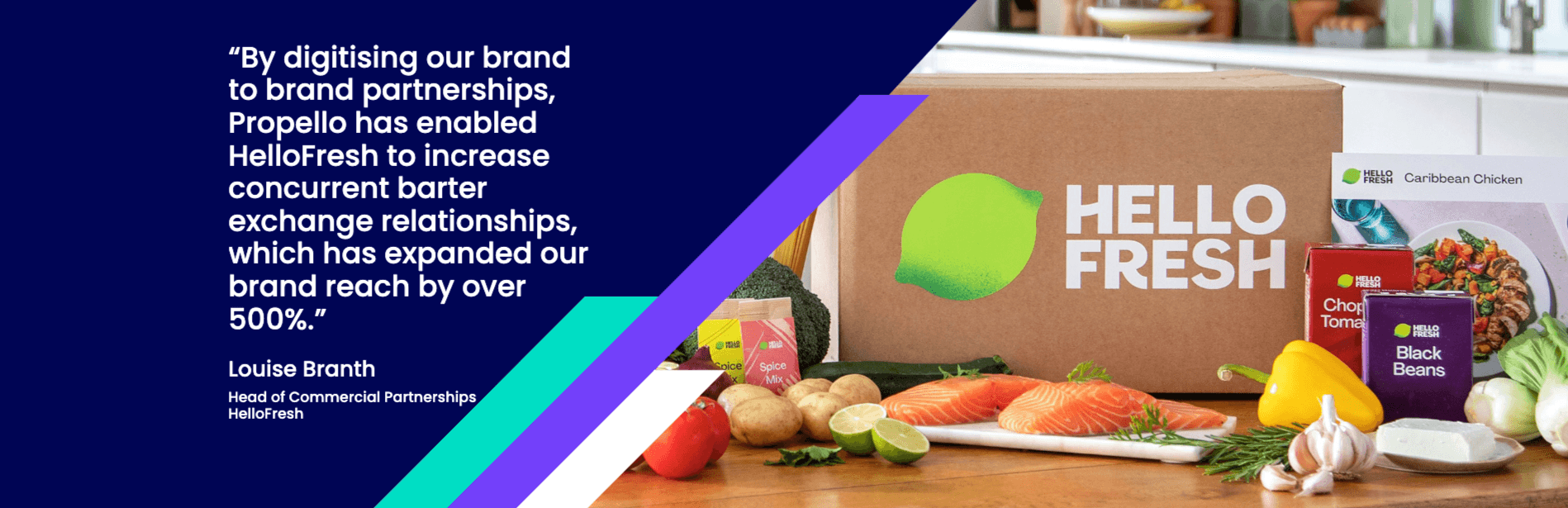
“By digitising our brand to brand partnerships, Propello has enabled HelloFresh to increase concurrent barter exchange relationships, which has expanded our brand reach by over 500%.”
Why it works: Propello Cloud increased HelloFresh’s concurrent partnership inventory by over 500%, generated valuable data insights, and opened access to a far wider partner ecosystem. The shift from print to digital is not just an operational improvement. It is a strategic unlock. Digital partnerships are measurable, scalable, and responsive to changing customer preferences in ways that print never can be.
Build Your Own Partnership Programme With the Help of Our Playbook
If these partnership marketing examples have given you ideas for your own brand collaborations, ourPartnership Marketing Playbook is the practical next step.
It draws on years of real client partnerships, including the programmes behind JD Gyms and HelloFresh, to give you a proven framework for launching, managing, and scaling partnership programmes that deliver measurable business growth.
Download the Playbook to access:
Step-by-step guidance for launching your first partnership programme
Data-driven strategies to optimise existing partnerships
Real-world case studies and lessons learned
Practical tools for measuring partnership ROI
Expert tips for scaling your programme effectively
What is partnership marketing, and how does it differ from traditional marketing strategies?
Partnership marketing combines resources between two or more brands to create content partnerships and strategic alliances that benefit all parties. Unlike traditional marketing channels that rely on singular brand messaging, these collaborations pool marketing budgets to create more impactful customer experiences and a stronger market presence.
Can you provide real-world examples of successful partnership marketing campaigns?
Companies like Nike and Apple demonstrate successful product partnerships through their fitness tracking collaboration, while influencer marketing campaigns by HelloFresh show how brands can earn a commission through strategic content creation. Event sponsorships between Red Bull and extreme sports showcase cost-effective brand collaboration.
What are the key benefits of implementing partnership marketing strategies?
The bottom line benefits include shared marketing research costs, expanded audience reach, and enhanced credibility. Through joint ventures, brands can build brand awareness more effectively than solo efforts. Landing page conversions often improve when backed by the trust of multiple established brands.
How can small businesses leverage partnership marketing to enhance their reach?
Small businesses can leverage influencer partnerships to increase brand awareness without extensive resources. By forming a strategic alliance with complementary brands, they can create content that resonates with their potential customer base while sharing promotional costs and expertise.
What are the common challenges faced when executing partnership marketing campaigns?
Common challenges include maintaining high-level brand consistency across marketing collaborations, aligning different corporate cultures, and coordinating campaigns effectively. Social media marketers must carefully balance partner expectations while ensuring authentic engagement with their audiences.
How do companies measure the success of their partnership marketing efforts?
Companies track ROI through shared KPIs, engagement metrics, and sales data. These metrics help evaluate both immediate campaign impact and long-term partnership value. Regular performance reviews ensure both parties benefit from their marketing channel investments.
What factors should be considered when selecting a partner for a marketing campaign?
Key considerations include brand values alignment, audience overlap, and resource compatibility. Successful partnerships require complementary strengths and shared goals. Partners should enhance, not dilute, each brand’s market position and reputation.
How can businesses ensure that their partnership marketing campaigns align with their brand values?
Brands must establish clear guidelines and communication channels to maintain authenticity. Regular brand audits ensure partnerships reflect core values. Documentation and approval processes help maintain consistency across all collaborative efforts.
What role does technology play in facilitating effective partnership marketing?
Digital platforms facilitate seamless partner collaboration and data sharing. Advanced analytics tools track cross-brand performance, while automation streamlines cooperative marketing efforts and ensures consistent messaging across multiple channels.
How can businesses maintain and strengthen their marketing partnerships over time?
Long-term success requires regular strategy reviews, open communication, and flexible adaptation to market changes. Partners should consistently explore new collaboration opportunities while maintaining focus on shared objectives and mutual growth potential.
Mark Camp
Mark is the Founder and CEO of Propello Cloud, an innovative SaaS platform for loyalty and customer engagement. With over 20 years of marketing experience, he is passionate about helping brands boost retention and acquisition with scalable loyalty solutions.
Mark is an expert in loyalty and engagement strategy, having worked with major enterprise clients across industries to drive growth through rewards programmes. He leads Propello Cloud’s mission to deliver versatile platforms that help organisations attract, engage and retain customers.
Start your customised Propello Cloud journey today
Explore the platform’s scalability, features and customisation options and get answers to your unique questions.