How Are the Biggest Brands Rewarding Customer Loyalty?
25 min to read
Published: July 18, 2022
Updated: August 4, 2026
In this blog post, I’ll show you how some of the world’s most successful brands are using loyalty programmes for rewarding customer loyalty. From Starbucks’ gamified app that encourages repeat purchases to Nike’s members-only benefits like early access to product releases and exclusive events. These programmes are designed to create a sense of exclusivity and appreciation that extends beyond just points and discounts.
Mark Camp
CEO & Founder at PropelloCloud.com
Contents
Key Takeaways
Rewarding customer loyalty is crucial for boosting retention, driving repeat purchases, enhancing brand advocacy, fostering community, and gaining valuable customer insights.
Effective reward strategies include discounts, free products, exclusive access, personalised rewards, experiential rewards, charitable donations, and gamification.
Successful loyalty programmes, like those of Starbucks, O2, Boots, American Express, Nike, Uber, Amazon, and JD Gyms, offer valuable lessons for businesses looking to boost customer retention and advocacy.
Challenges in rewarding customers include ensuring perceived value, balancing costs and impact, avoiding fatigue or entitlement, maintaining fairness, and addressing issues or complaints.
By crafting a tailored loyalty programme that resonates with customers, businesses can cultivate a devoted following and create a win-win situation for both the brand and its customers.
What Makes a Customer Loyalty Programme Successful?
A successful loyalty programme rewards customers in a way that feels genuinely relevant to them, not just transactional. According to Propello Cloud’s 2025 Loyalty Uncovered Report, 84% of enterprise brands now rank personalisation and strategic partnerships as their top investment priorities, ahead of points systems or discounting alone.
The brands that see results from rewarding customer loyalty combine the right reward type (points, tiers, paid membership, or always-on perks) with data-driven personalisation and a frictionless redemption experience.
This guide breaks down the strategies used by Starbucks, O2, Boots, Amazon, Nike, Uber, American Express, and others, plus the data behind why each approach works.
Why Should Businesses Reward Customer Loyalty?
Rewarding customer loyalty isn’t optional anymore; it’s a retention and acquisition strategy. Loyalty programmes reduce churn, increase customer lifetime value, and turn customers into unpaid brand advocates. Propello Cloud’s research backs this up directly: 83% of the 100 enterprise brands surveyed identified customer engagement as a critical business challenge, making loyalty investment a frontline response rather than a nice-to-have.
How Do Loyalty Programmes Increase Customer Retention and Lifetime Value?
Loyalty programmes increase retention by giving customers a reason to return beyond product quality alone. When customers feel rewarded, they consolidate spending with one brand rather than splitting it across competitors, directly lifting lifetime value. This matters because 80% of enterprise brands in Propello Cloud’s report cited churn management and retention as a top business challenge, with 35% rating it critical.
How Do Loyalty Programmes Drive Brand Advocacy and Repeat Purchases?
Happy, rewarded customers refer others at a fraction of the cost of paid acquisition. Repeat purchases follow naturally when customers feel their loyalty is recognised rather than taken for granted. Programmes that pair recognition with personalised offers see the strongest repeat-purchase behaviour, because the reward feels earned and specific to that customer rather than generic.
What Other Benefits Do Loyalty Programmes Provide?
Beyond retention, loyalty programmes generate first-party data that brands can’t get anywhere else. This data reveals customer preferences and behaviour, letting brands refine offers and marketing in ways that broad-stroke campaigns can’t match. It also builds community: personalised rewards create a sense of exclusivity that turns regular customers into vocal fans.
What Are the Most Effective Types of Customer Rewards?
The most effective customer rewards fall into seven categories: discounts and coupons, free products or upgrades, exclusive access, personalised rewards, experiential rewards, charitable donations, and gamified or surprise rewards. Each works differently depending on your business model and customer expectations.
Reward Type
Best For
Example Mechanic
Discounts and coupons
High-frequency, price-sensitive purchases
% off, free shipping codes
Free products/upgrades
Subscription or product-led businesses
Free trial month, sample products
Exclusive access
Brands with a strong community/fanbase
Early sale access, VIP events
Personalised rewards
Data-rich businesses with purchase history
Birthday offers, curated picks
Experiential rewards
Premium or lifestyle brands
VIP events, once-in-a-lifetime trips
Charitable donations
Values-driven customer bases
Donate-on-purchase schemes
Gamification & surprise
Brands wanting habitual engagement
Points, badges, leaderboards
What Is an “Always On” Rewards Programme?
An always-on (or “perks”) programme gives customers access to exclusive discounts or benefits simply for being a customer, with no spending threshold and no waiting period. O2 pioneered the model in 2008 with O2 Priority, and it remains one of the most effective formats for subscription and contract-based businesses because rewards are available the moment a customer needs them, not after a points threshold is hit.
Case Studies: How Major UK and Global Brands Reward Loyalty
How Does Starbucks Rewards Work?
Starbucks Rewards uses a two-tier, points-based system: Green (entry level) and Gold (450 stars within 12 months). Members earn a free drink for every 150 stars collected, with Gold members unlocking extras like free syrups, espresso shots, and a birthday drink.
Why it works: The two-tier structure keeps the programme easy to understand, while free extras give customers a clear, low-cost incentive to upgrade. Starbucks’ mobile app — which lets members track stars in real time — generates around 6 million sales a month, accounting for roughly 22% of all US sales. That’s a strong signal that UX investment in a loyalty app pays for itself directly in transaction volume.
How Does O2 Priority’s Always On Model Work?
O2 Priority gives customers weekly treats; food and shopping discounts and 48-hour early access to tickets for gigs at The O2 — all without requiring points or spend thresholds. Customers can redeem rewards the moment they need them.
Why it works: Always On rewards tap into customers’ fear of missing out (FOMO) by making clear what they’d lose by switching providers. The results back this up: O2 Priority gets 75 views a second, with customers redeeming 5 rewards every minute, every day. For brands in saturated markets — like telecoms — this model is one of the most effective ways to stay front of mind without relying on discounting alone.
Boots customers earn 3 points per £1 spent in-store, online, or via the app, with each point worth a penny towards future purchases. Launched in 1997, the card remains one of the most established points-based programmes in UK retail.
Why it works: Boots’ £30 million initial investment proved the model — but a points-based system doesn’t require that scale to work. Cost-effective implementation is exactly why points programmes remain so widely adopted: they’re relatively simple to run while still measurably increasing retention and spend. Boots also used Advantage Card data to identify its core demographic (women aged 25–45), enabling bespoke offers that increased redemption rates.
Membership Rewards lets cardholders earn points on every purchase, redeemable for travel, merchandise, or transfers to partner programmes like Delta SkyMiles and Marriott Bonvoy — often at favourable exchange rates. Premium cards add airport lounge access and faster point accrual.
Why it works: Partner networks let Amex offer a complete travel ecosystem without building every benefit in-house. If your brand has access to a partner or affiliate network, a similar co-created model can extend your value proposition without the operational overhead of building it all yourself. Propello’s research found 84% of enterprise brands now rank strategic partnerships among their highest investment priorities — making this one of the most validated strategies in the current market, not just an Amex-specific tactic.
Why Do Paid Loyalty Programmes Like Amazon Prime Work?
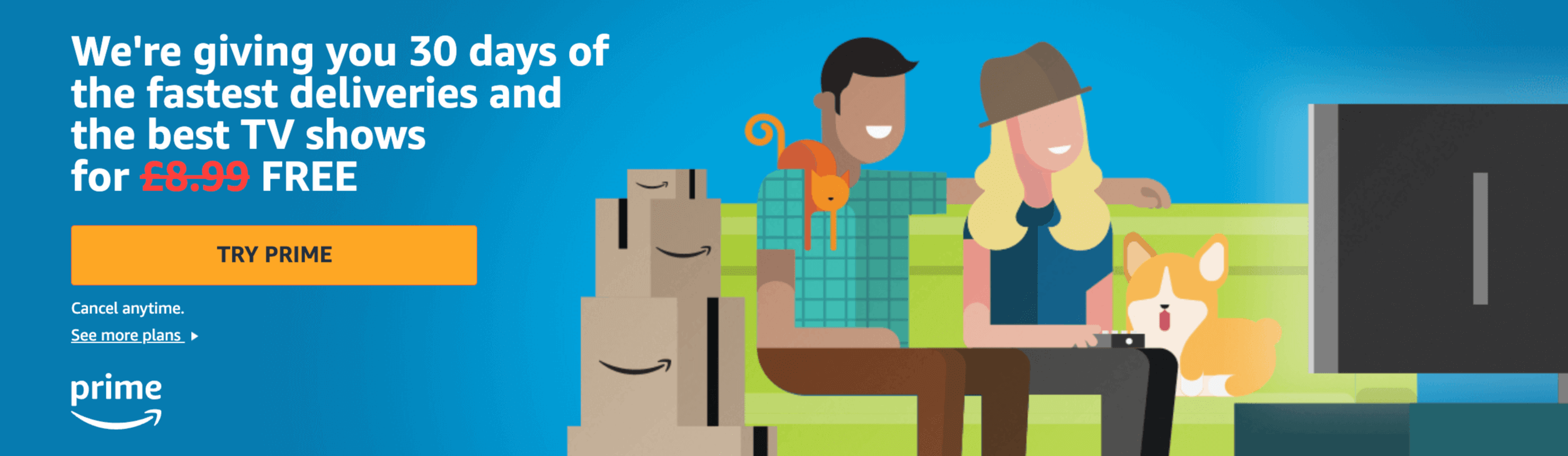
Amazon Prime is a paid loyalty programme: members pay monthly or annually for free shipping, Prime Video, ad-free music, and exclusive deals — no points system required.
Why it works: Paid loyalty programmes counter-intuitively drive higher retention and acquisition than free ones. According to McKinsey, 59% of consumers are more likely to choose brands with paid loyalty programmes, and 43% of paid members make weekly purchases. The logic is straightforward: once a customer has paid for membership, the perceived cost of switching — and of not using the benefits they’ve paid for — rises sharply.
Paid loyalty membership doesn’t reduce conversion — it increases it, because customers who’ve already invested money want to extract value from that investment.
How Does JD Gyms Plus Combine Always On and Paid Loyalty?
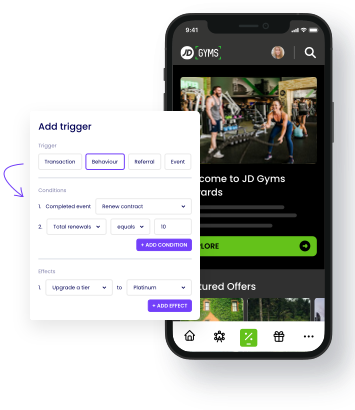
JD Gyms Plus is a paid, always-on hybrid: for £5/month, members get discounts from hundreds of partner brands (including MyProtein and Apple), a free Gym Buddy pass, a free PT session, and two weeks’ advance class booking.
Why it works: This is one of the strongest examples in the UK market of why paid loyalty performs so well. Propello’s Loyalty Uncovered Report features JD Gyms’ Plus Membership as a flagship case study: premium subscription uptake increased by 5,700% after launch — a figure that should reframe how any subscription or membership business thinks about paid tiers. The programme’s perks (Gym Buddy pass, PT session, and advance booking) were designed around specific member pain points rather than generic discounts, which is likely why uptake was so dramatic.
Uber’s referral programme gives existing users a unique code to share; both the referrer and the new user receive ride credit once the referred person completes their first ride.
Why it works: Uber uses a dual-sided referral model — rewarding both parties — rather than a single-sided one that only benefits the existing customer. Dual-sided referrals are generally the stronger format because the new customer starts their relationship with a positive first impression, making them more likely to convert into a regular user.
How Does NikePlus Use Gamification to Drive Loyalty?
NikePlus members get personalised shopping recommendations, early access to limited-edition product drops, birthday gifts, and exclusive content through Nike Training Club and Nike Run Club.
Why it works: NikePlus succeeds because gamification (leaderboards, challenges, achievement tracking) taps into customers’ competitive instincts while reinforcing the active lifestyle Nike’s products are built for. Early access creates urgency and exclusivity, while the training apps keep customers engaged with the brand daily — not just at the point of purchase.
How Does Lebara’s “Always On” Rewards Platform Work?
Lebara Mobile moved from a basic in-house rewards page to an outsourced, Always-On platform offering 24/7 reward access with no earning thresholds.
Why it works: This case study is one of the clearest data points in Propello’s 2025 research on the build-vs-buy decision. After switching to a specialist platform, Lebara expanded its rewards catalogue from 15 to over 100 brand partnerships, cut operational running costs by 3x, and acquired 100,000 members within two months of launch — having gone live in just 12 weeks. It’s a direct illustration of why 69% of enterprise brands surveyed in the report now prefer outsourcing their loyalty platform over building in-house.
How Does Vitality’s Tiered Loyalty Programme Work?
Vitality integrates with wearables and fitness trackers, rewarding healthy behaviours with tier-based benefits and partner perks from brands like Apple and Expedia.
Why it works: Vitality demonstrates how tiered, behaviour-linked rewards can serve a dual purpose — driving engagement and improving the insurer’s risk profile since healthier customers are correlated with reduced claims. The model relies on the same API and integration investment that 77% of enterprise brands now prioritise, since wearable-data syncing requires robust technical infrastructure to work in real time.
What Are the Biggest Challenges in Running a Loyalty Programme?
Loyalty programmes aren’t “set and forget”, they require continuous management and ongoing investment. According to Propello’s 2025 research across 100 enterprise brands, the top five challenges, in order of how many businesses cited them, are:
Customer engagement — 83% of businesses, 37% rate it critical
API integration complexity — 81% of businesses, 35% rate it critical
Churn management and retention — 80% of businesses, 35% rate it critical
Data privacy and compliance — 78% of businesses, 34% rate it critical
Multi-channel consistency — 77% of businesses, 34% rate it critical
Why Is Ensuring Rewards Feel Valuable So Difficult?
Rewards only work if customers perceive them as genuinely valuable — generic points or discounts aren’t enough on their own. This is closely tied to the personalisation challenge: 84% of enterprise brands now prioritise personalisation specifically because misaligned rewards (offers that don’t reflect what a customer actually wants) are one of the most common reasons loyalty programmes underperform.
How Should Businesses Balance Reward Cost Against Loyalty Impact?
The cost of rewards needs to be weighed against their measurable impact on retention, not offered indiscriminately. Tracking ROI on a rewards programme is essential to keep it sustainable — over-rewarding erodes margin without necessarily improving loyalty, while under-rewarding fails to move behaviour at all.
How Can Businesses Avoid Reward Fatigue or Entitlement?
Reward fatigue sets in when customers start expecting perks as a baseline rather than a bonus. Keeping a programme fresh — refreshing rewards regularly, communicating their value clearly, and avoiding over-familiarity — helps prevent loyalty rewards from becoming an assumed cost of doing business rather than a genuine incentive.
How Should Businesses Handle Common Loyalty Programme Complaints?
Clear processes for handling reward-related complaints protect trust in the programme. The table below outlines common issues and recommended responses:
Issue
Recommended Response
Customer doesn’t receive expected reward
Investigate and resolve promptly; communicate clearly throughout
Customer unhappy with reward value
Listen to feedback; consider adjusting rewards or improving how value is communicated
Customer struggles to redeem rewards
Simplify the redemption process; provide accessible support
Customer feels the programme is unfair
Review rules for consistency; communicate transparently about how rewards are earned
Should Businesses Build or Buy Their Loyalty Platform?
Most enterprise brands now prefer outsourcing their loyalty platform rather than building one in-house. Propello’s 2025 report found that 69% of the 100 enterprise brands surveyed favour outsourced solutions, with speed-to-market cited as the decisive factor, not just cost.
Lebara’s experience illustrates why: moving to a specialist platform let them launch in 12 weeks, scale rewards partnerships from 15 to 100+, and cut running costs by 3x. For most businesses without a dedicated in-house loyalty engineering team, a plug-and-play or headless API integration gets a competitive programme live in a fraction of the time a custom build would take.
Reward Customer Loyalty Like a Pro
Loyalty rewards work when they resonate with what your specific customers actually value, not when they simply mimic what a competitor is doing. Get this right, and the payoff compounds: higher spend, stronger retention, and customers who refer others without being asked.
The brands in this guide — from Starbucks’ tiered points system to Lebara’s Always On platform and JD Gyms’ paid-tier hybrid — all validate the same underlying finding from Propello’s 2025 Loyalty Uncovered Report: personalisation and partnerships now drive more loyalty value than points and discounts alone. Whichever model fits your business, the data suggests the same starting point: invest in understanding what your customers actually want, then build the reward structure around that.
FAQs
What are the benefits of rewarding customer loyalty?
Rewarding customer loyalty boosts retention, drives repeat purchases, enhances brand advocacy, fosters community, and provides valuable customer insights. Businesses can deepen emotional connections and create a win-win situation that benefits both the brand and its customers by making customers feel appreciated.
What types of rewards are most effective for customer loyalty programmes?
Effective reward strategies include discounts, free products, exclusive access to sales or events, personalised rewards based on customer preferences, experiential rewards, charitable donations on behalf of customers, and gamification elements.
How can businesses ensure that rewards are perceived as valuable by customers?
To ensure rewards are perceived as valuable, businesses should offer relevant, meaningful rewards aligned with customer preferences. Use data from loyalty programmes to understand customer behaviour and tailor rewards accordingly. Clearly communicate the value and exclusivity of rewards.
How can businesses balance the cost of rewards with their impact on loyalty?
Balancing the cost of rewards with their impact on loyalty requires careful tracking of the ROI of the rewards programme. While generous rewards are important, the programme must be sustainable for the business in the long run. Make adjustments as needed based on data analysis to optimise the cost-benefit ratio.
How can businesses avoid reward fatigue or entitlement among customers?
To avoid reward fatigue or entitlement, keep the loyalty programme fresh and exciting by regularly introducing new rewards, experiences, or partnerships. Clearly communicate the value and exclusivity of rewards, emphasising that they are special perks rather than guaranteed benefits.
How can businesses maintain fairness and consistency in reward distribution?
To maintain fairness and consistency, establish clear rules and guidelines for how rewards are earned and redeemed. Apply these rules consistently across all customers to build trust and credibility. Regularly review and update the programme to ensure it remains equitable and transparent for all participants.
How should businesses address potential issues or customer complaints related to rewards?
When addressing issues or complaints, promptly investigate and resolve the problem. Communicate clearly with customers throughout the process. Listen to feedback and consider adjusting rewards or better communicating their value. Ensure the redemption process is clear and easy, and provide support to assist customers.
What can businesses learn from successful loyalty programmes like those of Starbucks or Amazon?
Successful loyalty programmes offer valuable lessons, such as the importance of tiered structures, personalised rewards, exclusive experiences, and partnerships. They also highlight the effectiveness of gamification, referral incentives, and premium benefits in driving customer engagement and loyalty.
What role does technology play in creating and managing customer loyalty programmes?
Technology is crucial for loyalty programmes, enabling businesses to track customer behaviour, personalise rewards, and automate programme management. Digital platforms, mobile apps, and data analytics tools help businesses create seamless, engaging experiences for customers.
Mark Camp
Mark is the Founder and CEO of Propello Cloud, an innovative SaaS platform for loyalty and customer engagement. With over 20 years of marketing experience, he is passionate about helping brands boost retention and acquisition with scalable loyalty solutions.
Mark is an expert in loyalty and engagement strategy, having worked with major enterprise clients across industries to drive growth through rewards programmes. He leads Propello Cloud’s mission to deliver versatile platforms that help organisations attract, engage and retain customers.
Start your customised Propello Cloud journey today
Explore the platform’s scalability, features and customisation options and get answers to your unique questions.


.png)
.png)
.png)
.png)