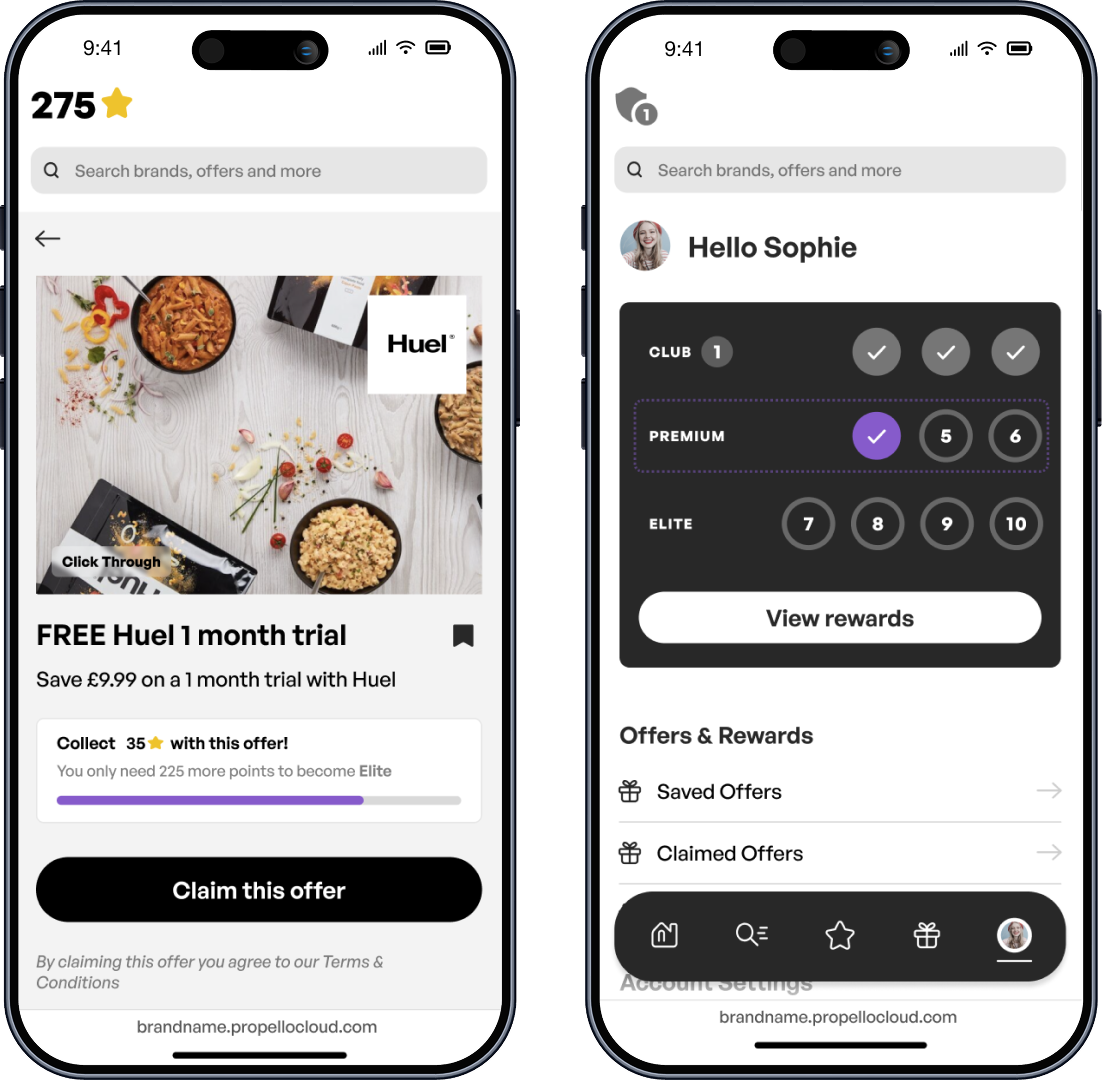
Why A Tiered Loyalty Program Drives Better Results
25 min to read
Published: December 7, 2023
Updated: July 29, 2026
Tiered loyalty programmes are multi-layered reward systems that offer progressively valuable incentives as customers meet spend or engagement thresholds. They outperform simpler alternatives by combining status psychology, data-driven personalisation, and compounding customer lifetime value.
Mark Camp
CEO & Founder at PropelloCloud.com
Contents
Key Takeaways
37% of customers adjust their spending behaviours specifically to reach a higher tier
The optimal tier structure has 3 to 4 levels, balancing accessibility with aspiration
80% of businesses cite churn management as a critical challenge — tiered programmes directly address this through progressive engagement
Personalisation is non-negotiable: 57.7% of Millennials abandon programmes with irrelevant rewards
Hybrid models combining tiers with points, gamification, and partner rewards consistently outperform single-mechanic approaches
FOMO drives around 60% of purchase decisions — a lever that tier design can systematically exploit
This guide covers everything you need to know about tiered loyalty programmes: how they work, their six core benefits, the key components that drive their success, how to implement them step by step, and the future trends shaping the space.
What Are Tiered Loyalty Programmes?
Tiered loyalty programmes are reward systems that offer progressively valuable incentives at each level, with customers advancing by meeting defined conditions such as a spend threshold, engagement target, or paid membership fee. They differ from flat points programmes by introducing status, exclusivity, and aspiration into the loyalty mechanic.
How Do Tiered Loyalty Programmes Work?
Tiered loyalty programmes assign members to status levels based on qualifying criteria, then deliver tier-specific rewards, perks, and communications at each level. Entry-level members receive immediate value to drive first repeat purchases. Mid-tier members receive better incentives to increase purchase frequency. Premium members receive exclusive experiences and partner rewards that justify continued high spend.
Today, customer experience is considered just as important as the rewards themselves. Participation should feel as exciting as the incentives on offer. Every level must be hyper-relevant in both its communications and reward content, not just its transactional mechanics.
Does Data Play a Role in Tiered Programmes?
Data is the engine behind effective tiered loyalty. Platforms capture purchase history and browsing behaviour via integrated payment solutions and mobile app interactions, then automate personalised offers at each tier. Two customers in the same tier can receive entirely different product recommendations based on individual behaviour signals.
Data also identifies when a customer is approaching the next tier threshold. That moment is ideal for an upsell prompt: a timely alert that they are close to unlocking a high-value reward creates urgency without feeling forced.
Is Customer Engagement Relevant to Tiered Systems?
Engagement is critical because customers can only advance tiers a limited number of times. Brands need strategies to keep members active in between advancements. The most effective include upselling and cross-selling offers, gamification, social media communications, community forums, referral programmes, exclusive events, and brand partnership promotions. Without these, even a well-structured tier system will see members plateau and disengage.
What Are the Main Benefits of Tiered Loyalty Programmes?
The main benefits of a tiered loyalty programme fall into six pillars: customer retention, customer lifetime value (CLV), segmentation and personalisation, engagement and brand loyalty, ROI, and competitive differentiation. Each benefit reinforces the others, creating a compounding effect when the programme is well designed.
1) How Do Tiered Programmes Improve Customer Retention?
Well-structured tier programmes improve engagement for 74% of customers. The drive to advance from Bronze to Silver to Gold increases customer interactions, particularly when strong engagement strategies are in place. Propello Cloud’s 2025 Loyalty Uncovered Report identifies churn management as a critical challenge for 80% of enterprise brands. Tiered programmes directly address this by giving customers a structural reason to stay and progress.
The risk: irrelevant rewards cause nearly 60% of Millennials to abandon programmes entirely, so compelling value at every level is non-negotiable.
2) How Do Tiered Programmes Enhance Customer Lifetime Value?
Tiered programmes boost CLV by incrementally increasing reward value at each level, thereby driving both purchase frequency and average spend. Satisfied customers also become brand advocates, generating referrals that consistently rank among the highest-converting acquisition channels.
The CLV formula for tiered programmes: CLV = (Average Order Value × Purchase Frequency × Retention Time) – Customer Acquisition Cost. Every tier advancement increases at least two of those variables simultaneously.
3) How Do Tiered Programmes Improve Segmentation and Personalisation?
Each tier captures engagement patterns, spending behaviours, and advocacy metrics, making audience segmentation more precise. Brands can run multiple personalised campaigns simultaneously across tiers, with individual customers in the same tier still receiving different product recommendations based on their own data.
This matters because 84% of enterprise brands in Propello Cloud’s 2025 Loyalty Uncovered Report rank personalisation as a top investment priority. Tiered segmentation is one of the most practical mechanisms for delivering it at scale.
4) How Do Tiered Programmes Amplify Engagement and Brand Loyalty?
Recognition is a powerful motivator: 74% of consumers feel loyal to brands that make them feel seen, appreciated, and recognised. Tier progression delivers that recognition. A congratulatory message on reaching a new rank transforms a transactional relationship into an emotional one, increasing the likelihood of continued engagement and spending.
Key insight: the emotional payoff of status advancement is often more motivating than the reward itself.
5) What ROI Can Businesses Expect From a Tiered Programme?
Tiered programmes provide a clear framework for ROI optimisation. Allocating different rewards to different tiers and testing performance helps businesses identify the most profitable reward mix. Scalability follows naturally as customers increase purchase frequency to move up the ranks.
The real-world evidence is compelling. JD Gyms saw a 5,700% increase in premium subscription uptake after launching their tiered Plus Membership programme, demonstrating how well-designed paid tiers can transform both engagement and revenue streams. And in our report, enterprise brands said 60% of consumers now spend more with brands that offer paid loyalty programmes.
6) How Do Tiered Programmes Differentiate a Brand Competitively?
Tiered programmes enhance brand identity by integrating a brand’s core product or service into the tier structure, using familiar naming conventions such as Bronze, Silver, and Gold. Brands that infuse tiers with their own personality and visual identity improve recall and elevate the overall experience. In crowded markets, a well-branded tier programme is a genuine differentiator that generic points schemes cannot replicate.
What Are the Key Components of a Tiered Loyalty Programme?
Every tiered loyalty programme depends on five key components. Without all of them, the structure cannot deliver consistent progression, perceived value, or long-term retention. These are psychology-led communications, in-tier progression mechanics, tier-specific perks, behaviour-based incentives, and the right customer outcome at each level.
How Should Communications Appeal to Psychological Drivers?
Tiered programmes typically consist of three to four tiers, each requiring clear eligibility criteria and attainable thresholds. If customers cannot see how to qualify for higher tiers or consider them too out of reach, participation drops. The opposite is equally damaging: easily attainable tiers carry lower perceived worth.
The solution is to anchor communications to two proven psychological motivators: status and fear of missing out (FOMO). Data shows that 37% of customers will spend more to improve their status. Practical examples: “Spend £25 More and Access Exclusive Rewards in the Gold Room” or “Extra Points on Every Purchase: 2 Hours Left on Your Speedrun to Silver.”
Why Is In-Tier Progression Important?
In-tier progression keeps customers active between advancements. FOMO influences 60% of purchase decisions, making it a reliable lever for encouraging repeat purchases that contribute towards the next threshold.
Brands should plot multiple pathways within each tier. Some customers respond to discounts, others to points accumulation or social recognition. As long as in-tier rewards provide genuine value, long-term engagement follows. A single pathway risks excluding entire customer segments.
What Tier-Specific Perks and Benefits Should Be Included?
Perks and benefits are distinct from rewards and should be exclusive to specific tiers. Examples include priority service, free shipping, and early product access. Crucially, perks must stack upward: customers will disengage if advancing to a higher tier means forfeiting benefits they previously enjoyed at a lower one.
What Are Behaviour-Based Incentives?
Behaviour-based incentives serve customers who do not respond to FOMO or status triggers. These include:
Spend-based progression: advancement occurs naturally through repeat purchasing
Engagement-based rewards: for members who participate in social media, community forums, or referral schemes
Milestone bonuses: one-time rewards for hitting specific behavioural thresholds
Every programme should incorporate behaviour-based incentives to ensure no customer segment goes unrewarded.
What Customer Outcome Should Each Tier Deliver?
A useful rule of thumb: entry-level perks should deliver immediate value, and premium tiers should justify higher spending. Getting outcomes right at each level is arguably the single most consequential design decision in the entire programme. If the premium tier does not feel worth the effort to reach, the whole progression mechanic loses credibility.
What Types of Tiered Loyalty Programmes Are There?
There are several types of tiered loyalty programmes, each tailored to specific goals and business models. Crucially, they are fully flexible: businesses can combine and configure them to fit their purposes precisely, which is why many loyalty experts deploy tiered structures alongside other programme types rather than in isolation.
What Is a Multi-Level Loyalty Programme?
The traditional multi-level approach remains a firm favourite for brands with diverse customer segments. Each tier offers benefits of incremental value. This format is best suited to businesses with frequent purchase cycles, as repeated transactions create multiple opportunities for customers to advance their status.
Best for: retail, subscription services, and any brand with high purchase frequency.
What Is a VIP Status Programme?
VIP status programmes are designed for luxury or premium brands seeking to recognise and reward high-value customers. They prioritise personalised services and distinctive experiences. Rewards must genuinely satisfy VIPs: if the entry criteria feel demanding relative to the perceived value, participation declines quickly.
Best for: premium brands, financial services, and high-ticket B2C categories.
What Are Experiential Reward Systems?
Experiential reward systems centre on non-transactional incentives rather than discounts or points. Rewards include behind-the-scenes experiences, early product access, invitations to in-person and online events, and curated day-out offers. Propello Cloud’s 2025 Loyalty Uncovered Report found that 74% of enterprise brands are prioritising experiential rewards, reflecting growing recognition that customers increasingly value experiences over material incentives.
Best for: leisure, travel, fitness, and lifestyle brands.
What Are Gamified Tiered Programmes?
Gamified programmes use mechanics such as milestone rewards, achievement badges, and leaderboards to sustain engagement. They are well-suited to brands that want to prioritise customer experience over psychological triggers. Based on Propello Cloud’s work with clients, gamified tiers consistently produce strong results in long-term retention.
Best for: brands with younger audiences, subscription models, and fitness or health sectors.
What Are Hybrid Loyalty Models?
Hybrid models combine tier structures with reward mechanics such as points, gamification, or partner rewards. A points-and-tiers combination is particularly effective: points provide clear progression metrics, while tiers deliver the status-based benefits that drive emotional engagement. Together, they form a comprehensive loyalty ecosystem. In Propello Cloud’s 2025 report, 68% of enterprise brands expressed interest in hybrid loyalty models, making them the second most popular investment category overall.
How Do You Implement a Tiered Loyalty Programme?
Building a tiered loyalty programme from the ground up takes considerable work. Technology must be developed or procured, loyalty expertise is needed, and your wider team requires training to promote the programme effectively. The six steps below cover the full implementation process.
Step 1: Align the Programme With Your Business Goals
Start with clear KPIs. Do you want higher retention? A more differentiated brand experience? Increased CLV? Only once goals are established should you begin structuring rewards, perks, and tier conditions. Every element of the programme architecture should flow from the outcome you are trying to achieve.
Common KPI targets for tiered programmes include:
Reducing churn rate by a defined percentage
Increasing average order value across the customer base
Growing the proportion of customers reaching the mid or premium tier
Improving Net Promoter Score among loyalty programme members
Step 2: Choose the Right Number of Tiers
Three to four tiers is the optimal range, supported by both Propello Cloud’s client experience and wider industry research. The rule of three, covering entry-level, mid-tier, and premium, is a familiar and intuitive structure. It gives brands a manageable number of tiers to differentiate meaningfully without overwhelming customers or creating operational complexity.
Step 3: Define Your Customer Outcomes Per Tier
Before launch, carefully consider the desired customer outcome for each tier level. Your KPIs should inform these decisions directly. Here is an example framework for a three-tier programme aimed at driving paid premium membership:
Tier
Goal
Reward Choice
Leads To
Entry
Increase engagement
Welcome points, small discounts, early sale access
Higher initial participation; first repeat purchase
Mid
Incentivise progression
Better discounts, early product access, milestone bonuses
Higher CLV through subscription fees and stronger brand attachment
Step 4: Differentiate and Brand Each Tier
Each tier must be thematically related but carry a defining characteristic. Naming conventions should reflect the unique value proposition of that level. Design quality matters beyond aesthetics: strong visual identity attracts participants, aids recall, and helps the programme stand out in competitive markets.
Step 5: Decide on Gamification
Decide before launch whether to include gamification. Retrofitting it later is costly in time, resource, and budget. We consider gamification a must. In Propello Cloud’s 2025 Loyalty Uncovered Report, 65% of enterprise brands are investing in gamification elements, and our clients have seen measurably higher engagement as a result. Brands using Propello Cloud’s platform can implement gamified tiers with relative ease.
A multi-channel communications strategy requires substantial copy and content per tier. Prepare contingencies before launch. If certain messages do not resonate, or a customer favours one channel over another, how will the programme adapt? According to our research, 77% of enterprise brands cite multi-channel consistency as a significant operational challenge. A capable solution provider will support your marketing team through this process.
What Are the Main Challenges of Tiered Loyalty Programmes and How Do You Solve Them?
Every tier programme faces common obstacles. Even well-designed structures can falter without the right solutions in place. Propello Cloud’s 2025 Loyalty Uncovered Report, based on conversations with 100 enterprise brands, identifies customer engagement (83%), API integration complexity (81%), and churn management (80%) as the three most pressing loyalty challenges. The four challenges below map directly to these findings.
Challenge
Solution
Complex design and communication
Use streamlined tier structures with clear, measurable progression metrics. Integrate CRM systems to coordinate messaging across all channels. Write straightforward copy that articulates benefits and advancement paths without ambiguity.
Balancing rewards
Use customer behaviour analytics to inform tier threshold design. Set progressive goals that create natural paths to advance. Run regular performance reviews to optimise tier requirements based on live engagement data.
Technical burden
Deploy scalable, plug-and-play loyalty management platforms that integrate via API. Use robust security tools to guard against data and loyalty fraud. Maintain regular staff training on programme management, or outsource to a specialist third party.
Ensuring fairness
Design clear eligibility rules from the outset. Consult loyalty experts to build a reward structure balanced against KPIs. Offer consistent opportunities to progress across all customer segments.
On the build vs buy question:69% of enterprise brands in Propello Cloud’s research prefer outsourced loyalty solutions, citing speed-to-market as the primary driver. Lebara Mobile, for example, transitioned from an in-house solution to Propello Cloud’s platform and achieved a 3x reduction in operational running costs, expanded from 15 to over 100 brand partnerships, and acquired 100,000 members within two months of launch.
How Do You Measure the Success of a Tiered Loyalty Programme?
To understand programme performance, track metrics that reveal the full picture: tier velocity, customer engagement patterns, behavioural shifts across levels, and customer lifetime value. Basic engagement figures alone tell only part of the story.
What Is Tier Velocity and Why Does It Matter?
Tier velocity measures how quickly customers progress through status levels. It is one of the clearest indicators of programme health. Slow velocity suggests thresholds are too high or rewards are insufficiently compelling. Tracking it regularly allows brands to course-correct before disengagement sets in.
Tier Velocity = (Total Time Spent in Tier) / (Number of Customers Advancing to Next Tier)
Average Tier Velocity = ∑ (Time to Tier Advancement per Customer) / Total Advancing Customers
Tier Distribution % = (Number of Customers in Tier) / (Total Active Loyalty Members) × 100
Which Customer Engagement Metrics Should You Track?
Engagement patterns across tiers reveal how different customer segments respond to programme benefits. The key metrics to monitor are redemption rates, interaction frequency, and cross-channel participation. Analysing these figures together gives a far more accurate picture of engagement than any single metric in isolation.
Redemption Rate = (Number of Rewards Redeemed) / (Number of Rewards Issued) × 100
Interaction Frequency = Total Interactions / Total Active Members
How Do You Analyse Customer Behaviour Across Tiers?
Tier progression often correlates with shifting purchase behaviours. By monitoring basket size, purchase frequency, and category exploration at each tier level, brands can identify and capitalise on emerging opportunities. These behavioural signals are particularly valuable for informing reward choices and refining tier thresholds over time.
Average Basket Size = Total Revenue / Number of Transactions
Purchase Frequency = Number of Purchases / Number of Unique Customers
Category Exploration = ∑ (Unique Categories Purchased per Customer) / Number of Customers
How Do You Measure Customer Lifetime Value in a Tiered Programme?
CLV is the ultimate long-term indicator of overall programme success, capturing the relationship between average order value, purchase frequency, and how long a customer stays with a business. Our data consistently shows that effective tier programmes significantly influence all three variables.
CLV = (Average Order Value × Purchase Frequency × Retention Time) – Customer Acquisition Cost
The practical implication: every tier advancement that increases purchase frequency or average spend compounds CLV over the entire customer relationship. This is why well-designed tiered programmes deliver disproportionate long-term ROI relative to their implementation cost.
What Future Trends Should You Watch in Tiered Loyalty Programmes?
The loyalty landscape is evolving quickly, driven by mobile technology, rising customer expectations, AI, and deeper integration with overall CX strategy. Brands that stay ahead of these shifts will build programmes that remain relevant and competitive.
How Will Mobile Wallets Change Tiered Loyalty?
Mobile wallets are becoming a mainstream loyalty touchpoint, expanding omnichannel options for businesses. Redeemable rewards accessible on the go add a layer of convenience that directly improves the overall customer experience. For tiered programmes, this means members can track their status, progress towards the next tier, and redeem rewards wherever they are. According to Propello Cloud’s 2025 research, 77% of enterprise brands prioritise mobile-first loyalty strategies, reflecting how central mobile has become to the loyalty interaction.
How Are Customer Expectations Shifting?
Customers increasingly expect hyper-personalisation and seamless omnichannel integration as baseline features, not differentiators. Self-service tools are also becoming a standard expectation: nearly 80% of customers prefer brands that offer self-service options. Tiered programmes that fail to meet these expectations will struggle to retain members at any level.
Key insight: personalisation and strategic brand partnerships are now the joint top investment priority for 84% of enterprise brands, according to Propello Cloud’s 2025 Loyalty Uncovered Report. Programmes that cannot deliver both will lose ground to those that can.
What Role Will AI Play in Tiered Loyalty?
AI and machine learning are transforming how programmes handle threshold optimisation and reward personalisation. These tools predict behaviour patterns and automate benefit adjustments, making the experience feel anticipatory rather than reactive. In Propello Cloud’s 2025 report, 62% of enterprise brands are actively investing in AI and machine learning for loyalty, with the primary use cases being churn prediction, real-time personalisation, and dynamic reward adjustment. Propello Cloud’s AI-led platform already applies these capabilities across client programmes.
How Will Tiered Loyalty Integrate With Broader CX Strategies?
The future of tiered loyalty lies in deeper integration with overall customer experience initiatives. Tier status will increasingly shape every customer interaction, from service prioritisation to personalised product recommendations, creating a unified engagement strategy rather than a siloed rewards mechanic. The brands that treat tier status as an input to their entire CX stack, not just their loyalty module, will build the most durable competitive advantages.
Ready to Drive Better Results With a Tiered Loyalty Programme?
Tiered loyalty programmes are a proven choice for businesses that need a multi-layered reward system. Mass digitalisation has shifted focus from rewards alone to the full customer experience, and data is now the engine behind personalisation, segmentation, and intelligent reward distribution across tiers.
Long-term engagement separates good programmes from great ones. Gamification, social media, community forums, and compelling rewards at every level all contribute to sustained participation. The key components, programme types, and implementation steps covered throughout this article give you everything needed to build a structure that works.
You are now well placed to begin designing your tiered loyalty programme.Contact our team today to get your programme launched within weeks.
FAQs
What makes tiered loyalty programmes more effective than traditional points-based systems?
Tiered programmes introduce status and exclusivity that points alone cannot provide. Customers who earn something they perceive as high-value are far more motivated to protect it. Points are typically available to all members and easily accumulated, which limits their perceived worth over time.
How many tiers should my loyalty programme have?
Three to four tiers is the recommended range. The rule of three, covering entry, mid, and premium levels, is familiar and intuitive for customers while giving brands a manageable structure to differentiate.
What is the best way to determine tier thresholds?
Start with customer spending patterns and engagement behaviours. Test where customers are dropping off and gather direct feedback. At a minimum, set both a spending rule and an engagement rule, then iterate based on performance data.
How do you maintain engagement once customers reach top-tier status?
Gamification is the most reliable strategy. Milestone rewards, competitions, and tier-specific challenges sustain engagement well after a customer has reached the highest level. Where gamification is not feasible, surprise-and-delight strategies are a strong alternative.
What are the essential metrics for measuring tier programme success?
Track tier velocity, customer lifetime value, cross-tier progression rates, and engagement patterns across status levels. All relevant formulas are included in the measurement section above.
How can businesses prevent programme complexity from reducing engagement?
Keep to three to four tiers. Ensure advancement pathways are clearly communicated and traceable. Use integrated communication systems to deliver consistent messaging across all channels.
What role does gamification play in tiered loyalty programmes?
Gamification sustains long-term engagement within tiers. Since customers can advance a maximum of three times in a four-tier programme, gamification keeps the experience fresh and rewarding between those advancement moments.
How important is personalisation in tier-based programmes?
Personalisation is non-negotiable. Communications must accurately reflect each customer’s tier. Generic messaging, or referencing the wrong tier entirely, will erode trust and disengage the customer.
What is the relationship between brand partnerships and tier programmes?
Strategic partnerships enable co-created rewards that are particularly compelling at the top tier, especially when data shows that high-ranking customers already engage with a potential partner’s products or services.
How are AI and machine learning transforming tiered loyalty programmes?
AI-led platforms like Propello Cloud automatically assess data and anticipate what customers at each tier level expect, making the experience feel attentive and relevant rather than generic.
Mark Camp
Mark is the Founder and CEO of Propello Cloud, an innovative SaaS platform for loyalty and customer engagement. With over 20 years of marketing experience, he is passionate about helping brands boost retention and acquisition with scalable loyalty solutions.
Mark is an expert in loyalty and engagement strategy, having worked with major enterprise clients across industries to drive growth through rewards programmes. He leads Propello Cloud’s mission to deliver versatile platforms that help organisations attract, engage and retain customers.
Start your customised Propello Cloud journey today
Explore the platform’s scalability, features and customisation options and get answers to your unique questions.