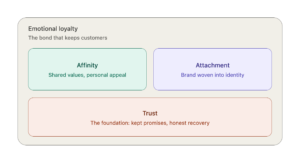
Emotional loyalty is the psychological bond that makes customers choose your brand over a cheaper alternative, recommend you without being asked, and forgive you when things go wrong. It is the difference between customers who stay because the deal is good and customers who stay because they genuinely care about your brand.
Mark Camp
CEO & Founder at PropelloCloud.com
Contents
Key Takeaways
Emotionally connected customers are around 52% more valuable than merely satisfied ones
Emotionally committed customers stay for an average of 5.1 years, versus 3.4 years for merely satisfied customers
According to Propello Cloud's 2025 Loyalty Uncovered Report, 84% of enterprise brands are investing in personalisation as their top loyalty priority
Trust, affinity, and attachment are the three core drivers of emotional loyalty
The most effective programmes blend transactional rewards with emotional connection, using one as the gateway to the other
Think of the last time you paid more at a favourite shop when a cheaper option existed or recommended a brand to a friend unprompted. That is emotional loyalty at work.
Points and discounts can acquire customers. Emotional loyalty is what keeps them.
What Is Emotional Loyalty?
Emotional loyalty is the bond that drives customers toward a brand for reasons beyond logic: price, convenience, or rational comparison. It is rooted in how your brand makes people feel.
Do they feel understood? Valued? Part of something? Those emotional responses build connections that transactional programmes cannot replicate.
How does emotional loyalty work in the brain?
Emotion gets there first. Before a customer weighs your price against a rival’s, the feeling has already landed, and feelings move faster than spreadsheets. Once someone forms a bond with a brand, it behaves like any other attachment that matters to them: it makes them less price-sensitive, and more willing to forgive the odd slip.
That is why an emotionally connected customer does not defect the moment a competitor undercuts you by a few percent. They are not running the maths.
They come back because the association feels good, and a good feeling is quicker to reach for and harder to shift than a price comparison.
Does emotional decision-making actually drive purchasing behaviour?
Evidence consistently shows that feelings outweigh rational calculation in most purchasing decisions. Consider how you choose a restaurant: you may have checked prices and reviews, but the final choice is driven by memory, atmosphere, and how the staff made you feel. The data confirms what most marketers already suspect: emotion leads, logic follows.
What Is the Difference Between Emotional Loyalty and Transactional Loyalty?
Transactional loyalty is built on incentives: points, discounts, and free items. Emotional loyalty is built on identity, values, and connection. The distinction matters because transactional loyalty is inherently fragile. The moment a competitor offers a better deal, it evaporates.
The most effective loyalty programmes do not choose between the two. They use transactional rewards as the entry point and build emotional connection from there.
Your points programme might get customers through the door. Personalised experiences, shared values, and genuine care are what keep them coming back when your competitors offer better deals.
Why Does Emotional Loyalty Matter More Than Points?
Emotionally loyal customers spend more, stay longer, cost less to serve, and actively recruit new customers. The commercial case is well established, and the gap between emotionally connected and merely satisfied customers is larger than most brands realise.
How does emotional loyalty affect customer lifetime value?
Emotionally attached customers are, on average,52% more valuable than repeat customers who are satisfied but not emotionally connected. They purchase more frequently, spend more per order, and are more open to trying additional products.
This is not because they are unaware of alternatives. They are fully aware and choose to stay anyway.
Can emotional loyalty improve customer retention rates?
According to aMotista study, emotionally connected customers remain loyal for an average of 5.1 years, compared to 3.4 years for satisfied but not emotionally connected customers. That is a 50% longer relationship on the same customer base.
Our 2025 Loyalty Uncovered Report found that 80% of enterprise brands cite churn management as a critical challenge. Emotional loyalty is one of the most effective structural solutions to that problem.
Does emotional loyalty create a competitive advantage?
Yes, and it is one of the few advantages that competitors genuinely cannot replicate. Prices can be matched. Features can be copied. Even loyalty programme mechanics can be imitated. But the emotional relationships your brand builds are specific to your customers, your history, and your values.
Those connections create exit barriers that no promotional offer can easily overcome.
Emotionally loyal customers also become advocates. They recommend your brand without being asked, defend it when criticised, and bring in new customers through genuine word-of-mouth.
In an era when consumers are increasingly sceptical of traditional advertising, organic advocacy is exceptionally valuable.
What Are the Key Components of Emotional Loyalty?
Emotional loyalty is not a single feeling. It is built from three distinct psychological drivers, each of which can be deliberately cultivated through your programme design and brand behaviour.
What is brand affinity, and how do you build it?
Brand affinity is the intrinsic appeal your brand holds for a customer. It grows when your values align with theirs and when your communications feel personal rather than broadcast. You build affinity by being clear about what you stand for and then consistently acting on it.
Customers develop affinity when they see their own values reflected naturally in your brand’s story, not just in your mission statement.
What is brand attachment and why does it matter?
Brand attachment occurs when customers integrate your brand into their identity. Apple customers are not simply product users; they are “Apple people.”
That level of attachment is built through fulfilling experiences, personal touches that make the customer feel seen, and emotional moments that become lasting memories. Attachment is what makes switching feel like a personal loss rather than a practical decision.
What is brand trust, and how is it earned?
Trust is the foundation of emotional loyalty. It develops when you consistently deliver on your promises, remain honest, and demonstrate that you genuinely care about the customer’s needs. Critically, trust is also built through how you handle failure.
Transparent brands that own their mistakes and resolve issues fairly often emerge with a stronger relationship than before the problem arose. Service recovery, done well, is a more powerful loyalty builder than perfect service.
How Do You Build Emotional Loyalty?
Building emotional loyalty requires a deliberate strategy, not just better rewards. The brands that do it well combine a clear emotional intent with the right data infrastructure and a team culture that can deliver on it consistently.
How do you create an emotional loyalty strategy?
Start with three questions before you design anything:
What emotions do you want customers to associate with your brand?
Which customer segments would benefit most from a deeper emotional connection?
What behaviours would indicate that emotional loyalty is growing?
Once you have those answers, map your customer journey to identify emotional touchpoints: moments where customers are most receptive to forming a connection.
These typically occur at first purchase, during problem resolution, at personal milestones, or during life transitions.
Why is personalisation the most powerful tool for emotional loyalty?
Personalisation signals to customers that you see them as individuals, not transactions. That’s why in our 2025 Loyalty Uncovered Report, 84% of enterprise brands told us they are investing in personalisation as a top priority.
The commercial logic is clear: 61% of customers say they are willing to pay more for a personalised experience, and 82% say personalised experiences influence their choice of brand.
True personalisation goes far beyond using a first name in an email. It means building the entire experience around a customer’s history, preferences, and behaviour patterns.
How do brand values and authenticity drive emotional loyalty?
Customers recognise authenticity. When your actions consistently reflect your stated values, affinity grows. When they do not, trust erodes quickly and is difficult to rebuild.
Your brand’s core values should not live in a mission statement. They should be visible in every decision you make, including ones that cost you in the short term. Sustainable sourcing when it is more expensive. Taking a clear position on community issues. Choosing the customer’s long-term interest over a quick upsell.
How does technology enable emotional loyalty at scale?
Technology makes it possible to deliver personalised, emotionally resonant experiences to millions of customers simultaneously. A customer data platform that consolidates website behaviour, purchase history, support interactions, and loyalty programme activity gives you the full picture of what matters to each individual.
A loyalty programme is one of the richest data sources you could have. Every interaction captures behavioural signals that reveal what customers value emotionally, not just what they buy.
With those insights, you can create experiences that feel genuinely thoughtful rather than algorithmically generated.
What role does customer service play in building emotional loyalty?
Excellent service remains one of the most direct routes to emotional connection. When customers feel genuinely valued, especially during difficult moments, loyalty deepens significantly.
Train your team to listen actively, solve problems creatively, and act in the customer’s best interest without needing to escalate every decision.
The brands with the strongest emotional loyalty are not necessarily the ones that never get things wrong. They are the ones who handle it right when they do.
How do community and surprise-and-delight strategies strengthen emotional bonds?
Humans have a fundamental need to belong. Building a community around shared values or interests taps directly into that need.
Effective approaches include:
Discussion forums where customers help each other
In-person or digital events that create shared experiences
Recognition programmes that celebrate customer milestones
Surprise rewards that arrive without being expected
The element of surprise is particularly powerful. When customers do not anticipate special treatment, the emotional impact is disproportionate to the cost.
A handwritten note, an unexpected upgrade, or acknowledging a personal milestone creates a memory that a discount never could.
How Do You Measure Emotional Loyalty?
Emotional loyalty is measurable. The key is combining multiple signals rather than relying on any single metric. Here are the four most useful indicators.
Net Promoter Score (NPS)
Ask customers: “How likely are you to recommend us to a friend or colleague?” on a 0-10 scale. Subtract the percentage of detractors (0-6) from promoters (9-10).
A high NPS indicates emotional connection, not just satisfaction. Monitor changes over time and engage both fans and critics to understand the emotional drivers behind their scores.
Customer Effort Score (CES)
After key interactions, ask, “How easy was it to get this resolved today?” on a 1-7 scale. High scores indicate you are building emotional associations with effortless service. Low scores reveal friction points that actively damage loyalty.
CES is particularly useful for identifying where your customer journey is breaking trust rather than building it.
Sentiment Analysis
Use tools such asGoogle’s Natural Language API to analyse customer communications across social media, reviews, and support tickets. Look beyond positive or negative sentiment for emotional ownership language.
Are customers saying “my brand” or “our community”? That possessive language is one of the clearest signals of genuine emotional attachment.
Customer Lifetime Value (CLV)
Calculate CLV as: (Average Purchase Value) x (Purchase Frequency) x (Customer Lifespan) minus acquisition costs. Compare CLV across segments with different engagement levels.
Emotionally engaged customers consistently outperform on all three variables: they buy more often, spend more per order, and remain customers for longer.
Pro tip: The most useful insight comes from combining metrics. Connecting NPS scores with purchase behaviour and engagement data lets you identify which emotional drivers are most directly linked to revenue.
Emotional Loyalty in Practice: Real Programme Examples
The theory is clear. Here is what emotional loyalty looks like when applied through well-designed programmes.
WillU: B2B emotional loyalty with 95%+ client retention
WillU, a B2B financial services business, used Propello Cloud’s white-label technology to build “WillU World”: a branded ecosystem that extends client relationships far beyond transactional banking.
The result is a client retention rate of over 95%. The programme worked because it made clients feel like valued partners rather than account numbers, building genuine community in a sector not typically associated with emotional connection.
HelloFresh: “Always On” rewards that grow emotional attachment
HelloFresh moved beyond traditional points-based loyalty by delivering instant, ongoing rewards through brand-to-brand partnerships. Using Propello Cloud’s platform, they grew the number of concurrent partner brand relationships by over 500%.
By creating continuous value for subscribers rather than waiting for purchase milestones, HelloFresh built an emotional connection into the subscription experience itself.
ISM: Community-driven loyalty that members talk about
The Incorporated Society of Musicians (ISM) offers members savings on everyday essentials through Propello Cloud’s platform. Members have said: “The money I save is greater than the cost of my ISM membership.”
The programme creates a genuine value exchange where professional support meets practical daily benefits, deepening community connection in a way that pure membership perks alone could not achieve.
JD Gyms: Premium loyalty that members invest in
JD Gyms’ Plus Membership programme demonstrates how emotional loyalty can be monetised directly. By combining premium benefits with gamification, they achieved a 5,700% increase in premium subscription uptake.
In our Loyalty Uncovered Report, we found that 60% of consumers now spend more with brands that offer paid loyalty programmes. JD Gyms proves the model: when emotional value is clear, customers will pay for it.
What Are the Future Trends in Emotional Loyalty?
Emotional loyalty is evolving alongside technology and shifting consumer expectations. Three trends are reshaping how brands build and sustain emotional connections.
Values-based loyalty is becoming a baseline expectation
Shared values used to be a nice-to-have. Now they decide the sale.
That is nearly two in three customers judging you on what you stand for, not just what you sell. Emotional loyalty is no longer only about how you treat customers. It is about how you treat the world.
Hyper-personalisation is replacing broad segmentation
Broad messaging is losing ground to content and experiences that feel specific to the individual. Customers who feel genuinely understood, rather than marketed at, respond emotionally.
In our report, 83% of enterprise brands cite customer engagement as their top challenge. Hyper-personalisation, powered by real-time behavioural data, is the most direct answer to that challenge.
Community-based loyalty is shifting the relationship model
Forward-thinking loyalty programmes are moving from brand-to-customer relationships toward customer-to-customer connections.
Brands that create genuine communities through forums, live events, shared challenges, and peer recognition build emotional bonds that extend beyond any individual interaction with the brand itself.
When customers feel connected to each other through your brand, switching becomes a social loss, not just a practical one.
Build Emotional Loyalty That Lasts
Emotional loyalty cannot be bought with a discount. It is built through consistent effort: understanding what your customers value, designing experiences that reflect it, and maintaining the authenticity to back it up over time.
The payoff is substantial.
Customers who stay longer, spend more, refer others, and stand by you when things are difficult. In a market where products and prices are increasingly interchangeable, that kind of relationship is priceless.
Ready to build loyalty that outlasts the next discount? That is the part we can help with. See how a white-label platform like Propello Cloud turns points into the kind of connection customers do not walk away from.
FAQs
What is emotional loyalty, and how does it differ from transactional loyalty?
Emotional loyalty is a deep psychological connection customers feel towards a brand, while transactional loyalty is purely rational. What makes emotional loyalty important is that it creates important relationships built on shared values and meaningful interactions rather than mere financial exchanges.
Can B2B brands build emotional loyalty?
Yes, and the payoff is often bigger. B2B relationships run on trust and long contracts, so an emotional bond compounds rather than resets each quarter. WillU built a branded ecosystem on Propello Cloud and holds over 95% client retention. Treat clients as partners, not account numbers, and they stop shopping around.
How can brands develop emotional loyalty among their customers?
Brands can build customer loyalty by consistently delivering value beyond transactions, personalising interactions, and demonstrating authentic care. Actively seeking feedback and creating a sense of community around shared values drives customer engagement and meaningful emotional connections.
What role do customer experiences play in building emotional loyalty?
Customer experiences directly impact emotional attachment when they consistently exceed expectations. Memorable, positive customer touchpoints across all channels build trust through reliability and exceptional service, transforming satisfied customers into passionate brand advocates.
Can emotional loyalty be measured, and if so, how?
Yes. Combine four signals rather than trusting one: Net Promoter Score, Customer Effort Score, sentiment analysis and customer lifetime value. The sharpest read comes from connecting them, so an NPS score sits next to what that customer actually spends. One metric flatters. Four, cross-referenced, tell you the truth.
What are some examples of brands that have successfully built emotional loyalty?
Look at the programmes doing it now. WillU holds over 95% client retention in B2B financial services. HelloFresh grew concurrent partner-brand relationships by more than 500%. JD Gyms lifted premium subscriptions by 5,700%. Different sectors, same lesson: when the emotional value is clear, customers stay, spend, and pay for more.
How does emotional loyalty impact customer retention and lifetime value?
Emotionally loyal customers display higher retention rates and spend significantly more over time. When positive customers feel a genuine connection, they’re less price-sensitive and more forgiving of occasional mistakes, dramatically increasing their overall lifetime value.
Are there specific industries where emotional loyalty is more critical?
Service-oriented industries like hospitality, healthcare, and luxury retail particularly benefit from emotional loyalty. Sectors where consumers build trust through repeated personal interactions see stronger competitive advantages when emotional connections become part of their core strategy.
What challenges do businesses face when shifting from points-based to emotion-based loyalty strategies?
Transitioning from points-based to emotion-driven loyalty requires cultural transformation, not just programme redesign. Organisations struggle to align marketing campaigns with authentic values, retrain staff, properly measure customer loyalty, and maintain consistency across touchpoints.
How does emotional loyalty influence word-of-mouth marketing and brand advocacy?
Emotionally connected customers become powerful brand ambassadors, actively promoting companies through authentic word-of-mouth recommendations. Their genuine enthusiasm helps attract new customers more effectively than traditional advertising, particularly amongst sceptical consumers seeking trusted opinions.
Mark Camp
Mark is the Founder and CEO of Propello Cloud, an innovative SaaS platform for loyalty and customer engagement. With over 20 years of marketing experience, he is passionate about helping brands boost retention and acquisition with scalable loyalty solutions.
Mark is an expert in loyalty and engagement strategy, having worked with major enterprise clients across industries to drive growth through rewards programmes. He leads Propello Cloud’s mission to deliver versatile platforms that help organisations attract, engage and retain customers.
Start your customised Propello Cloud journey today
Explore the platform’s scalability, features and customisation options and get answers to your unique questions.