Customer acquisition costs (CAC) are climbing across nearly every sector, and the channels that once delivered are splintering. So marketers pour more budget into campaigns that return less, guessing which channels actually earn their keep, stuck between chasing new customers and holding on to the ones they already have.
Mark Camp
CEO & Founder at PropelloCloud.com
Contents
Key Takeaways
Acquisition marketing targets people at the consideration stage, converting those who already know your brand into customers.
The acquisition funnel has four stages, discovery, consideration, conversion and retention, and structuring around them lifts conversion and cuts wasted spend.
Referrals, brand partnerships and retail media are the three channels that win qualified leads at a lower cost than paid advertising.
Behavioural segmentation predicts purchase readiness far better than demographics like age or location.
Build your strategy systematically, from auditing performance to testing and refining, so every channel is measured against clear objectives.
CAC tells you what a customer costs to win; CLV tells you what they are worth over time.
Aim for a CLV:CAC ratio of at least 3:1, a floor for sustainable growth, not a ceiling.
What Is Acquisition Marketing?
Acquisition marketing is the work of turning interested prospects into paying customers. These are people who have already met your brand at the awareness stage, liked what they saw, and are now weighing up whether to buy. Acquisition marketing meets them at that consideration moment and moves them to a decision.
How Is Acquisition Marketing Different from Brand Awareness?
The difference comes down to stage. Brand awareness works the top of the funnel, sparking interest in people who have never heard of you. Acquisition marketing picks up at the consideration stage, converting the people who already know you into leads, and then into customers.
Brand awareness
Acquisition marketing
Funnel stage
Awareness
Consideration
Goal
Demand generation
Lead generation
The job
Create interest in people who don’t know you
Convert people who already do
The line between the two is not rigid. Good awareness work already nudges people towards consideration, which is why it pays to understand what moves a prospect to climb the loyalty ladder in the first place.
I explain it to clients like this. Brand awareness builds the foundation. Acquisition marketing builds on it, turning that attention into revenue. Neither works well alone. Awareness with no acquisition is interest that never converts, and acquisition with no awareness is a pitch to people who have never heard of you.
What Is the Acquisition Marketing Funnel?
The acquisition marketing funnel is the path a prospect takes from first discovering you to becoming a paying customer. Unlike broad campaigns that cast a wide net, a structured funnel targets people already showing genuine interest, so you lift conversion and waste less budget on audiences who were never going to buy.
What Are the Stages of the Acquisition Funnel?
I’ve found the most effective funnels run on four stages, each needing its own tactics:
Discovery. Prospects first find you through organic search, paid ads or social. Win it with SEO, a real social presence and targeted display that answers the problems they are already researching.
Consideration. Leads weigh you against the alternatives. Give them what they need to decide: case studies, product demos and honest competitor comparisons.
Conversion. The first purchase. Strip out friction, make the value obvious, and add an incentive that tips the decision.
Retention. The new customer stays and, ideally, advocates. Personalised onboarding and post-purchase engagement keep them, and turn them into a source of fresh referrals.
Get all four working together and the funnel stops being a diagram and becomes a system, one that delivers at every stage.
Why Does Acquisition Marketing Matter?
An acquisition strategy matters because retention alone cannot grow you. Keep only the customers you already have and you plateau. A proper acquisition strategy brings in new ones through partnerships, referrals and retail media, often at a lower cost than paid ads. The win is balance, not acquisition over retention.
Acquisition gets a bad rap. I hear it often: it costs too much, retention is cheaper, put the budget there.
There is truth in that, and I will be the first to admit the risk of leaning too hard on acquisition. But retention on its own leaves growth on the table. Miss acquisition and you miss the partnerships, referrals and newer channels that bring fresh audiences in.
Bring your acquisition channels together in one strategy and you widen your reach and win market share, targeting the exact segments you want. That holds whether you are a startup chasing your first thousand customers or a mature brand defending its base. New business is what keeps a company moving.
Three approaches show how much acquisition marketing can do when applied with intent:
Strategy
How it helps
Partnerships
Drive brand exposure and equity to audiences you could not reach alone.
Referrals
Lower CAC for business models that live or die on customer acquisition.
Retail media
Tap retailer-owned ad platforms to reach ready-to-buy audiences and drive immediate sales.
Partnerships and referrals share a useful trait: they turn your existing customers and partners into advocates, extending your reach through channels people already trust. That tends to lower your acquisition costs and bring in customers with higher lifetime value.
Retail media works differently, buying presence at the point of purchase, but the aim is the same: qualified new customers at a better cost.
How Do Brand Partnerships Drive Customer Acquisition?
Brand partnerships acquire customers by borrowing another brand’s audience. You team up with a business whose products complement yours (gym membership and protein powder, a phone maker and a games studio) and put your offer in front of people already primed to want it. Their customer meets you through a brand they trust, which is why the lead arrives warm.
The process usually looks like this:
Find a complementary partner. A national gym chain and a protein brand share one audience: health-conscious consumers. Neither competes with the other. Affiliate networks like AWIN, a Propello Cloud partner, are a good place to find brands with well-aligned audiences.
Agree a barter exchange. Instead of paying for access, each brand promotes the other to its own audience.
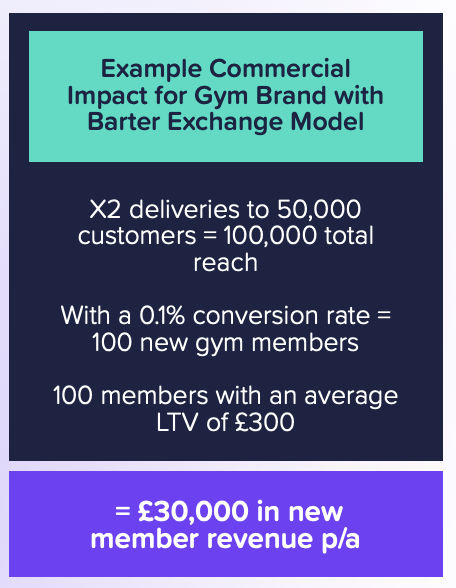
Expose each audience. The gym, with 100,000 members, gives the protein brand prominent placement in its online rewards programme. The protein brand, with 50,000 customers, adds two inserts for the gym in its ecommerce deliveries.
Bank the mutual value. Both brands reach a relevant, engaged audience with no ad spend, and no customer data changes hands.
Put rough numbers on that exchange and the acquisition case gets concrete:
That is £30,000 a year in new member revenue from a single insert swap, with no media budget behind it. And because the introduction comes from a brand the customer already rates, these leads arrive at the consideration stage by default.
Relevance, credibility and a bit of exclusivity do the qualifying work that paid ads have to buy.
This is not a fringe tactic either. In Propello Cloud’s Loyalty Uncovered 2025 report, investment in strategic brand partnerships averages 84% across sectors, from 88% in retail down to 79% in B2C SaaS.
When that many brands are backing partnerships this hard, the acquisition maths above is a big part of why.
Here is how to get more out of brand partnerships as an acquisition channel:
Find Mutual Demand First
The best partnerships are genuinely two-way: no conflict of interest, a clear gain for both sides, and an agreed model for how you collaborate. Get those three right before anything else.
The sharpest way to test a fit is to ask. Both partners survey their own customers with questions like:
Would you like to see offers from our partner brands?
Would you be interested in a discount code for [product] from our partner?
The first question shows whether there is any appetite for partner offers at all. The second names the segment already at the consideration stage for that specific partner, the people worth reaching first.
Announce the Partnership Publicly
A partnership only acquires customers if both audiences actually hear about it. Agree the communication guidelines before launch, then announce it properly across the channels that carry weight: content, email, social, wherever your audience actually pays attention.
Treat it as a shared story, not two logos bolted together in a press release. You are co-creating something relevant for both customer bases, so frame it that way.
Done well, the announcement runs both ways. You reach consideration-stage leads inside your partner’s audience, and they reach fresh prospects inside yours.
Communicate the Benefits
The benefit has to be obvious to the customer, or the offer does nothing. Lead your messaging with what they get, not the fact that two brands teamed up.
Customers win when a partnered promotion feels tailored and useful: rewards that offset the weekly shop, a discount on cover they already pay for, perks that fit the life they actually live. That relevance is the pull.
Emphasise the exclusivity and the tangible payoff, and you and your partner both stand out in your markets, lifting acquisition and conversion together.
Why Is Referral Marketing So Effective for Acquisition?
Referral marketing works because the recommendation comes from someone the prospect already trusts. A friend’s word carries weight no advert can buy, so referred leads arrive warm, convert at higher rates, and cost less to win than customers from paid channels.
Most happy customers will refer you if you make it easy, and a personal recommendation from friends or family is the most trusted source of all, ahead of any paid advert.
Give customers a way to be heard. Feedback surfaces the weak points in your product or service before they turn into reasons to leave, and it tells you exactly what to fix.
That matters most when you are relying on advocacy to acquire customers. People only refer an experience they rate, so the experience has to be worth their name on it.
2. Encourage Sharing
Make sharing effortless. Nothing kills a referral faster than friction, so the link should work in one tap, whether it lands in an email, a social post, or a QR code.
Referring you should be as easy as mentioning you. The less work it takes, the more it happens.
3. Personalise the Process
Tailor the content on both sides, for the advocate doing the referring and the prospect receiving it. Use your analytics to read preferences and where each person sits in the journey, then match the reward to the advocate, from a discount to a free product.
Epsilon found 80% of consumers are more likely to purchase from brands that offer personalised experiences.
What Makes Retail Media a Strong Acquisition Channel?
Retail media puts your brand in front of people at the exact moment they are shopping, on the retailer’s own site, where buying intent is already high. That timing is what makes it such a strong acquisition channel.
Networks like Amazon Ads, Walmart Connect and Tesco Media let you reach shoppers actively browsing for products like yours. Unlike a casual scroll on social, these are people already close to a decision, which makes them prime targets to acquire.
Advertisers know it. In McKinsey’s 2023 research, 73% said they planned to increase retail media spend over the following year, chasing consumers right at the point of purchase.
Here is how retail media does the acquisition work:
High-Intent Audience Targeting
Retail media lets you target people who are actively shopping for what you sell, not a broad audience who might one day care. That precision is the point: you reach buyers at the moment of intent, so acquisition spend works harder than it ever would on an awareness campaign.
Sponsored Product Placements and Ads
Sponsored listings, banner ads and search placements sit inside the retailer’s own store, right where people are browsing to buy. They put your product in front of the right shopper at the right moment, which is what turns a first-time visitor into a customer.
Data-Driven Targeting
Retail media runs on the retailer’s first-party data: real browsing and purchase behaviour from actual shoppers. That is a sharper signal than third-party tracking ever gave you, so you can find and reach likely new customers with far more accuracy, and waste far less budget on people who were never going to buy.
Co-Branded Acquisition Campaigns
Some networks let you run co-branded campaigns with the retailer itself, offering exclusive deals or trials. New customers meet your brand alongside one they already trust, which lends instant credibility and lowers the barrier to that first purchase.
Closed-Loop Attribution
Most retail media platforms offer closed-loop reporting, so you can see exactly how many sales a specific ad drove. That direct line from spend to purchase lets you optimise on real conversions rather than impressions or clicks, and prove which acquisition tactics actually pay.
Omnichannel Acquisition Opportunities
Retail media reaches past the website. In-store screens, shelf-edge ads and point-of-sale displays carry the same targeting into the aisle, so a shopper can meet your brand online and again in person.
The budgets show where this is heading. According to KPMG, UK retail media ad spend is expected to top £4.8 billion in 2026, up from around £4 billion in 2025, and retail media now takes a growing share of ad budgets, roughly 16% today against 11% in 2022. More brands are treating it as a core acquisition channel, not a side experiment.
How Do You Build an Acquisition Marketing Strategy?
You build an acquisition strategy systematically, not at random. Scattered campaigns waste money. A real strategy lines up your business goals with what your audience needs, then moves through a clear sequence you can measure and repeat.
7 Key Steps to Develop an Effective Acquisition Strategy
The most successful acquisition strategies follow a clear development process:
Audit your current performance. Before changing anything, measure your existing conversion rates, acquisition costs and channel performance. That baseline is how you prove improvement later.
Define your value proposition. Say plainly what makes your product uniquely worth buying, and tie it to the specific pain your audience feels.
Map the customer journey. Know every touch-point a prospect hits, from first discovery to post-purchase. The acquisition funnel covered earlier breaks these stages down in full.
Select the right channels. Not every channel suits every business or segment. Alongside the partnerships, referrals and retail media covered above, acquisition also runs on SEO and blogging, email marketing, paid ads, content, social media, influencer and affiliate marketing, video, and even direct mail. The job is matching the handful that fit your audience and model, not chasing all of them.
Create content that fits each stage. A prospect at discovery needs something different from one at conversion. Match the format to the moment.
Put measurement in place. Set up tracking for every key metric before you launch, not after, so you can see what is working while it matters.
Test, then refine. Start small, measure, optimise, and only scale what earns it.
Understanding Your Target Audience
The whole strategy rests on knowing who you are actually trying to reach:
Behavioural segmentation. Group prospects by what they do, not just who they are. How someone engages with your brand tells you more about their readiness to buy than their age or postcode.
Intent signals. Identify the specific behaviours that flag buying intent for your product. They differ wildly from one industry to the next.
Competitive analysis. Work out who your prospects buy from now, and why. The gap is your opening.
Voice-of-customer research. Interview existing customers about how they decided. What tipped them to you over the alternatives?
Get these foundations right and you have a system that attracts prospects and converts them efficiently, not just a run of campaigns. The best strategies keep evolving with the data, the market and new channels. And you only know what to evolve if you are measuring the right things.
How Do You Measure Acquisition Marketing Success?
You measure acquisition by tracking a few key metrics consistently, not by watching everything at once. Two matter most: what it costs to win a customer and what that customer is worth over time. In my experience with enterprise clients, this is where many fall down. They run plenty of channels but never pin down which ones actually acquire customers, so they give up and write acquisition off as too expensive.
Usually the fix was simple: track the right metrics, then use what you learn to steer the spend.
Customer Acquisition Cost (CAC)
CAC is what it costs, on average, to win a single new customer. It is the first number to track, because until you know what acquisition costs, you cannot tell which channels are worth the spend.
How Do You Calculate Customer Acquisition Costs?
Add up everything you spend to acquire customers in a period: advertising and paid media (pay-per-click (PPC), social, display), sales salaries and commissions, software and tools, and lead generation. Then divide by the number of customers you won in that period.
CAC = total sales and marketing spend ÷ number of new customers acquired
Customer Lifetime Value (CLV or LTV)
CLV is the total value a single customer generates across their whole relationship with you. Where CAC tells you the cost, CLV tells you the return, which is why the two only mean anything together.
Track it once you have acquired a segment, so you know the effort of winning them actually pays back. CLV is also the bridge into retention: it is how you judge whether customers are worth keeping.
How Do You Calculate Customer Lifetime Value?
Pick a period to measure, say the first year after acquisition. Then:
Average purchase value (APV) = total revenue ÷ number of purchases.
Purchase frequency (PF) = number of purchases ÷ number of customers.
Customer lifespan = the average time a customer keeps buying. If you don’t track it directly, estimate it as 1 ÷ churn rate, where churn rate = customers lost ÷ customers at the start of the period.
Simplified: CLV = customer value (APV × PF) × average customer lifespan.
What Is a Good CLV:CAC Ratio?
The real value comes from putting the two together. The widely used benchmark is a CLV:CAC ratio of at least 3:1: each customer should be worth roughly three times what it costs to acquire them. The rule of thumb comes from venture capitalist David Skok, who set it out on his ‘For Entrepreneurs‘ blog as the floor for a healthy recurring-revenue business.
Drop below 3:1 and acquisition is eating your margin; sit well above it and you may be under-investing in growth.
Launch Your Acquisition Marketing Strategy
Customer acquisition comes down to reaching the right people at the consideration stage, when they are already weighing you up. Combine referrals, brand partnerships and retail media, and you win qualified leads for a fraction of what paid channels cost.
Word-of-mouth and partnerships do double duty here: they tip prospects toward conversion and build credibility with audiences who have never met you, all while keeping acquisition costs down.
The real prize is not just more business. It is the right business, the customers who stay, spend and bring others in.
Pulling these channels into one programme is what platforms like Propello Cloud are built for. To see how that looks for your business, book a demo and we will walk you through it.
FAQs
What is the difference between acquisition marketing and performance marketing?
Acquisition marketing is the broad goal of winning new customers across any channel, from referrals to partnerships to paid ads. Performance marketing is one method within it: paid campaigns bought and optimised against measurable outcomes like cost per acquisition. All performance marketing is acquisition; not all acquisition is performance marketing.
How is acquisition marketing different from growth marketing?
Acquisition marketing focuses on bringing new customers in. Growth marketing is wider, covering the whole lifecycle, acquisition, activation, retention and referral, usually through constant experimentation. Think of acquisition as the front door, and growth marketing as the strategy for the entire house, front door included.
What is the difference between customer acquisition and lead generation?
Lead generation captures contact details from people who show interest, filling the top of your pipeline. Customer acquisition is the full journey that turns those leads into paying customers. Lead generation is a step inside acquisition, not a synonym for it: a lead only counts once it converts.
How long does it take to see results from acquisition marketing?
It depends on the channel. Paid ads and retail media can drive purchases within days. Referral programmes, partnerships and organic content compound more slowly, often over months, but tend to deliver lower costs and higher-value customers over time. Fast channels and slow channels work best together.
What counts as a good customer acquisition cost?
There is no universal figure. A healthy CAC is one your customer lifetime value comfortably outweighs by a good multiple. Judge it against what a customer is worth over their lifetime, not against a benchmark from another industry, since acceptable costs vary widely by sector and business model.
How can you reduce customer acquisition costs?
Lean on channels where existing customers and partners do the work: referrals and brand partnerships bring in warm, pre-qualified leads that convert more cheaply than cold paid traffic. Beyond that, tighten your targeting, improve conversion rates so fewer leads go to waste, and drop channels that do not pay back.
Is it cheaper to acquire new customers or retain existing ones?
Retaining customers is generally cheaper than acquiring new ones, since existing customers already trust you and need less convincing. But growth needs both. Neglect acquisition and you plateau; neglect retention and you leak the customers you paid to win. The aim is balance, not one over the other.
Does acquisition marketing work for B2B businesses?
Yes. The stage-based logic is the same, though B2B buying cycles are longer and involve more decision-makers. Referrals, strategic partnerships and account-focused content tend to outperform broad paid campaigns, because B2B buyers lean heavily on trusted recommendations and relevant proof before they commit.
How much of my marketing budget should go to customer acquisition?
There is no fixed split; it shifts with your stage. Early-stage businesses usually weight spend towards acquisition to build a base, while mature ones balance it with retention to protect what they have. Let your CLV:CAC ratio guide how hard you can afford to push acquisition.
How is AI changing customer acquisition?
AI is sharpening targeting and personalisation, helping brands spot high-intent prospects and tailor offers at scale. It also powers the first-party data models behind retail media. The fundamentals do not change, though: you still need the right offer, in front of the right person, at the consideration stage.
Mark Camp
Mark is the Founder and CEO of Propello Cloud, an innovative SaaS platform for loyalty and customer engagement. With over 20 years of marketing experience, he is passionate about helping brands boost retention and acquisition with scalable loyalty solutions.
Mark is an expert in loyalty and engagement strategy, having worked with major enterprise clients across industries to drive growth through rewards programmes. He leads Propello Cloud’s mission to deliver versatile platforms that help organisations attract, engage and retain customers.
Start your customised Propello Cloud journey today
Explore the platform’s scalability, features and customisation options and get answers to your unique questions.