To create a customer engagement strategy, map your customer journey, define the value you offer at each touchpoint, then deliver it consistently across every channel through loyalty, personalisation and reward. Doing this turns one-off buyers into loyal advocates who spend more, stay longer and bring others with them.
Mark Camp
CEO & Founder at PropelloCloud.com
Contents
Key Takeaways
A customer engagement strategy turns scattered, one-off interactions into relationships that last.
Engagement runs deeper than satisfaction because it tracks the whole relationship, not a single happy moment.
Engaged customers are worth more over their lifetime, buying more often and staying longer than the rest.
The groundwork comes first, from audience research and personas to a clear value proposition and a mapped customer journey.
Loyalty, referrals, gamification, content, community and personalisation are the tactics that move engagement when you pick the mix that fits your customers.
Consistency across every channel matters more than being present on all of them.
The brands that pull ahead treat engagement as a live system, refining it on evidence rather than instinct.
What Is a Customer Engagement Strategy?
A customer engagement strategy is your deliberate plan for turning scattered, one-off interactions into relationships that last. It defines the channels, content and rewards you use to keep customers close, and ties every one of them to a commercial goal rather than a vague hope that people stick around.
Customer engagement is the emotional connection a customer has with your brand. The strategy is what makes it happen on purpose instead of by accident.
Here is where most get it wrong. They treat engagement as a campaign, something you switch on for a quarter and measure in likes. It should be the layer running underneath every touchpoint you own.
I have worked with JD Sports Gyms and HelloFresh, and the winners all do one thing. They strip out the friction. App, website, shop floor: they meet customers where they already are and make every interaction effortless.
Brands like Netflix learn what you watch and quietly reshape themselves around you every time you log in. That is the baseline customers now measure you against.
A strong strategy maps four things:
The touchpoints where customers meet your brand, from first click to renewal
The value you deliver at each one, over and above the product itself
The channels and tools that carry it, loyalty, rewards and personalisation among them
The metrics that prove it is working, not just that it is happening
Put that in place, and your relationship with customers becomes a dialogue aligned with what they genuinely need. That is what turns repeat buyers into the advocates who bring others with them.
What Is the Difference Between Customer Engagement and Customer Satisfaction?
The difference is time. Satisfaction measures how a customer feels about one moment. Engagement measures the strength of the whole relationship, across every interaction they have with you.
Businesses can post glowing satisfaction scores and lose customers anyway. Here is why. Satisfaction is a snapshot. A customer can rate last week’s order five stars and still walk away the moment someone cheaper comes along.
Engagement is the thing that keeps them from leaving.
A satisfied customer likes what you sold them. An engaged customer is invested in you. They take part, they come back, they bring other people with them. That is not a better score. That is a better business.
The distinction plays out across the board:
Customer Satisfaction
Customer Engagement
Measures happiness at a single touchpoint
Tracks relationship strength over time
Focuses on individual transactions
Emphasises ongoing interactions
Reflects immediate experience
Builds long-term emotional connection
Captures surface-level feedback
Reveals deeper behavioural patterns
Shows current sentiment
Predicts future loyalty
Passive measurement
Active, two-way relationship
Product or service-centred
Customer-relationship centred
Short-term metric
Long-term strategic indicator
What Are the Benefits of a Customer Engagement Strategy?
A customer engagement strategy delivers higher customer lifetime value, lower acquisition costs, richer customer insight, and advocates who recommend you to other people. That is what an engaged customer base returns, and it is only where the upside starts.
Enhanced customer lifetime value
Engaged customers buy more often, and they stay longer. That adds to what each one is worth over the life of the relationship.
Gallup puts the gap in hard terms: across profitability, share of wallet, revenue and relationship growth, a fully engaged customer is 23% more valuable than an average one. A disengaged one is worth the equivalent of a 13% discount.
Natural brand advocacy
Connected customers do your marketing for you. They recommend you unprompted, to people who trust them far more than they trust any ad you could buy.
Stronger market position
In a crowded market, price is the easiest thing for a rival to copy and the relationship is the hardest. Engagement is the part of your offer competitors cannot simply undercut.
Improved business intelligence
Every interaction is data. Engaged customers give you more of it, and more honest versions of it, so you stop guessing what they want and start knowing.
New revenue opportunities
Revenue keeps going past the checkout. An engaged audience is one you can monetise again through reciprocal brand partnerships, turning your customer base into a revenue stream in its own right.
Reduced marketing costs
You already paid to win these customers once. Engaged ones buy again without you paying to win them twice, which quietly drops your cost per sale.
Future-proofed growth
Transactions vanish the moment a cheaper offer shows up. Relationships hold. Build on the second and your growth survives the next price war, the next downturn, and the next competitor.
What Are the Steps to Build a Customer Engagement Strategy?
Building a customer engagement strategy runs through ten steps: research your audience, build personas, define your value proposition, map the customer journey, audit partnerships, set measurable goals, align your team, choose your tools, establish ROI tracking, then monitor and adjust.
The groundwork you do here decides whether or not everything you execute later produces results.
Step #1: Conduct market research to understand your audience
Start with evidence, not assumptions. Gather quantitative and qualitative data, interview existing customers about their real motivations, and study how competitors engage so you can find the gaps they have left open.
Step #2: Develop detailed customer personas
Segment by behaviour, not demographics alone. Document each persona’s motivators, pain points and decision triggers, then shape a value proposition that speaks directly to each one.
Step #3: Define your value proposition
Be clear about why customers choose you over anyone else. Write your core value in customer terms, and pin down exactly how you deliver it at each stage of the journey.
Step #4: Map out the customer journey
Document every touchpoint, from first click to renewal. Find the moments where engagement drops off, and plan a specific intervention for each one rather than hoping it sorts itself out.
Step #5: Audit and explore partnership opportunities
Review your existing brand partnerships for relevance and performance. Then find partners whose value aligns with your audience, and structure deals that pay off for both sides.
Step #6: Set clear engagement goals
Vague ambitions drive nothing. Set specific targets, define what success looks like at 30, 60 and 90 days, and build dashboards that track leading and lagging indicators both.
Step #7: Create your internal alignment plan
A strategy no one owns goes nowhere. Brief every team on their role in delivering it, run regular check-ins to adjust course, and give people the tools and training to execute properly.
Step #8: Choose the right tools and technology
Pick platforms that fit your existing stack rather than fight it. Configure them to personalise at scale, and automate the routine without stripping out the human touch.
Step #9: Establish measurement and ROI tracking
Build tracking that captures engagement metrics and commercial outcomes side by side. Set reporting cycles that surface what to optimise, and alerts for any sharp shift in engagement.
Step #10: Monitor, measure, and adjust your strategy
Engagement is never set and forget. Review the numbers weekly, gather feedback from customers and team alike, and stay ready to pivot when the market or your customers move.
None of this runs in a straight line. You will move back and forth between these steps as you learn, and that is the point. Keep the momentum up, and keep every step pulling towards the same value proposition.
What Are the Best Tactics to Add to Your Customer Engagement Strategy?
The tactics that move customer engagement are loyalty programmes built on brand partnerships, referral systems, gamification, social media, genuinely useful content, AI and automation, community building, and personalisation at scale.
None work in isolation. The brands that win pick the mix that fits their customers and run it properly.
1) Reward-driven loyalty programmes built on brand partnerships
Rewards earn attention because almost everyone already plays the game. 79% of UK consumers belong to at least one loyalty programme, according to Mando-Connect and YouGov. The real question, then, is whether yours gives customers a reason to care.
Having helped enterprise brands launch reward programmes quickly, I can tell you the points and perks are the easy part. The engine is partner offers that add real value to the reward, and the market knows it.
Strategic partnerships rank among the top investment priorities for enterprise brands, with 84% putting them front and centre in Propello Cloud’s 2025 Loyalty Uncovered Report.
So look past the blunt discount. Offer exclusive experiences, early access, and partner benefits that genuinely fit your customers’ lives. Every partnership should strengthen your value proposition rather than dilute it.
Then obsess over delivery. Reward redemption and partner access have to feel effortless, because a clumsy claim kills the engagement the reward was built to create.
2) Referral systems that turn customers into advocates
Your happiest customers are your cheapest growth channel, if you make it easy for them to talk. Start with what actually drives a recommendation, which is rarely the cash. People refer because they trust you and want to look good doing it.
Build a tiered programme that recognises rising levels of advocacy, and put it where customers will see it, across every touchpoint. Clear messaging, a frictionless share and a little gamification turn a good intention into an actual referral.
Then watch which incentives bring in quality, not just volume. The pattern feeds itself: referred customers go on to make 31% to 57% more referrals than everyone else, which means every advocate you win is quietly recruiting the next one.
3) Gamification that rewards the right behaviour
Points and badges are the surface. Real gamification gives customers a reason to keep going, built around milestones that happen to be commercial wins for you. It has gone mainstream for a reason.
The ones getting value from it design clear games, offer a mix of formats, from stamp cards to timed challenges, and make every tier worth reaching with transparent, achievable criteria.
Match the mechanic to the job. Tiers for long-term loyalty, challenges for specific actions, timed games for urgency. Watch which ones move the behaviours you want, and lean into those.
4) Social media used for dialogue
Social works when you talk with people, not at them. Find the two or three platforms your customers actually use and go deep there rather than spreading thin across all of them.
Post things worth engaging with: insights, answers, real reasons to reply, not a feed of product shots. The brands that win here show expertise while still sounding like a human.
Listen as hard as you post. Social listening tells you what customers feel and where the openings are, and a genuine reply does more for engagement than any scheduled broadcast.
5) Content that earns attention and drives action
Content works when it solves something. Build resources around your customers’ real problems and ambitions, and the educational pieces will out-engage the promotional ones every time.
Map content to the journey, so there is something useful at each stage, from first awareness through to advocacy. Vary the format to suit how different people like to learn, and keep every piece pulling towards a clear purpose.
Track what actually gets read and acted on, then make more of that. And always give the reader an obvious next step.
6) AI and automation that scale without going cold
Technology should carry the load, not flatten the experience. Hand the repetitive work to automation so your team can spend its time where a human actually matters.
Use AI to personalise interactions, but build in the escape hatch. Set clear escalation paths so a complex query reaches a real person fast rather than looping a frustrated customer through a bot.
Mind the tone. Every automated message still speaks in your brand voice, and a mechanical one undoes the engagement you are chasing. Refine those workflows on customer feedback for the best results.
7) Community that turns customers into insiders
When customers connect with each other, engagement multiplies. Find the natural gathering point, a private group, a forum, a run of exclusive events, and give the community room to form there.
Facilitate rather than control. Let the best conversations happen on their own, and empower your most engaged customers to lead, recognising the ones who consistently add value for others.
Vibrant communities still need tending, so give someone the job of keeping discussions alive and useful. Done right, a customer base becomes something far more valuable: a place people belong.
8) Personalisation delivered at scale
Engagement has to feel personal to each customer, and that goes well beyond a first name in an email. It means understanding what someone actually needs and delivering it at the exact point in their journey where it lands.
Customers now treat this as table stakes. Salesforce found that 88% of customers rate the experience a company provides as highly as its products and services, the highest that figure has ever been. Meet that bar and personalisation stops feeling like marketing and starts feeling like service.
Use your customer data to build experiences that shift as behaviour shifts, always tied to your value proposition. Then build the feedback loop: keep what drives real engagement, drop what falls flat, and stay relevant.
How Can You Continuously Improve Your Customer Engagement Strategy?
You improve a customer engagement strategy by running it as a live system. Measure what ties to revenue, act on customer feedback fast, and keep the experience consistent across every channel. Finally, refine on evidence, not instinct, and never assume this quarter’s approach will fit the next.
Which engagement metrics should you actually track?
Track the numbers that tie to commercial outcomes, not the vanity metrics that look impressive and change nothing. Likes feel good. Retention pays the bills.
Build reporting cycles that surface what to fix, capture the hard numbers and the qualitative signal both, and keep the point in view: action, not a fuller dashboard. Data you never act on is just expensive reassurance.
How should you handle customer feedback?
Close the loop out loud. Act on the insight, then tell customers what changed because of them. That one move, visible responsiveness, does more for the relationship than another round of questions ever will.
Collecting feedback is the easy half. The brands that pull ahead reshape what they offer around what customers tell them, rather than filing the survey and moving on.
How do you keep engagement consistent across channels?
The fix is a shift in mindset. Customers care about the experience and barely notice the channel it arrives through. Whether someone reaches you through your app, your website or a shop floor, the value has to feel the same. Less about being everywhere, more about being consistent where it counts, with a message that holds together across every touchpoint your customers actually use.
This is the one most brands get wrong, and their own data says so: multi-channel consistency is among the challenges enterprise brands rank highest, with 77% naming it a struggle in our 2025 Loyalty Uncovered research.
What Are the Common Challenges in Customer Engagement and How to Overcome Them?
The most common customer engagement challenges are rising acquisition costs, inconsistent experiences across channels, low programme adoption, proving ROI, limited resources, siloed data, and weak internal alignment. Each has a practical fix, and none of them are edge cases.
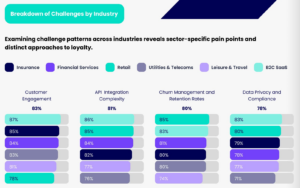
In Propello Cloud’s Loyalty Uncovered research (2025), customer engagement itself came out as the single biggest challenge enterprise brands face, named by 83% of them, ahead of API integration at 81% and churn at 80%.
Read that back: the thing this entire guide is about is also the thing most businesses find hardest.
Which is no reason to shy away from it. It is the reason the brands that crack it pull so far ahead. Here are the obstacles that come up most, and what actually moves them.
Challenge
Solution
Rising customer acquisition costs
Traditional acquisition channels keep getting more expensive.
Monetise the audience you already have through reciprocal brand partnerships. Build engagement programmes that turn your customer base into a revenue stream.
Inconsistent cross-channel engagement
Fragmented experiences across different touchpoints.
Connect your mobile, web and physical touchpoints into one unified approach, and keep your value proposition consistent whatever the channel.
Low programme adoption
Customers aren’t actively participating in engagement initiatives.
Design your engagement strategy around intrinsic customer needs rather than just extrinsic rewards. Make participation effortless and immediately valuable.
Measurement complexity
Struggling to prove ROI from engagement initiatives.
Set clear commercial objectives from the start. Track engagement metrics and business outcomes side by side to show tangible value.
Resource constraints
Limited team capacity to manage engagement programmes.
Lean on no-code tools, such as CRM or a loyalty platform, that let a small team launch and manage initiatives. Automate the routine, keep the personal touches.
Data silos
Customer information scattered across different systems.
Use platforms that integrate cleanly with your existing stack, and build a single view of engagement across every touchpoint.
Weak team alignment
Engagement delivered inconsistently across departments.
Give teams a clear framework for their role in engagement, and build processes that reward open communication and shared problem-solving.
What Is the Future of Customer Engagement?
The future of customer engagement is hyper-relevant, built on mutually beneficial brand partnerships and the right blend of AI and human touch. Standalone rewards schemes are giving way to interconnected value propositions that benefit customer, brand and partner alike.
Three forces are shaping what comes next:
Relevant partnerships widen what you can offer without building it all yourself, turning your customer base into a source of ongoing value.
AI with a human hand on it. Personalising at scale is table stakes now; AI that feels mechanical is a liability. The question is whether the technology serves the relationship or replaces it.
Adaptability. The brands that thrive will move fast, monetise their audience through smart partnerships, and keep delivering real value at every stage of the journey.
Through all of it, authenticity is the whole game. Build programmes that deliver tangible benefits and mean it, and the engagement follows.
Build a Customer Engagement Strategy That Lasts
Propello Cloud helps enterprise brands build engagement on partnerships, personalisation and rewards that customers actually care about, without the resource drain of building it all in-house.
Whether you are sharpening your value proposition or starting from scratch, the opportunity is the same: deeper relationships, and the growth that follows.
Book a demo and let’s talk about what that looks like for your business.
FAQs
How long does it take to see results from a customer engagement strategy?
Early signals often appear within the first few months: higher repeat visits, better email response, more programme sign-ups. The deeper outcomes, retention, lifetime value and genuine advocacy, usually take closer to a year, because they rely on trust and habit forming over many interactions rather than one campaign.
What is the difference between customer engagement and customer experience?
Customer experience is the sum of every impression a customer forms across all their interactions with you. Engagement is narrower and more active: how willingly customers interact, participate and return. Experience sets the conditions; engagement is the behaviour those conditions produce. You need a strong experience before engagement follows.
What is the difference between customer engagement and customer loyalty?
Engagement is the ongoing interaction and emotional connection a customer has with your brand. Loyalty is the result: the decision to keep choosing you over the alternatives. Engagement is the cause, loyalty the effect. A customer rarely stays loyal without being engaged first, so engagement sits upstream of retention.
What are the main types of customer engagement?
Engagement usually falls into three types. Behavioural engagement is what customers do, such as logins, purchases and visits. Emotional engagement is how they feel about your brand and whether they believe in it. Social engagement is how they act around you, through communities, referrals and reviews. Strong strategies address all three.
How does B2B customer engagement differ from B2C?
B2B engagement involves several stakeholders, longer buying cycles and decisions made by committee, so relationships are built account by account over time. B2C engagement is faster, more emotional and aimed at individuals at scale. The principles are shared, but B2B leans harder on value, service and long-term partnership.
Who should own the customer engagement strategy within a business?
Engagement works best as a shared responsibility rather than one team’s job. Marketing often leads the strategy, but service, product, sales and data teams all shape what customers actually receive. Many businesses appoint a single owner, such as a head of customer or CRM lead, to keep efforts joined up.
How often should you review and update your customer engagement strategy?
Review the headline metrics monthly and the strategy itself each quarter, so you act on what the data shows without constant churn. Build in a deeper annual review to check it still fits your market, your customers and your commercial goals. Engagement shifts with behaviour, so a fixed-and-forget plan dates quickly.
How do you re-engage inactive or lapsed customers?
Start by segmenting lapsed customers by how recently and how often they used to engage, then tailor the approach to each group. Win-back messages work best when they lead with genuine value, a relevant reward or a reminder of what they are missing, rather than a generic discount. Make returning effortless.
What role do employees play in customer engagement?
Employees shape engagement at almost every touchpoint, from service conversations to the tone of your messaging. Teams who understand the strategy and feel invested in it deliver more consistent, genuine interactions, and customers notice. Engaged employees tend to create engaged customers, so internal buy-in and training are foundations, not afterthoughts.
Why do customer engagement strategies fail?
Most fail for predictable reasons: chasing vanity metrics instead of commercial outcomes, treating engagement as a one-off campaign, or bolting on rewards with no real reason for customers to care. Fragmented channels and weak internal alignment quietly undermine the rest. The fix is a consistent, customer-led approach tied to business goals.
Mark Camp
Mark is the Founder and CEO of Propello Cloud, an innovative SaaS platform for loyalty and customer engagement. With over 20 years of marketing experience, he is passionate about helping brands boost retention and acquisition with scalable loyalty solutions.
Mark is an expert in loyalty and engagement strategy, having worked with major enterprise clients across industries to drive growth through rewards programmes. He leads Propello Cloud’s mission to deliver versatile platforms that help organisations attract, engage and retain customers.
Start your customised Propello Cloud journey today
Explore the platform’s scalability, features and customisation options and get answers to your unique questions.