Why Insurance Customer Experience Is The Competitive Advantage Hiding in Plain Sight
25 min to read
Published: April 8, 2025
Updated: August 12, 2026
Insurance customer experience is every interaction a policyholder has with you, from first quote to final claim. In a sector where people rarely make contact, those few moments decide who renews and who walks. Get them right and CX stops being a cost line. It becomes the clearest competitive advantage you have.
Mark Camp
CEO & Founder at PropelloCloud.com
Contents
Key Takeaways
Experience is the differentiator, not the product. Insurance is commoditised. How you deliver cover now matters more than the cover itself, and the insurers pulling ahead know it.
The few moments you get have to count. Contact is rare, so each touchpoint is heavy. Customers with a poor claims experience tend to switch providers.
Personalisation and self-service are the baseline. Customers expect journeys built around them and the tools to manage cover any device, any time. Anything less reads as dated.
Consistency is the foundation, not a feature. Omnichannel means one joined-up experience where data follows the customer and nobody repeats themselves. Break it and every other effort shows the seam.
Empathy is the advantage efficiency can't buy. Insurance shows up in stressful moments, and how you show up gets remembered. Pair digital speed with human warmth and customers trust you.
Insurance sells a promise you hope you never have to use. That is a hard thing to build an experience around, which is why many insurers don’t try. And yet the insurance customer experience is exactly where the relationship is won or lost.
Get it right, and the payoff is not subtle. Longer retention. Stronger referrals. Higher NPS. More room to cross-sell to people who actually want to hear from you.
So we will show you how to build an experience that keeps customers pressing renew year after year. Because the next best quote is always one tab away, and slow, clunky journeys are how you hand customers to it.
Automation plays its part, of course. But personalisation is what leads.
How Is the Insurance Customer Journey Evolving?
The insurance customer journey is shifting from occasional, transactional contact to always-on, self-service and personalised across every channel. Customers want digital tools, real-time updates and journeys built around them. Some insurers are keeping pace. Too many are not, and the gap shows up exactly where it hurts, in loyalty, growth and trust.
Close it, and the journey starts to feel smooth, convenient and shaped around how customers actually want to deal with you.
Is Digital Transformation the New Standard for Insurance Customer Experience?
Technology has raised the bar at every touchpoint. Getting a quote, tracking a claim, reaching support without ten minutes on hold – customers now expect all of it to be fast, frictionless and fully digital. And more than any single feature, they expect it to feel built for them.
That makes personalisation the baseline, not the bonus.
The insurers pulling ahead are not the ones with the flashiest app. They are the ones building smarter journeys on automation, rich customer data and a real grasp of what their audience values.
How Is Omnichannel Shaping Experiences in Insurance?
In-branch-only and phone-only servicing is finished. Insurance is an omnichannel product now, and customers expect the experience to hold together whether they are on a laptop, in an app or talking to an agent.
Here is the useful nuance. An Insured.io survey found 81% of policyholders prefer online portals or apps for routine tasks, but that preference slides as the task gets harder, down to roughly half for submitting a claim.
So the demand is not simply digital. It is digital for the easy things, a human for the hard ones, and no dropped context when customers move between the two.
Most legacy systems were never built to do that. The insurers that wire their channels and customer data together turn that gap into an advantage. They deliver the kind of joined-up journey where trust is built and lifetime value grows.
Which Insurance Touchpoints Build Customer Loyalty?
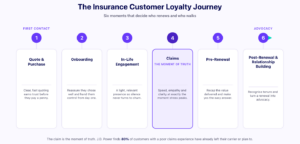
Every touchpoint in the insurance journey can build loyalty or quietly erode it, but a few carry far more weight than the rest: the quote, onboarding, in-life contact, the claim, and renewal. That is because insurance is not a high-frequency product.
Most customers deal with their provider a handful of times a year, sometimes less, so the moments that do happen have to count. Get one wrong and the damage is rarely contained.
J.D. Power found 80% of insurance customers who suffer a poor claims experience have left their carrier or plan to.
The whole relationship can turn on a single interaction. Handle those few moments well, and each one becomes a reason to stay.
Here is how each stage earns its keep.
1. Quote & Purchase
The quote sets the tone for everything after it. Make it confusing or pushy and the relationship starts on the back foot. Customers want speed, plain language and a value they can grasp in seconds. A clean quoting flow with relevant suggestions earns trust before they have paid a penny, and progress trackers or switch incentives cut the drop-off.
2. Onboarding
Onboarding is where expectations get met or missed. It is your chance to reassure customers they chose well. Welcome emails, app setup prompts and clear explainer content reduce friction fast, while self-service tools and policy-based personalisation hand them control from day one. A small onboarding reward helps, but the real win is quieter: less anxiety, more early confidence.
3. In-Life Engagement
This is often where the experience goes quiet, and silence breeds doubt. Doubt breeds churn. A light, relevant presence between the big moments keeps you front of mind and makes customers feel supported, not sold to.
Share updates on value-added services, or give them visibility into their own progress, like a safe-driving score or a wellness streak. A quiet stretch handled well becomes a reason to stay.
4. Claims Experience (The Moment of Truth)
This is where a policyholder becomes loyal or walks. A claim is not a process, it is an emotional moment, and customers judge you on how you handle it. They want speed, empathy and clarity.
Real-time updates, honest expectations and solid self-service take the friction out of a stressful moment. And a thoughtful follow-up or recovery reward does more than close the claim. It changes how they see you.
5. Pre-Renewal
Renewal is when customers quietly ask whether it was worth it. Your job is to make the answer an easy yes.
Recap the value they actually got, not just the cover but the experience around it. Personalised prompts and a well-judged incentive reinforce that and take the friction out of the decision.
Done well, renewal stops feeling like a transaction and starts feeling like a re-commitment.
6. Post-Renewal & Relationship Building
Most insurers go quiet the moment a policy renews. That is the mistake. Acknowledge tenure, mark the milestones and keep the relevant experiences coming, and a renewal becomes the start of something longer.
Customers who feel seen after renewing are the ones who engage, refer and advocate. In a category built on trust, that advocacy is the strongest outcome you can earn.
How Do You Build a Customer-Centric Insurance Experience?
A customer-centric insurance experience rests on four things done consistently: personalisation, self-service, transparency and omnichannel consistency. The touchpoints matter, but they only work when the foundation underneath them is right.
Get that foundation wrong and every interaction feels slightly off, no matter how polished the individual moment. Get it right and the same touchpoints reduce friction, deepen trust, and turn routine admin into real brand equity.
Here is what each principle demands.
1. Personalisation: From Policies to People
Personalisation is what stops insurance feeling faceless. The lever is behavioural data, used to shape the journey from first quote to post-renewal so the customer feels known rather than processed.
In practice that means different onboarding flows for different policy types, add-ons suggested from past behaviour, or timely content pitched to someone’s life stage and risk profile. None of it is complex. It just requires acting on data you already hold.
2. Self-Service: Power in the Customer’s Hands
Customers now expect to run their insurance the way they run their banking: any device, any time, no queue. Digitised claims, policy changes that take a few taps, and a first notice of loss (FNOL) a customer can file from their phone the moment something goes wrong are now non-negotiable, and the whole game is clarity and ease.
Done well, self-service lifts pressure off your contact centres while handing policyholders real control. And when a case gets genuinely complicated, the option to escalate straight to a live visual claims session keeps it seamless at exactly the moment stress peaks.
3. Transparency: The Trust Multiplier
Trust in insurance is not won with grand gestures. It is won with communication that stays clear and consistent. Policy documents in plain English. Claims decisions explained without the fog. Pricing that actually makes sense.
When customers feel informed and in control, their willingness to stay grows with their confidence. The other half of transparency is proactivity: setting expectations early, sharing updates before you are asked, owning mistakes when they happen. That is what builds the sense of reliability that keeps people renewing for years.
4. Omnichannel Consistency: Seamlessness Without the Silos
Customers do not think in channels. They think in problems they want solved, and they expect the thread to hold, however they got there and whoever they reach.
This is the foundation the other three principles sit on, not a feature you bolt on at the end. When it holds, personalisation and self-service feel effortless. When it breaks, the customer feels every seam, no matter how good the rest is.
How Do Rewards Improve the Insurance Customer Experience?
Used well, rewards turn thin, infrequent contact into moments that build emotional connection and cut churn. That matters more in insurance than almost anywhere, precisely because the contact is so limited.
A reward is rarely about the payout. It is about giving customers a reason to engage when nothing is wrong, and recognition when something goes right.
There are four ways that this plays out.
Rewarding Responsible Behaviour
Customers want recognition for doing the right thing. Reward the behaviours that matter, safe driving, sensible home upkeep, healthy-lifestyle milestones, and you reinforce good habits while deepening emotional loyalty. Skip the one-off discount.
Tier progression and unlockable perks give customers something to work towards, and they turn good behaviour into a shared win: lower risk for you, real value for them.
Engaging Customers Between the Big Moments
The long quiet stretches between claims and renewals are where loyalty leaks away. Rewards give you a reason to show up in them. Game mechanics do part of the job: progress bars, challenges and limited-time bonuses turn passive policyholders into active ones, keeping you present even when no claim is in sight.
Relationship gestures do the rest: a wellness check-in, a “thanks for being with us” note, a small surprise when nothing is wrong. Both say the same thing. You are here before they need you.
Hyper-Relevant Rewards from Aligned Brand Partners
Generic rewards do nothing. Relevant ones change the relationship. Partner with brands that already fit your policyholders’ lives. Fitness apps for health cover, smart-home kit for home insurance, and EV charging for motors.
Relevance makes the reward feel curated rather than pulled from a catalogue. The value comes from the partnership, so you add everyday relevance without inflating what you spend to deliver it.
Referral Programmes That Benefit Both Existing and New Customers
A referral is a customer vouching for you, and nobody vouches for an experience that let them down. So the groundwork for referrals is everything above: get the experience right and customers share it.
The programme itself should reward both sides. Dual-sided bonuses, welcome perks for the new customer, and tier unlocks for the referrer. All of it beats leaning on cash alone.
Proof It Works in Practice
This isn’t theory. Hagerty, the classic-car insurance specialist, partnered with Propello Cloud to launch a white-label membership programme for its HDC UK community without straining internal resources. As Managing Director Mark Roper put it, the collaboration “aligned perfectly with our goals.”
How Do You Measure Insurance Customer Experience Success?
You measure it with the handful of metrics that actually link to loyalty, then you build a feedback loop that connects what customers feel to what the business earns. Metrics alone fix nothing. The right ones, tracked consistently, show you where the journey is working, where friction hides, and how perception shifts over time.
The trick is to look past transactional numbers and start tying sentiment to outcomes.
Which Insurance Customer Experience Metrics Should You Track?
Three indicators tell you most of what you need. Net promoter score (NPS) measures advocacy, how likely customers are to recommend you. Customer satisfaction score (CSAT) is the pulse check after a specific moment like a claim or onboarding. Retention rate is the long view, whether policyholders actually choose to stay. Track them together and the picture sharpens: which stages create value, and which quietly push people out.
How Can Data Improve the Customer Experience?
Customer data improves the experience when you read behaviour against feedback and act on the gap. Every interaction leaves a signal: claims activity, app usage, policy upgrades, reward redemptions, all already sitting in your systems.
If claimants who self-serve report higher satisfaction, invest there. If customers drop off midway through onboarding, that is where the welcome journey is leaking.
Why Balance Quantitative and Qualitative Feedback?
Numbers tell you what happened. Comments tell you why. Scores alone will steer you wrong, so mine the qualitative sources most insurers underuse: survey verbatims, NPS comments, contact-centre transcripts, social reviews.
They surface the emotional triggers and friction points a metric flattens out. Better still, they hand you the customer’s own language, which is exactly what you want shaping your next round of messaging.
Do Insurers Need a CX Dashboard?
Yes, because teams cannot improve what they cannot see. A simple dashboard that tracks the key metrics by journey stage keeps every department looking at the same picture. Put CX numbers next to operational and financial ones and the business impact stops being abstract.
Link journey data to retention, renewal and upsell, and suddenly the case for experience-led investment makes itself, with accountability that runs across functions rather than stopping at one team’s door.
Which Technologies Improve Insurance Customer Experience?
Four capabilities carry the weight: a platform to run the journeys on, AI to personalise them, analytics to read them, and integration to hold them together. What matters is that they support real-time personalisation, cross-channel consistency and data-driven decisions at every step.
Technology is no longer a back-office function. It is the frontline of the experience, and the stack you build decides whether the journey feels modern and seamless or dated and frustrating.
What Do Digital Experience Platforms and Rewards Add?
A unified digital experience platform is the foundation any scalable CX strategy sits on. It should let you build intuitive journeys across quote, claims, onboarding and renewal, then plug into tools like loyalty programmes to add the emotional layer a policy alone never will.
Integrated properly, rewards turn transactional touchpoints into relationship-building ones, giving customers a reason to return, engage and advocate long after the sale.
How Do AI and Automation Personalise Insurance CX?
AI makes fast, relevant, personal feel possible at scale. From automated claims updates to product recommendations shaped by real-time behaviour, it lets you guide customers proactively, flag issues before they escalate, and send communications that feel one-to-one without anyone writing a thousand individual emails.
That is the double win: the experience feels more personal to the customer while the manual load on your team drops, freeing them for the high-stakes, human moments where a person genuinely matters.
Why Do Analytics Tools Matter for CX?
Every great experience rests on understanding what customers actually want, and analytics is how you see it. Track engagement across touchpoints, compare performance by segment and channel, and find the exact points where people drop out of the funnel.
Then read for patterns. What do your renewers have in common? What behaviour predicts churn? Answer those and you design better experiences faster.
What Makes a Connected Insurance Customer Experience?
Customers do not care how your systems work. They care that they do, and that they work together. Wire your CX platform, CRM, policy systems and reward engines into one flow and the data follows the customer everywhere they go. No repeating themselves. No contradictory messaging. No team working half-blind. Connected systems are what connected experiences are built on.
What Is the Future of Insurance Customer Experience?
The future of insurance customer experience is more human, more intuitive and more emotionally intelligent, not because it sounds nice, but because the alternative is a slow bleed. Acquisition-heavy models are hitting diminishing returns. Accenture estimates up to $170 billion in global premiums are at risk by 2027 from poor claims experiences alone.
Customers who get seamless, attentive experiences everywhere else will not accept friction, opacity and generic journeys from their insurer. The insurers who thrive from here will anticipate needs, personalise at scale, and treat experience as the product rather than the wrapper.
Here is what that future looks like.
Which Trends Are Reshaping Insurance CX?
Three shifts are rewriting the rules. First, embedded insurance is folding cover into everyday moments, bought at checkout or switched on inside a travel or retail app, so the product meets customers where they already are.
Second, omnichannel engagement is replacing static campaigns, because the micro-moments that build loyalty, a timely nudge, a well-judged push, a reward that actually lands, only work when they follow the customer across channels.
Third, experience has stopped being an afterthought and become the differentiator. The insurers who grasp that will pull ahead. The ones who don’t will watch it show up in their NPS.
How Does Predictive Analytics Anticipate Customer Needs?
Predictive analytics turns customer data into early warning. Read the behavioural signals and you can flag churn risk before it hardens, spot a likely claim before it lands, and time an offer to a life change as it happens.
A cross-sell when behaviour signals a house move. A retention nudge the moment someone starts comparing quotes. Each one tells the customer you are paying attention, and quietly closes the door competitors are trying to open.
That is the shift: from reacting once something has gone wrong to acting while you can still shape the outcome.
What Should Insurers Do to Meet Rising Customer Expectations?
You do not need to reinvent your products. You need to reinvent how you deliver them. Make self-service genuinely simple. Make digital transformation invisible, so customers feel the result and never the machinery. Let personalisation show up in tone, timing and relevance rather than a name dropped into an email.
Above all, keep it consistent: if omnichannel value only appears at renewal or during a claim, it is not a strategy, it is a gesture. Insurance customers do not want more communication. They want smarter communication, tailored, transparent and respectful of their time.
Why Are Insurance Relationships Becoming More Emotion-Driven?
Because efficiency alone does not earn loyalty. Most insurers optimise for speed and stop there. The ones that pull ahead add empathy on top, and it matters most in the moments that carry real weight, a claim, an accident, a loss.
You are going to show up at those moments regardless. How you show up is what gets remembered. Automation earns its place, but so does human warmth, and the brands that blend the two are the ones customers trust.
The subtler move is to bring that warmth when nothing is wrong, not only when it is. Reinforcing your value on a good day, not just rescuing it on a bad one, is what turns a policyholder into an advocate.
Great Insurance Customer Experience Isn’t Optional. It’s Inevitable.
Insurance customer experience is no longer a secondary concern you get to the once the core product is sorted. Prioritise it and it becomes your edge, your differentiator, the clearest signal that you actually understand today’s customers. Neglect it and you are the one playing catch-up.
The insurers setting the pace are not bolting experience onto old foundations. They are rebuilding from the ground up: personalised, emotionally intelligent, consistent across every channel, friction stripped out and relevance put in its place.
So the question was never whether you will prioritise insurance customer experience. It is how fast, and with how much intention, you will make it the advantage it is already becoming for someone else.
If you want a hand working out where to start, contact our team and we will talk it through.
FAQs
What is Insurance Customer Experience (CX)?
Insurance customer experience (CX) is how a policyholder perceives every interaction with their provider, from the first quote to a claim years later. It spans every touchpoint, whether that is a self-service portal, a mobile app or a conversation with an agent. Because insurance contact is infrequent, each of those moments carries unusual weight.
Why is personalisation so important in insurance CX?
Personalisation matters because it turns a faceless, transactional product into one that feels built around the individual. By tailoring communication, offers and services to real customer data, insurers show they understand individual needs, which deepens trust and lifts retention.
How does omnichannel strategy enhance insurance customer experience?
An omnichannel strategy keeps the experience consistent whether a customer is online, on mobile or speaking to an agent. Instead of disjointed handoffs, they get one continuous journey where nothing has to be repeated and no context is lost. That consistency is what reduces friction and improves satisfaction.
What role does automation play in improving CX for insurers?
Automation streamlines the processes customers find slowest, like onboarding and claims management, so interactions become fast, relevant and real-time. Done well, it delivers responses that still feel personal while cutting the manual load on your team, freeing them for the moments that genuinely need a human.
How can insurers use customer data to improve experience?
Customer data reveals behaviour trends, segment preferences and the exact points where journeys break down. Insurers can use those insights to personalise communication, time it well, and even anticipate needs before customers raise them, shifting CX from reactive to proactive.
What are the benefits of offering self-service tools to policyholders?
Self-service tools let policyholders manage cover, file claims and find information on their own terms, any device, any time. That independence raises satisfaction, takes pressure off contact centres, and matches what customers now expect as standard rather than a bonus.
How does transparency affect customer loyalty in insurance?
Transparency builds trust, and trust is what keeps customers loyal. Clear policy terms, honest pricing and proactive claims updates make customers feel informed and in control. Those who do are far more likely to renew and to recommend you to others.
Why is emotional intelligence critical to insurance customer experience?
Insurance often shows up in stressful, high-stakes moments, a claim, an accident, a loss. Insurers that meet those moments with genuine empathy, not just efficiency, build the kind of bond that survives the occasional problem. That is what reduces churn and turns satisfied policyholders into advocates.
What’s the impact of CX on Net Promoter Score (NPS) in insurance?
A strong insurance customer experience lifts NPS directly, because satisfied, loyal customers are the ones most likely to recommend you. The reverse is just as true: because insurance contact is so infrequent, a single poor touchpoint can pull a score down sharply.
How can insurance companies improve digital experiences for their customers?
Insurers improve digital experience by modernising the platforms underneath it, integrating systems so data flows freely, and offering real-time support across channels. The priorities that move the needle most are an intuitive interface, proper mobile access, and omnichannel journeys that stay consistent wherever the customer lands.
Mark Camp
Mark is the Founder and CEO of Propello Cloud, an innovative SaaS platform for loyalty and customer engagement. With over 20 years of marketing experience, he is passionate about helping brands boost retention and acquisition with scalable loyalty solutions.
Mark is an expert in loyalty and engagement strategy, having worked with major enterprise clients across industries to drive growth through rewards programmes. He leads Propello Cloud’s mission to deliver versatile platforms that help organisations attract, engage and retain customers.
Start your customised Propello Cloud journey today
Explore the platform’s scalability, features and customisation options and get answers to your unique questions.