The Ultimate Guide to Maximising Loyalty Programme ROI
27 min to read
Published: November 21, 2024
Updated: September 7, 2026
Most enterprises can tell you their loyalty programme is working. Far fewer can prove it. I’ve spent years helping brands across sectors measure loyalty programme ROI, and one pattern holds: the programmes that last are the ones whose owners can put a hard number on the customer lifetime value they create.
Mark Camp
CEO & Founder at PropelloCloud.com
Contents
Key Takeaways
ROI, net profit against total programme cost, is the clearest proof of whether a loyalty programme pays.
The biggest returns come from personalisation, emotional connection, well-tuned reward structures and operational efficiency.
The metrics that matter most are customer lifetime value, redemption rate, churn, customer acquisition cost and purchase frequency.
Data only pays when you act on it: segment members, analyse behaviour, then model what they'll do next.
For most brands, outsourcing a programme is cheaper and faster to launch than building in-house.
Future-proofing depends on the technology underneath: API-first architecture, cloud, machine learning and mobile-first rewards.
Loyalty programme ROI is what your programme returns for every pound it costs to run: net profit minus total cost, divided by total cost. You maximise it on two fronts. Lift the revenue side through retention, higher spend and customer lifetime value, and hold down the cost side through efficient rewards, smart partnerships and the right technology.
This guide walks through the lot: how to calculate programme effectiveness, control implementation costs, and turn customer data into decisions that boost returns rather than just describe them.
Why Measure Loyalty Programme ROI?
You measure loyalty programme ROI because it’s the number that settles whether a programme is working. I’ve spent years helping enterprise clients measure and maximise it, looking at the ratio between net profit and total programme expenditure across three key areas:
Initial implementation costs for setup and launch
Ongoing management expenses
Optimisation investments for continuous improvement
From my experience working with subscription-based businesses and ecommerce brands, ROI quantifies your programme’s financial efficiency in real terms. It shows exactly what return you’re getting for every pound invested.
I’ve seen time and again that healthy returns directly correlate with well-designed programmes that truly enhance your value proposition. When returns start diminishing, it’s a clear signal that your programme needs optimisation.
Here’s what I find hugely valuable: ROI isn’t just about measuring success. It’s about understanding how your loyalty initiatives drive customer lifetime value and incremental revenue.
Working with brands like HelloFresh and JD Gyms, I’ve seen effective ROI tracking turn customer engagement into commercial outcomes you can bank.
How Do You Calculate Loyalty Programme ROI?
The foundational formula is straightforward: loyalty programme ROI = (Net profit − Total cost) / Total cost. But there’s no one-size-fits-all approach to applying it. Every business needs its own methodology, built around its own commercial objectives.
Your calculation methods need to evolve as your programme grows. Take referral programmes; we’ve seen cases where integrating these into existing loyalty initiatives required new measurement approaches to capture the full impact on customer acquisition costs and membership growth.
The basic formula gives you a starting point. But it’s the combination of loyalty metrics, from purchase frequency to repeat purchase rates, that tells the complete story of your programme’s effectiveness.
How Do Loyalty Programmes Generate Revenue?
Loyalty programmes generate revenue directly and indirectly. Based on our work with enterprise clients, we see direct impact through increased purchase frequency, contract renewals, cross-selling and up-selling. Programme members consistently demonstrate higher average order values, while rewards incentivise repeat transactions.
But the financial impact extends beyond transactions. Engaged members become powerful brand advocates, reducing customer acquisition costs through referrals and word-of-mouth growth.
When we analyse programme ROI with clients, we look at both immediate revenue lift and long-term value creation through enhanced customer loyalty.
Direct Revenue Streams and Opportunities of Loyalty Programmes
These are the streams you can trace straight to the transaction line. Each maps to a member behaviour the programme rewards, from a repeat visit to a bigger basket, and each shows up in data you can track from launch.
1. Increased Purchase Frequency
Loyalty programmes incentivise customers to shop more often by rewarding repeat visits and purchases. Whether through earning points, redeeming rewards, or maintaining tier status, these mechanisms create consistent revenue streams from returning customers.
2. Higher Average Order Value (AOV)
Offers tied to loyalty programmes, such as discounts for reaching a spending threshold or double points for specific purchases, encourage customers to spend more per transaction. This drives up the value of each sale and enhances overall profitability.
3. Premium Programmes
Subscription-based or premium loyalty programmes generate upfront revenue through paid memberships. These often include exclusive benefits like free shipping or member-only discounts, which entice customers to shop more frequently and maximise their membership’s value.
4. Increased Revenue From Tier Progression
Tiered loyalty programmes encourage higher spending by offering escalating benefits for achieving higher tiers. Customers are motivated to increase their purchases to unlock exclusive rewards, such as premium discounts, VIP experiences, or additional perks, directly boosting revenue as they climb the tier ladder.
5. Data-Driven Up-Selling and Cross-Selling
Customer data collected through loyalty programmes enables personalised recommendations, leading to increased revenue from up-selling premium products and cross-selling complementary items. Tailored offers ensure higher conversion rates and greater spend per customer.
6. Reduced Price Sensitivity
Loyalty members are less likely to seek discounts elsewhere as they focus on earning rewards or maintaining their tier status. This decreases reliance on promotions and enhances profit margins, as members perceive greater value from the programme itself.
7. Customer Retention and Lifetime Value
Customer retention drives sustainable revenue growth through long-term engagement. Our enterprise clients consistently demonstrate how retention-focused loyalty programmes transform one-time buyers into brand advocates.
Through analysing member behaviour patterns, we see how reward engagement influences repeat purchase decisions. This shift from acquisition to retention fundamentally changes the revenue dynamics. Each retention point directly impacts your bottom line through increased customer lifetime value.
The numbers back this up. Bain’s Fred Reichheld found a 5% lift in retention can raise profits by 25% to 95%, depending on the sector.
By optimising reward structures around retention, we help clients build sustainable revenue streams through an engaged, high-value member base.
Indirect Revenue Streams and Benefits of Loyalty Programmes
Indirect streams don’t show up as a line item, which is exactly why they get overlooked. They reshape the economics all the same, lowering what you spend to acquire and retain, and turning the data a programme collects into sharper commercial decisions.
1. Brand Advocacy and Referrals
Strong loyalty programmes transform regular customers into passionate brand advocates. When members consistently experience value through relevant rewards, they naturally promote your brand through referrals.
Bond found 79% of consumers are more likely to recommend a brand with a strong loyalty programme. But success requires more than transactions. Our most effective client programmes focus on emotional engagement through hyper-relevant rewards and reciprocal partnerships.
This amplified advocacy reduces acquisition costs while building a sustainable growth engine through member referrals.
2. Brand Affinity and Emotional Loyalty
Offering meaningful rewards or exclusive experiences, loyalty programmes strengthen emotional bonds between customers and your brand. This deeper connection drives long-term engagement and increased spending.
3. Enhanced Customer Insights
Loyalty programmes collect valuable data on customer preferences, behaviours, and spending patterns. These insights inform marketing and product strategies, leading to optimised campaigns and higher ROI.
4. Competitive Differentiation
In saturated markets, a robust loyalty programme provides a unique value proposition that discourages customers from switching to competitors, thereby reducing churn and protecting market share.
5. Retail Media Opportunities
Customer data from loyalty programmes can be monetised through participation in retail media networks. Brands and partners can leverage insights to create targeted advertising campaigns, opening a new revenue channel.
6. Better Inventory and Demand Planning
Understanding customer preferences through loyalty data enables better forecasting and inventory management. This reduces overstock and shortages, improving profitability while meeting customer expectations.
What Strategies Maximise Loyalty Programme ROI?
The highest-return strategies are personalisation, building emotional connections, optimising reward structures, and running the programme efficiently on both operations and communications. None is a one-size-fits-all fix, but together they answer what members actually expect, which is what keeps them evergreen as behaviour shifts.
Personalisation and Targeting
Personalisation is one of the most reliable ways to lift loyalty programme ROI. BCG found that shoppers given a highly personalised experience were 40% more likely to spend more than they’d planned.
Tailoring rewards to individual preferences makes them resonate with customers. Satisfied customers are far likelier to engage and participate in the loyalty programme, maximising its ROI in the process.
Understanding Customer Preferences
Leveraging data analytics using the techniques discussed earlier will give you deeper insights into customers on an individual level. Understanding their preferences, shopping habits and past interactions will inform your rewards structure. It forms the foundation of crafting that all-important personalised experience.
Rewards such as tailored discounts, exclusive access to new products or events and highly customised products or services significantly increase the perceived value of the loyalty programme.
Building Emotional Connections
Personalisation also helps your value propositions go beyond transactions. Emotional connections with brands make individuals feel understood and that their unique needs are catered to. High engagement, rising levels of satisfaction and motivated advocacy positively impact ROI.
Emotional bonds also translate into increased customer lifetime value, as customers are more likely to stick with a brand that consistently aligns with their preferences. Which tells us that consistency is key for achieving steady levels of ROI.
Operational Efficiency and Cost Reduction
You must also remember to reduce loyalty programme costs by improving operational efficiency. Streamlining operations is actually imperative. Otherwise, you will never realise the full potential of your ROI.
Let’s take a look at how you can improve the overall performance of your loyalty initiatives without compromising financial investments.
Optimising Reward Structures
This is the backbone of your loyalty programme. A poorly optimised structure could have significant consequences on your operational costs.
Select rewards that align with customer preferences and are cost-effective for the business. The only way to strike this balance is to test and experiment. Personalising the experience requires robust data sources anyway.
In the long run you will learn more about each individual. Thus, you’ll be able to tailor compelling incentives and manage programme expenses using technology and cost-efficient communication channels.
Leveraging Technology
Outsourced white-label loyalty and reward programmes offset the cost of building a loyalty programme internally. There’s no need to build a team of developers and loyalty experts when you licence specialist software. Without significant operational overhead, you’ve already optimised the ROI of your pre-launched loyalty programmes.
Third-party solutions also streamline the administration and management of loyalty programmes. Due in part to their automated tracking systems that reward specific behaviours.
Memberships can be managed with ease and data analysed by outsourced loyalty experts. All of this contributes to a seamless and engaging customer experience and also offers the added benefit of being fast-to-market.
Cost-Efficient Communication
Communication strategies may be synonymous with marketing but that doesn’t mean they need to be expensive. In fact, marketing loyalty programmes work better when you communicate directly with your existing customer base. For example, email marketing is just one example of a cost-effective channel.
Utilising targeted digital communication channels, such as email marketing or app notifications, allows you to engage with customers without incurring excessive costs when marketing your loyalty programme. Again, this will contribute to its financial sustainability and further maximise its ROI.
What Are the Main Challenges to Loyalty Programme ROI?
Four challenges do the most damage to loyalty programme ROI: patchy data collection, vague objectives, engagement that plateaus over time, and the difficulty of putting a number on emotional value. Each has a fix, and the table below pairs them.
Challenges
Solutions
Inadequate Data Collection
Gaps in your data lead to unreliable insights.Incomplete measurement holds back every optimisation that follows.
Strengthen Data and Analytics
Invest in tools that capture interactions across every touch-point.Track member behaviour comprehensively so the insights hold up.
Unclear Objectives
Vague or unrealistic goals pull the programme out of alignment.Without a target to measure against, ROI becomes guesswork.
Set SMART Objectives
Define goals that are specific, measurable, achievable, relevant and time-bound.Revisit and adjust them as business needs shift.
Engagement Plateau
Member engagement fades over time without fresh reasons to take part.A programme left static loses momentum.
Innovate Continuously
Refresh rewards and features before interest dips.Use member data to spot early signs of drop-off and act on them.
Hard-to-Measure Emotional Value
Emotional impact is difficult to quantify without the right analytics.Miss it and you undercount the programme’s real effect.
Track Emotional Signals
Use sentiment analysis to read brand perception and satisfaction.Monitor social mentions and run regular feedback surveys.
Rising Reward and Point Liability
Unredeemed points and reward costs build up as hidden liabilities.Left unchecked, they erode profitability over time.
Tighten Cost Controls
Set clear point-expiration rules and a cost-effective reward mix through partnerships.Automate fulfilment to cut operational overhead.
Fraud and Data Security Threats
Reward fraud and data breaches drain value and damage member trust.A single lapse can undo years of loyalty building.
Safeguard Member Trust
Put fraud prevention and data security controls in place, backed by regular audits.Protecting member data protects the revenue behind it.
Scaling Without Losing Performance
A programme that can’t scale stalls as members and markets grow.Performance issues at scale cost engagement and ROI directly.
Plan for Growth
Build on scalable infrastructure that supports multi-market expansion.Let data analytics guide expansion and keep optimisation continuous.
Which Metrics Reveal Loyalty Programme ROI?
The metrics that matter most are customer lifetime value, redemption rate, churn rate, customer acquisition cost and purchase frequency. Tracked over time, they show what’s working beneath top-line revenue, and where a programme is leaking value.
Customer Lifetime Value (CLV) Analysis
Customer lifetime value measures the total revenue a member generates across the whole relationship, which makes it the truest read on a programme’s impact.
Through our work with enterprise clients, we track how reward engagement correlates with increased customer lifetime value. This insight helps shape programme optimisation and reward structures that drive long-term value.
Redemption Rate
Redemption rates reflect how often your customers participate or interact with your loyalty programme. Monitoring how many customers redeem rewards or take advantage of the benefits you offer clearly shows the strength of your loyalty programme’s pull. In other words, how attractive it is to customers.
High redemption rates indicate not just the level of engagement but the value perception of your offerings. If your rewards are cost-effective and experience a high redemption rate, that’s a winning formula and will result in a healthy ROI.
A low rate signals the opposite: the reward structure or your communications need work. Pair that with expensive rewards and ROI turns negative.
Churn Rate
Churn rate tracks how many members you’re losing and how well your retention strategies are holding them. Loyalty programmes are one of the most effective ways to bring it down.
The modern consumer expects tangible benefits in return for their loyalty. After implementing a loyalty programme, churn rates are essential for calculating the return of your retention efforts.
Customer Acquisition Cost (CAC)
Loyalty programmes can have a big impact on customer acquisition costs by increasing the lifetime value of existing customers. When members spend more and shop more often, you don’t have to rely as heavily on expensive marketing to attract new customers.
Plus, loyalty programmes often encourage referrals, turning happy customers into advocates who bring in new business naturally. This combination helps reduce the overall cost of acquiring new customers while strengthening the value of the existing ones.
Purchase Frequency Patterns
Purchase frequency insights tell us how effectively your programme drives repeat engagement. We analyse customer behaviour data to understand what motivates return visits and identify opportunities to increase interaction through targeted rewards.
How Do You Use Loyalty Programme Data to Improve ROI?
Loyalty programmes generate a wealth of data, but it’s only valuable when you act on it. Three techniques turn that data into ROI: customer segmentation to group members by behaviour and value, behavioural analysis to find which rewards actually drive action, and predictive modelling to forecast what members will do next.
Segment Your Customers
Segmentation improves ROI by showing you which members value what, so you stop rewarding everyone the same way. Group your base by the attributes that actually predict behaviour:
Purchasing behaviour
Demographics
Engagement levels
Once the segments are clear, you can see how well your rewards land with each one, and where they miss. That read on relevance is what protects your investment. A programme that doesn’t resonate wastes the time and budget you poured into it, and the waste compounds if you spot the mismatch and still don’t act on it.
Conduct Behavioural Analysis
Behavioural analysis improves your rewards by showing which ones actually change what members do, not just which ones earn a polite nod. Track behaviour over time and the patterns surface: the incentives that drive a repeat visit, a bigger basket, a tier climb.
It also answers the cost question. Test reward structures against real behaviour and you find the incentives that pull hard but cost little, the combination that maximises ROI. Do it long enough and you learn what members respond to, and what actually motivates them to take part.
Apply Predictive Modelling
Predictive modelling involves using AI to analyse past behaviour and forecast what a member will do next. It tells you which reward they’ll respond to, when they’re at risk of lapsing, what to offer to keep them. That shifts loyalty management from reactive to proactive, so you can adjust before the numbers start to move.
Is It Cheaper to Build or Buy a Loyalty Programme?
It depends on scale and time horizon, but outsourcing is usually the lower-cost route to a live programme. Our own build-versus-buy analysis puts it at 5 to 10 times less expensive than building in-house. Building in-house gives you the most control and customisation, but front-loads heavy investment in technology, resources and maintenance, which delays ROI. Outsourcing is faster to market and scalable, with predictable costs that often improve ROI through quicker implementation and expert support.
The table below breaks these cost factors down side by side.
Cost Element
In-House (Build)
Outsourced (Buy)
Initial Setup Costs
High: Includes software development, hardware, infrastructure, and recruitment.
Medium: One-time onboarding and implementation fees.
Technology Costs
High: Custom development, maintenance, and upgrades of loyalty software.
Medium to Low: SaaS-based platforms with fixed subscription or usage-based pricing.
Resource (team)
High: Dedicated IT, marketing, customer service, and analytics teams.
Low: Service provider includes staff in their offering.
Training Costs
High: Internal teams need continuous training on the platform and new trends.
Low: Minimal training as the vendor handles most tasks.
Operational Costs
High: Day-to-day management of campaigns, analytics, and member support.
Low to Medium: Vendor handles operations; costs depend on the level of service.
Data Security/Compliance
High: Requires dedicated resources for data compliance, data storage, and security audits.
Medium: Vendors have to be compliant as part of their offering but might charge extra for advanced security.
Flexibility and Customisation
Medium to High: High flexibility but comes with additional development costs for changes.
Medium: Customisation might be limited or charged as an add-on.
Scalability
Medium: Scaling requires additional resources and infrastructure investment.
High: Vendors typically provide scalable solutions as part of their service.
Time to Market
Long: Requires significant time for development and testing.
Short: Ready-to-use platforms can launch quickly.
Ongoing Maintenance Costs
High: Regular updates, bug fixes, and feature development.
Low: Included in vendor’s subscription fee or service package.
Hidden/Variable Costs
Low: Predictable as managed internally, but unexpected issues can arise.
Medium: Potential for unexpected fees (e.g., for additional features or integrations).
Overall Cost Efficiency
Low to Medium: Suitable for companies with specific needs and long-term commitment.
High: Cost-effective for quick deployment and lower management overhead.
How Do You Future-Proof a Loyalty Programme?
Future-proofing a loyalty programme comes down to the technology underneath it and how fast it adapts to the market. The durable moves are API-first architecture, cloud infrastructure that scales and delivers rewards in real time, machine-learning personalisation, and continuous refinement as members shift toward mobile-first and instant digital rewards.
What Technology Does a Loyalty Programme Need?
Underneath, a loyalty programme needs four things: API-first architecture, cloud infrastructure, machine-learning personalisation and a mobile-first front end. Call it the plumbing. Get it right and rewards land in real time, data moves cleanly between systems, and the whole thing scales without buckling.
Get it wrong, and every new feature becomes a project.
An API-first build is what lets a programme talk to existing systems (the CRM, the app, the analytics stack) without a custom integration each time. Cloud infrastructure absorbs the growth, so a member base can double without the platform slowing down.
Machine learning handles what people can’t do at scale: reading behaviour patterns to time each reward and keep it relevant, member by member.
The front end matters just as much.
Members expect instant notifications, digital wallet passes and rewards that work the moment they’re earned. The programmes that hold attention keep testing new mechanics, from gamification to social sharing, and roll the winners out across every market at once.
How Do You Keep a Loyalty Programme Competitive?
You keep it competitive by adapting faster than the market shifts. Members who once waited a fortnight for a points statement now expect the reward to hit their phone the second they earn it, and mobile-first stopped being optional a while ago.
Partnerships are where the economics get interesting. The right brand alliance widens what members can do with their rewards without adding cost to your own balance sheet, and it puts the programme in front of a new audience through a partner who already has their trust.
A good partner ecosystem raises perceived value and lowers the cost of delivering it at the same time.
The hard part is that none of it holds still, and this is what I watch most closely with clients. Preferences shift, competitors copy what works, and a mechanic that drove engagement last year goes quiet.
The programmes that stay ahead are reviewed constantly, member behaviour on one side, competitor moves on the other, and adjusted before the numbers dip rather than after. That’s hard to do by hand, which is where a platform like ours, built to flag those shifts as they happen, makes a difference.
The Bottom Line on Loyalty Programme ROI
Every lever in this guide, personalisation, partnerships, the technology underneath, comes back to one discipline: measurement. The programmes that compound in value are the ones whose owners can point to a number and say what it returned. The ones that get cut run on faith.
That’s the real work: not launching a programme, but proving it pays, then making it pay more each quarter. Balance member value against what it costs to deliver, keep rewards relevant as expectations shift, and read the data closely enough to move before the numbers do.
Get that right and a loyalty programme stops being a line of cost. It becomes one of the most efficient growth engines you own.
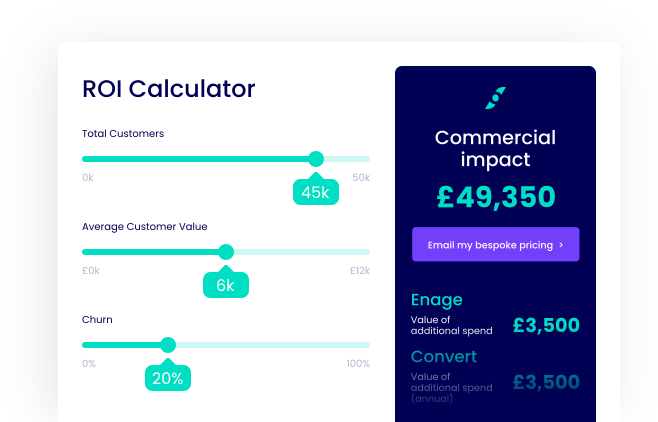
Want to see what yours could return? Our ROI calculator gives you a projection in minutes.
FAQs
What is a good ROI for a loyalty programme?
A good programme returns several times what it costs to run, and the best clear well beyond that. But it depends on design and discipline: the same platform delivers a strong or weak return depending on reward structure, friction and how closely it’s measured. If you’re not tracking incremental profit against total cost, you can’t know either way.
Are loyalty programmes worth the investment?
For most brands, yes, with one caveat: the programmes that pay are the ones measured closely enough to prove it. A well-designed programme lifts retention, spend and advocacy at a lower cost than chasing new customers. A poorly run one quietly leaks budget. The difference is rarely the concept; it’s the execution.
How long does a loyalty programme take to pay off?
Expect the top-line lift to show quickly, often within the first quarter, but judge true profitability over 12 to 18 months. Loyalty ROI is dynamic: retention and repeat purchases build on each other, so returns look modest early and steepen as the member base matures. Judge it over quarters, not weeks.
How do you calculate customer lifetime value?
The simplest version multiplies average order value by purchase frequency by average customer lifespan. For a sharper figure, apply your profit margin and discount future revenue to today’s value. Then compare member CLV against non-member CLV, that gap is the clearest single measure of what a loyalty programme adds.
What counts as a good redemption rate?
There’s no universal benchmark, it swings by programme type, but many programmes land around 20%, with airline and high-value schemes higher. The number matters less than the trend and the cost: a high redemption rate on cost-effective rewards signals healthy engagement; a low one points to rewards that aren’t landing.
How much more do loyalty members spend than non-members?
Studies consistently show members spend more, commonly cited in the region of 12 to 18% more per year, through a mix of more frequent visits and bigger baskets. The exact lift varies by sector and design, which is why tracking member versus non-member spend directly beats leaning on a benchmark.
What makes a loyalty programme successful?
Success comes down to relevance and measurement. The best programmes reward the behaviours that actually drive profit, keep rewards personal enough to feel worth chasing, and track member value closely enough to adjust before engagement dips. A programme that launches and stands still loses momentum; the ones that last keep refining.
How much does a loyalty programme cost?
Costs fall into three buckets: setup (platform, integration, launch), ongoing management (operations, support, optimisation), and the rewards themselves. Building in-house front-loads heavy technology and staffing costs; outsourcing trades that for predictable subscription fees. Reward liability, points owed but not yet redeemed, is the cost most brands underestimate.
Which type of loyalty programme delivers the best ROI?
There’s no single winner, it depends on your customers and margins. Points and earn-and-burn schemes drive repeat purchases; tiered programmes push higher spend by making status worth chasing; paid or premium tiers generate revenue upfront. Many strong programmes blend them. The best fit is the one matched to how your members actually buy.
What's the difference between customer loyalty and customer retention?
Retention is behavioural: whether a customer keeps buying from you. Loyalty is the preference behind it, the reason they choose you when a cheaper option exists. A loyalty programme targets both, but the richer prize is genuine loyalty, because retained-but-indifferent customers still leave the moment someone undercuts you.
Mark Camp
Mark is the Founder and CEO of Propello Cloud, an innovative SaaS platform for loyalty and customer engagement. With over 20 years of marketing experience, he is passionate about helping brands boost retention and acquisition with scalable loyalty solutions.
Mark is an expert in loyalty and engagement strategy, having worked with major enterprise clients across industries to drive growth through rewards programmes. He leads Propello Cloud’s mission to deliver versatile platforms that help organisations attract, engage and retain customers.
Start your customised Propello Cloud journey today
Explore the platform’s scalability, features and customisation options and get answers to your unique questions.