The top customer retention strategies pair loyalty rewards with the fundamentals that keep people coming back: seamless onboarding, genuinely useful content, and double-sided referrals, among others. Together they cut churn and lift customer lifetime value. We’ll cover the ten I rely on most, the same ones that deliver for brands like JD Gyms and HelloFresh.
Mark Camp
CEO & Founder at PropelloCloud.com
Contents
Key Takeaways
Keeping an existing customer costs far less than winning a new one, and loyal customers spend more the longer they stay.
The ten core retention strategies work best as one joined-up experience rather than used in isolation.
Referred customers tend to churn less and are worth more over their lifetime, so referrals are a retention tool and not only an acquisition one.
Customers now demand personalisation, and tailoring rewards to individual behaviour lifts both engagement and retention.
Unconditional gifts have been shown to raise customer spending by up to around a third, and they work best layered onto an existing reward programme.
Half of customers will leave after a single bad experience, which makes strong service and well-handled complaints a frontline retention lever.
Retention is an ongoing commitment that depends on tracking the right metrics and refining your approach as customer expectations shift.
Most brands pour their budget into winning new customers and treat keeping them as an afterthought. That is the wrong way round. Acquisition is the expensive part. Retention is where the margin lives.
Why Is Customer Retention Important?
Customer retention is important because keeping a customer costs far less than winning a new one, and loyal customers are worth more the longer they stay. The maths is brutal: acquiring a new customer costs anywhere from five to 25 times more than retaining an existing one, according to Harvard Business Review.
But cost is only half the story.
Loyal customers buy again, spend more over time, and start selling you to other people for free. That is the flywheel. You keep more customers, they bring you more customers, and you stop renting growth by the month.
What Are the 10 Core Customer Retention Strategies?
The ten core customer retention strategies are loyalty and reward programmes, seamless onboarding, fast delivery and simple returns, educational content, double-sided referrals, better customer service, social media engagement, dedicated communities, reviews and testimonials, and learning from complaints.
Each works on its own. But together they create a single experience that keeps customers and turns them into advocates.
1) Customer Loyalty & Reward Programmes
Loyalty programmes work because they do more than hand out points. They build an emotional connection between customer and brand, and that connection is what makes people stay.
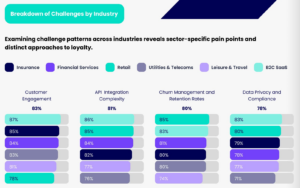
That matters because churn is the problem most brands are fighting. In our 2025 Loyalty Uncovered report, 80% of enterprise brands said churn management and retention was a challenge.
A loyalty programme is one of the most direct answers: when someone is enrolled in a reward scheme, switching to a competitor means walking away from something they have already built. That sense of invested value is a real barrier to churn, tying the customer to you by purchases and by feeling, not only by price.
Exclusivity sharpens it. A customer edging closer to the next reward is more likely to make the extra purchase, on a product they already rate. They feel satisfied, you see higher engagement and sales. Both sides win.
2) Seamless Customer Onboarding
Onboarding is one of the most overlooked moments in the customer journey and one of the most important.
In Wyzowl’s onboarding survey, 63% of customers said the support they expect to receive after buying factors into whether they buy at all. Onboarding is shaping the decision before the relationship has even started.
The same survey found that over 90% of customers think the companies they buy from could do better at it. That gap is the opportunity. In a market where most brands under-deliver on onboarding, doing it well is a straightforward way to stand out.
Strong onboarding prevents early churn, yes. Its bigger job is to prove the customer made the right call, and to set the tone for the whole relationship.
3) Fast Deliveries & Simple Returns
Convenience is one of the strongest drivers of repeat buying. Fast delivery and simple returns meet what modern shoppers expect, and they build the trust that brings people back.
Returns are where much of this gets decided. In UPS’s 2019 Pulse of the Online Shopper study, a survey of more than 18,000 shoppers worldwide, 36% had returned an item in the previous three months, and 73% said the returns experience affects whether they will shop with a retailer again.
That makes returns a retention moment in their own right. A smooth one can turn even a disappointed buyer into a repeat customer.
4) Create Educational Content
Educational content builds trust and loyalty. When you give customers genuinely useful information, you position your brand as an expert, and better still, a trusted advisor. That standing opens natural cross-selling and up-selling opportunities.
Make it valuable, and make it free where you can. It signals you are invested in your customers’ success, not only their spending.
What you get back is a stronger relationship, a better experience, and a customer who sticks around.
5) Double-Sided Referral Marketing Programmes
Referral marketing is one of the most underused retention tools going. Most brands treat it as an acquisition tactic and stop there.
The evidence is strong.
Tracking around 10,000 customers of a German bank over 33 months, Schmitt, Skiera and Van den Bulte found that referred customers are about 18% less likely to churn than non-referred ones, and that retention gap holds over time. They are also worth at least 16% more across their lifetime, though the authors note it varies by segment, so focus referrals on your best customers rather than everyone.
The reason is trust. A referred customer arrives already vouched for by someone they know.
When you build a referral programme, reward both sides, which is what double-sided rewards means. Make sharing easy, and track what it brings in.
Double-sided referrals pay off three ways: existing customers feel valued, new customers start from a position of trust, and you keep more of both.
6) Improve Customer Service and Support
Strong customer service gives customers a reason to stay. Poor service hands them a reason to leave, and to tell people why.
That is the part worth dwelling on. A customer service interaction is rarely neutral. Handled well, it deepens the relationship and often turns into a recommendation. Handled badly, it does the opposite, and the complaint usually travels further than the praise.
This is why I tell clients that customer service is an investment. It is one of the highest-return things you can put money into for retention. Every resolved issue is a customer kept, and often a customer who now has a reason to speak well of you.
Treat support as the front line of loyalty, not the back office of complaints. Answer queries and complaints quickly, listen properly, and fix things for good.
7) Engage on Social Media
According to Bain & Company, customers who engage with a brand on social media spend 20% to 40% more with it than other customers and give it a Net Promoter Score around 33 points higher.
You could call that promotion. I call it a conversation.
Brands that respond thoughtfully, address concerns in the open, and celebrate their customers build real trust. Real-time feedback matters, but it is how you handle criticism that sets you apart. Quick, honest responses show you are listening.
8) Build Dedicated Communities
Dedicated communities are a powerful driver of retention. They give customers a space to connect, share experiences and support each other, all centred on your brand.
In Higher Logic Vanilla’s research, 74.5% of customers said that access to an online community makes them feel more valued. A community gives members the knowledge of long-time customers and builds the kind of trust and loyalty that keeps people around.
These spaces prove their value in several ways. They are a channel for feedback, support and product discussion, and a direct line into what customers actually need. They also take pressure off your team, because customers help each other.
Offering exclusive rewards to your most active members lifts retention further. It makes your most engaged customers feel recognised, and turns them into advocates for the brand.
9) Encourage Reviews and Testimonials
Reviews and testimonials build trust, provide social proof, and help your search rankings. The hard part is getting customers to leave them. Incentives help. A reward programme can offer a small thank-you for leaving one.
Strike the balance, though. Rewards that are too generous attract people chasing the freebie rather than honest feedback.
The best reviews come from your engaged customers and repeat buyers. They write the detailed, authentic feedback that actually persuades a prospect, and every honest review adds to the sense that your brand is worth buying from.
10) Learn from Customer Complaints
How you handle complaints makes or breaks retention. No brand is perfect. The best ones turn a complaint into a reason to stay.
The stakes are clear. In Zendesk’s Customer Experience Trends Report 2020, half of customers said they would switch to a competitor after a single bad experience, and 80% would leave after more than one. You often get one chance to put things right.
So treat complaints as opportunities, each one a specific, free piece of insight into what needs fixing. Watch for them across social media, review sites and your own community, and act before a fixable problem becomes a reason to leave.
The payoff goes beyond preventing churn. It builds trust, earns positive word of mouth, and strengthens the brand.
What Are Some Advanced Customer Retention Tactics?
Once the fundamentals are in place, four tactics take retention further: deep personalisation built on a single view of the customer, inviting customers into beta testing, exceeding expectations through surprise and VIP treatment, and reaching out before problems reach you.
Each goes beyond the basics, and rewards the brands willing to put the work in.
1) Optimising Personalised Customer Experiences
At Propello Cloud we build personalisation into the core of our programmes, because a genuinely tailored approach changes how customers engage with a brand.
A McKinsey study found that 71% of consumers expect personalised interactions, and the brands that deliver see it in stronger engagement and better retention.
The foundation is usually a unified customer view (UCV): one record per customer that pulls together data from every touchpoint, from online browsing to purchase history to service interactions.
That single view is what lets you stay consistent across every interaction, anticipate what a customer needs, and send communications that actually land, whether you are personalising for one customer or a whole segment.
How Do You Personalise the Rewards Experience?
You personalise the rewards experience by tailoring what each customer earns to their own behaviour: what they buy, how they engage, and where they are in their journey. Done across the whole journey, it brings back repeat buyers, advocates and lapsed customers alike.
At Propello Cloud we draw on the unified customer view, insights from our platform alongside a client’s CRM data, to deliver rewards that fit the individual. Three things make that work:
Customised achievement paths: goals set around a customer’s own engagement and purchase patterns.
Behaviour-triggered rewards: automated rewards tied to specific actions or milestones.
Relevant communications: timely, targeted messages about rewards that lift engagement and conversion.
A unified customer view and personalised rewards are powerful, but they are one part of a wider, business-wide personalisation strategy.
The real work is using data intelligently across every touchpoint to build experiences customers want to return to.
2) Invite Customers to Open Beta-Testing
Understanding your customers is an ongoing job, and user research and usability testing are a big part of it. The insights drive real improvements to your product and experience, and both feed long-term retention.
They also keep you ahead of what customers need, with their input shaping the decisions you make about features. Opt-in beta testing is a good example. It is a reliable way to drive satisfaction, and it gives you more besides:
Honest feedback from the people who know your brand best.
Better usability, improved with the users who care most.
Stronger engagement, because customers become active partners in making the product better.
Bringing customers into your product’s development gives them a sense of shared ownership, and that is hard to walk away from, especially when their feedback has visibly shaped what you built.
Run surveys during and after the test to capture how they feel in the moment.
3) Exceed Customer Expectations
Long-term loyalty comes from consistently beating what customers expect. Two approaches work especially well here: surprise and delight, and VIP treatment. Here is how each one earns its place.
Surprise and delight is the unexpected upgrade, the personal note, the small gift. The point is to create moments that stick in a customer’s mind, and the effect is measurable.
A 2026 study in the Journal of the Academy of Marketing Science ran field experiments in real shops and found that an unconditional gift, given with no strings attached, lifted customer spending by up to around 32%.
Two findings stand out: the value of the gift barely mattered, even a token item worked, and unconditional gifts beat earned rewards on both loyalty and spending. That makes a surprise gift a natural layer on top of a reward programme.
The one catch is to surprise sparingly. The more routine it becomes, the less it lands.
VIP treatment makes a customer feel genuinely important to your brand. It can be as simple as remembering their preferences, or as involved as exclusive events and early access to new products before general release. Those privileges create a sense of status that deepens the relationship, and smaller touches like priority service and personalised recommendations do the same job day to day.
Both approaches work best when they feel personal rather than automated. A gesture that looks mass-produced surprises no one.
4) Be Proactive in Customer Communication
Do not wait for customers to come to you with problems. Anticipate what they need and reach out first, with a helpful tip, an order update, or a quick check-in after a purchase.
Proactive communication stands out precisely because so little of it happens. Picture a system that spots a likely issue from a customer’s usage pattern and reaches out with a fix before they have even noticed something is wrong.
AI is well suited to spotting those patterns. If you are not ready to bring AI in yet, the simpler tactics do the groundwork: helpful tips, order updates, and post-purchase follow-ups.
Which Customer Retention Metrics Should You Track?
The five retention metrics worth tracking are customer retention rate, customer lifetime value, churn rate, Net Promoter Score, and repeat purchase rate. Between them they tell you how many customers you keep, what each one is worth, and why they stay or go.
Here is what each measures and why I watch it:
Customer retention rate: the percentage of customers you keep over a given period. This is the headline indicator of loyalty programme success.
Customer lifetime value (CLV): the total worth of a customer across the whole relationship. It tells you how much you can justify spending to acquire and keep them.
Churn rate: the percentage of customers you lose. Watch it closely, it flags problems early.
Net Promoter Score (NPS): how satisfied customers are and how likely they are to recommend you. We treat a rising NPS as an early signal of healthy revenue.
Repeat purchase rate: how often customers come back. A direct read on engagement and product satisfaction.
How Do You Build a Successful Customer Retention Strategy?
Building a customer retention strategy comes down to three things: the elements that make a programme worth staying in, a plan that turns those elements into action, and the tools to run it day to day. The three reinforce each other, so build them together.
What Are the Elements of an Effective Customer Retention Programme?
Personalisation: Tailoring experiences to how customers actually behave is what makes rewards, incentives and benefits land. When the offer matches the person, they engage and stay. It is the piece we put at the front of our own programmes.
Consistent communication: Keep the conversation going, but quality beats quantity. A planned calendar of seasonal promotions holds that balance better than a constant drip of messages.
Value-added services: This is where partnerships earn their place. Complementary rewards that enhance your core proposition give customers a reason to stay that your product alone cannot, which is what we built for clients like HelloFresh.
Feedback loop: Ask customers what they think, then act on it. Their input shows where the experience breaks down, the view you cannot get from the inside.
How Do You Create a Customer Retention Plan?
Set clear goals: Decide your target retention rate and how much you want to lift CLV. Without a number, you cannot tell if it is working.
Segment your customers: Not all customers are the same, so your best customers and your lapsed buyers need different strategies. Build for each group.
Map the customer journey: Identify key touchpoints where you can improve the experience, from first purchase to renewal.
Define your metrics: Choose KPIs that line up with your business objectives. Pull the full list from the metrics section above.
Create an implementation timeline: A retention strategy is built in stages, not overnight. Sequence the work so each piece supports the next.
What Tools Do You Need for Customer Retention?
The core tool you need is a loyalty and retention platform that plugs into your existing CRM and ecommerce stack, so you can run programmes, track what is working and act on it without stitching systems together.
No-code matters here: it means your marketing team can run the whole thing without waiting on developers. At Propello Cloud we built exactly that. It lets clients:
Launch reward programmes quickly
Add gamification features
Manage brand partnerships in one place
Track and analyse retention metrics in real time
Tools should simplify the work, not add to it. A retention strategy takes real effort to build, but the payoff runs for years.
Making Customer Retention a Long-Term Advantage
Customer retention keeps changing, and the brands that win keep changing with it. Hyper-personalisation and value-based loyalty are already reshaping what customers expect, and they will shape how you need to respond.
The practical answer is to build for flexibility. Invest in omnichannel experiences, and watch the technologies that help you build real emotional connections with customers, not just transactional ones.
Retention is a commitment you keep. Stay close to how customer expectations shift and refine your approach as they move. That is how you build a loyal customer base that grows a business for years.
FAQs
What is a good customer retention rate?
It depends heavily on your industry and business model, so benchmark against your sector rather than a universal number. As a rough guide, subscription and SaaS businesses often aim for annual retention above 90%, while ecommerce and retail typically see lower repeat rates of around 20% to 30%. Track your rate across different periods, monthly, quarterly and yearly, to see how it moves rather than fixating on a single figure.
What is a good churn rate?
Churn is the inverse of retention, so a lower churn rate signals a healthier, more loyal customer base. What counts as good varies by industry and business model, but many businesses aim to keep annual churn in the low single digits, often cited at around 2% to 8%. The more useful habit is to benchmark against your own past performance and your sector, then work the number down over time.
How do you calculate customer retention rate?
Use the formula [(E – N) / S] x 100. E is the number of customers at the end of a period, N is the number of new customers gained during that period, and S is the number you started with. Subtracting new customers isolates how many of your existing customers you actually kept, which is what retention measures.
What is the difference between customer retention and churn?
They are two sides of the same measure. Retention rate is the percentage of customers you keep over a period, and churn rate is the percentage you lose. If you retain 90% of customers in a period, you have churned 10%. Tracking both gives a fuller picture: churn flags where customers are leaving, while retention shows how well you are holding on to them.
What causes customer churn?
The most common causes are poor customer service, a product or experience that fails to meet expectations, a sense that the price no longer matches the value, and a more attractive competitor. Weak onboarding and a lack of ongoing engagement also push customers away early in the relationship. Identifying which of these applies to your business is the first step to reducing it.
How does customer retention increase profit?
Retained customers cost less to serve than newly acquired ones, buy more often, and tend to spend more over time, so a stable base lifts profit without constant acquisition spend. Research popularised by Bain’s Frederick Reichheld found that increasing retention rates by 5% can raise profits by anywhere from 25% to 95%. Loyal customers also refer others, which lowers acquisition costs further.
What is the difference between customer retention and customer loyalty?
Retention is a behaviour you can measure, whether customers keep buying from you. Loyalty is the attitude behind it, an emotional preference for your brand over the alternatives. The two are linked but not identical. A customer can be retained through convenience or lock-in without being loyal, whereas a genuinely loyal customer not only stays but spends more and recommends you to others.
How can small businesses improve customer retention?
Small businesses can compete on the things that do not need a big budget: fast, personal service, recognising repeat customers, and following up after a purchase. A simple loyalty or referral scheme, consistent communication, and acting visibly on feedback build the kind of relationship larger competitors struggle to replicate. The advantage of being small is closeness to the customer, so use it.
How long does it take to improve customer retention?
There is no fixed timeline, as it depends on your sales cycle and how often customers buy. Some changes, such as fixing a poor onboarding flow or responding faster to complaints, can show results within a few months. Deeper gains from loyalty programmes, personalisation and community tend to build over a year or more, because retention is measured across repeat cycles rather than single transactions.
What is customer retention management?
Customer retention management is the ongoing practice of measuring, analysing and improving how well a business keeps its existing customers. It brings together the metrics that track retention, the strategies that influence it such as loyalty programmes and proactive service, and the tools that deliver them. The goal is to turn retention from an occasional campaign into a continuous part of how the business operates.
Mark Camp
Mark is the Founder and CEO of Propello Cloud, an innovative SaaS platform for loyalty and customer engagement. With over 20 years of marketing experience, he is passionate about helping brands boost retention and acquisition with scalable loyalty solutions.
Mark is an expert in loyalty and engagement strategy, having worked with major enterprise clients across industries to drive growth through rewards programmes. He leads Propello Cloud’s mission to deliver versatile platforms that help organisations attract, engage and retain customers.
Start your customised Propello Cloud journey today
Explore the platform’s scalability, features and customisation options and get answers to your unique questions.