15 Membership Trends for Engagement, Acquisition & Retention in 2026
25 min to read
Published: October 9, 2025
Updated: August 7, 2026
In this blog, we’ll be exploring the top 2026 membership trends identified in our latest research. Sustained growth for any organisation requires a great deal of determination and adaptability. Staying aware of the latest trends helps you prepare for and adapt to changing environments. You’ll know what to prioritise when it comes to meeting member expectations.
Mark Camp
CEO & Founder at PropelloCloud.com
Contents
Key Takeaways
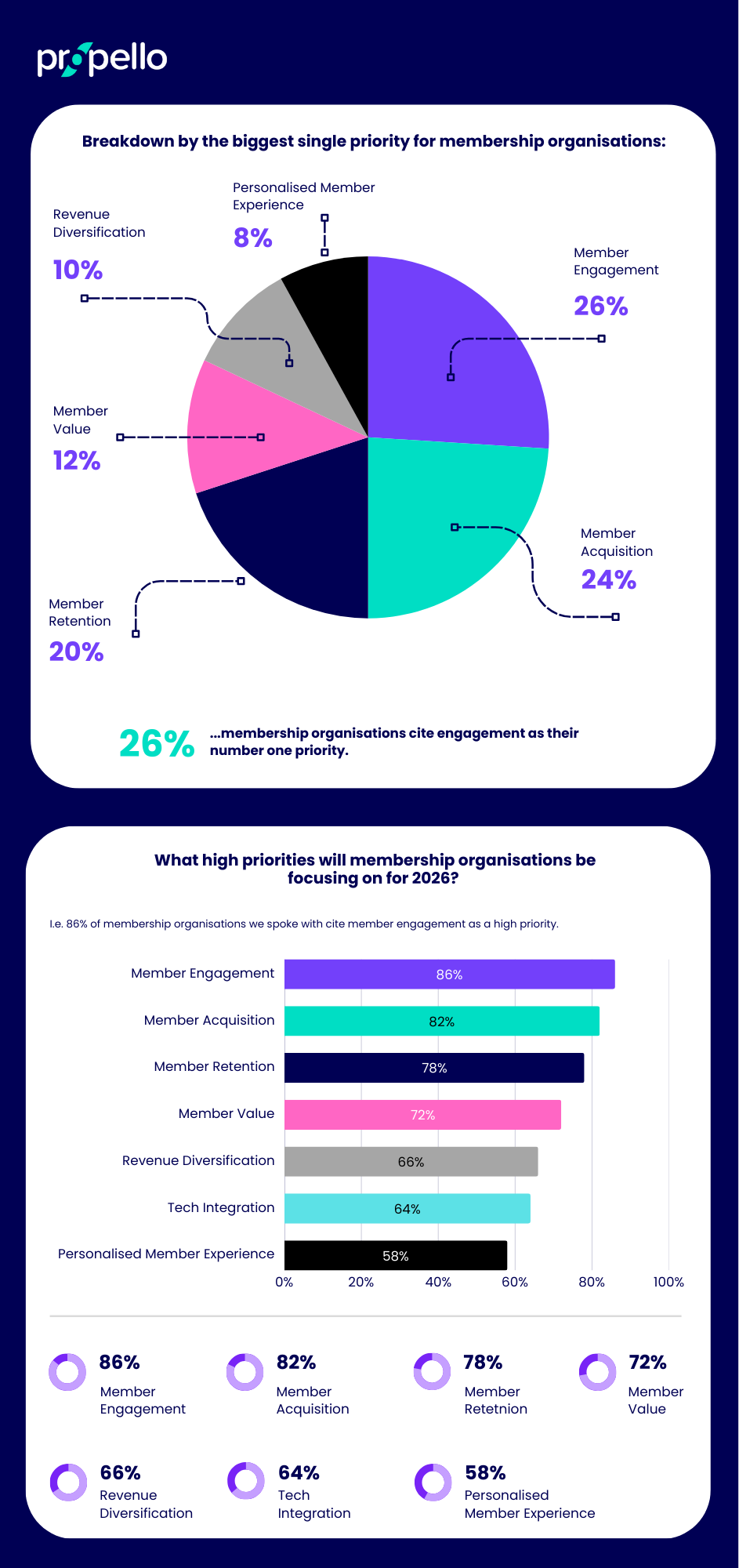
Engagement is the #1 priority with 86% of organisations ranking it as a high priority, followed by acquisition 82% and retention 78%.
Despite its importance, only 41% of large organisations (and 27% overall) have a documented engagement strategy which results in fragmented member experiences and churn.
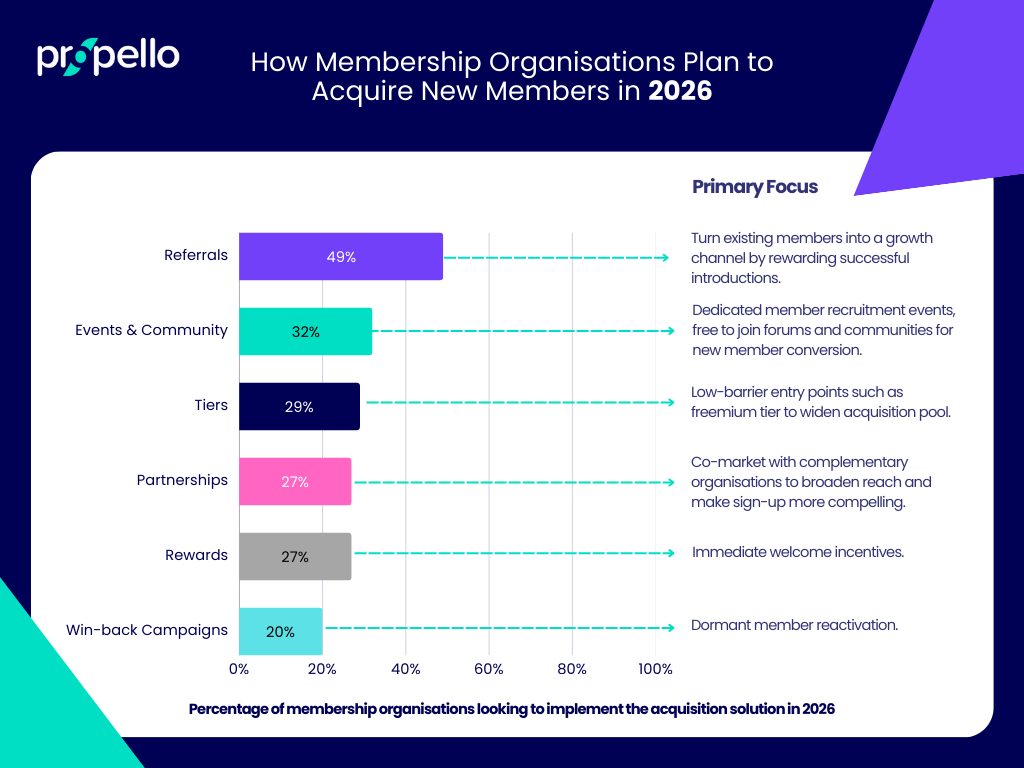
49% plan to consider or review referral programmes, 32% will deliver more recruitment events, 29% will consider or introduce low-barrier entry/freemium tiers, 27% will increase partner marketing for amplified reach, 27% are considering the introduction of welcome incentives.
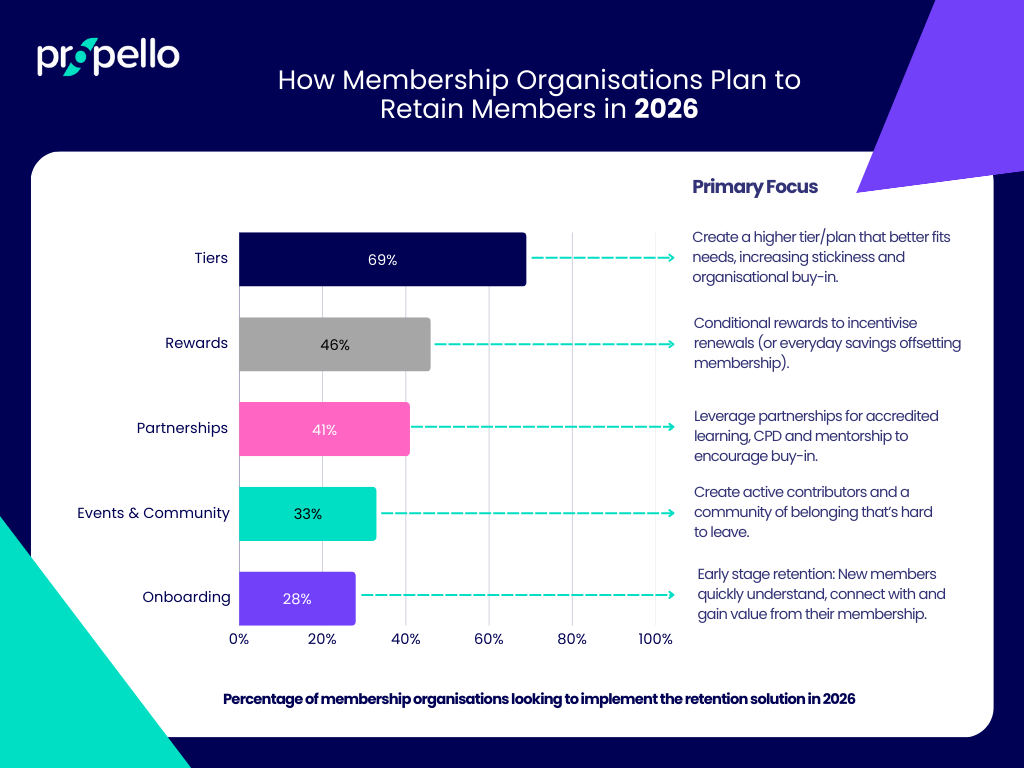
69% see tiers as an important retention strategy as it helps cement buy-in; 46% are interested in conditional rewards to incentivise membership renewals, 41% will increase partnerships activity to aid retention, 33% see events as key to retention and 28% will focus on better initial onboarding to communicate value early on to help secure long-term renewals and Lifetime Value (LTV).
41% will increase partnership activity to aid retention, 33% see events as key to retention and 28% will focus on better initial onboarding to communicate value early and secure long-term renewals and higher Lifetime Value (LTV).
If members can see savings and progress all year (not just at renewal), they stay. Teams are making value visible with perks that offset fees, stronger partnerships, smarter onboarding, and tiered bundles.
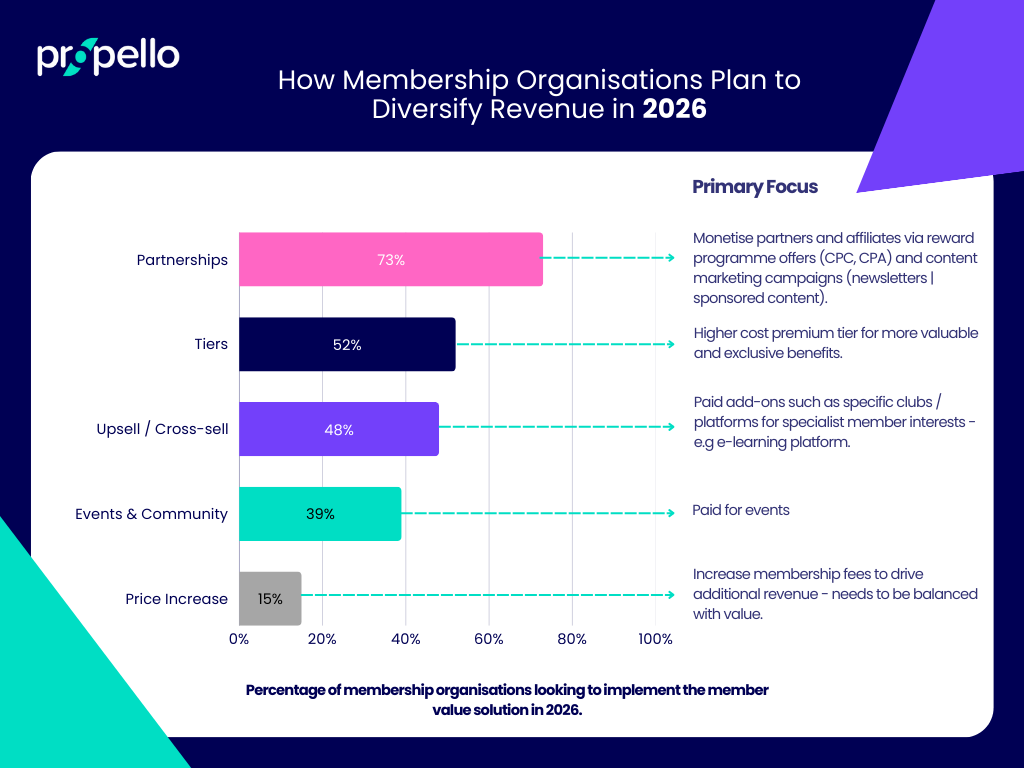
Of those increasing activity to broaden income beyond dues, 73% will monetise partners/affiliates, 52% are looking to launch premium tiers, 48% are looking to cross-sell/upsell and 39% plan to leverage additional revenue from events.
Propello Cloud is proud to be a MemberWise Recognised Supplier, trusted by leading membership organisations including NASUWT, The Ivors Academy, ISM, and the Royal College of Surgeons of Edinburgh.
Our white-label loyalty and reward platforms help membership bodies drive retention, boost member engagement, and deliver added value through personalised, benefit-led experiences.
What Are the Top Priorities for Membership Organisations in 2026?
Propello Cloud’s research with enterprise membership organisations revealed that member engagement, acquisition, and retention dominate the 2026 agenda. The table below shows where organisations are focusing their efforts and how urgently.
From our discussions, we identified seven key focus points: the first seven trends (1-7) in this article.
Priority
Critical*
High Priority
Rank
Member Engagement
26%
86%
1
Member Acquisition
24%
82%
2
Member Retention
–
78%
3
Member Value
12%
72%
4
Revenue Diversification**
10%
66%
5
Tech Integration
–
64%
6
Personalised Member Experience
–
58%
7
* The primary focus for the organisation (organisations can have several high priorities) ** Revenue Diversification includes revenue beyond membership fees, e.g., cross-selling and upselling, partnership and affiliate monetisation and premium tiers.
What Are the Key Focus Areas and Challenges for Membership Organisations?
Based on our research, membership organisations face seven interconnected challenges heading into 2026:
Membership engagement
New member acquisition
Member retention
Enhancing member value
Diversifying revenue
Personalised experiences
Tech integration and digitisation
What follows covers each challenge, the data behind it, and how leading organisations are responding.
1) What Is Member Engagement and Why Does it Matter in 2026?
Member engagement is the degree to which members actively participate in and derive value from their membership. Engaged members feel recognised and connected to your organisation, which leads to deeper emotional loyalty and adds value at every touchpoint in the member lifecycle.
What are the causes of poor member engagement?
Poor member engagement usually comes down to one core problem: members can’t clearly see what they’re getting for their money. Misaligned benefits, fragmented technology, and generic communications all contribute, but unclear value is the common thread that makes everything else worse.
Here’s what happens when members don’t engage:
Irrelevant or outdated benefits erode perceived value, making members question why they’re paying.
Fragmented technology and disconnected data create disjointed experiences that frustrate rather than delight.
Complicated onboarding, redemption processes, and renewal journeys introduce friction at the moments that matter most.
Slow issue resolution and poor service damage trust, particularly among members who are already disengaged.
Generic value propositions fail to hold interest at key lifecycle touchpoints, increasing the risk of lapse.
Our insights: What does the research say about member engagement strategies?
According to our 2025Membership Trends Report, 26% of large membership organisations cite engagement as their single biggest priority, and 86% rank it as a high priority overall.
Yet according to the MemberWise Digital Excellence Report, only 41% of large organisations (£3m+ revenue) and 27% of the sector overall have a documented engagement strategy.
The reason engagement tops the priority list is the same reason it remains unsolved: most organisations know it matters but haven’t formalised how to improve it.
Without a documented strategy, member journeys default to fragmented, inconsistent experiences. Disengaged members don’t announce their dissatisfaction. They simply don’t renew, forcing costly acquisition cycles to replace them.
How are membership organisations engaging their members?
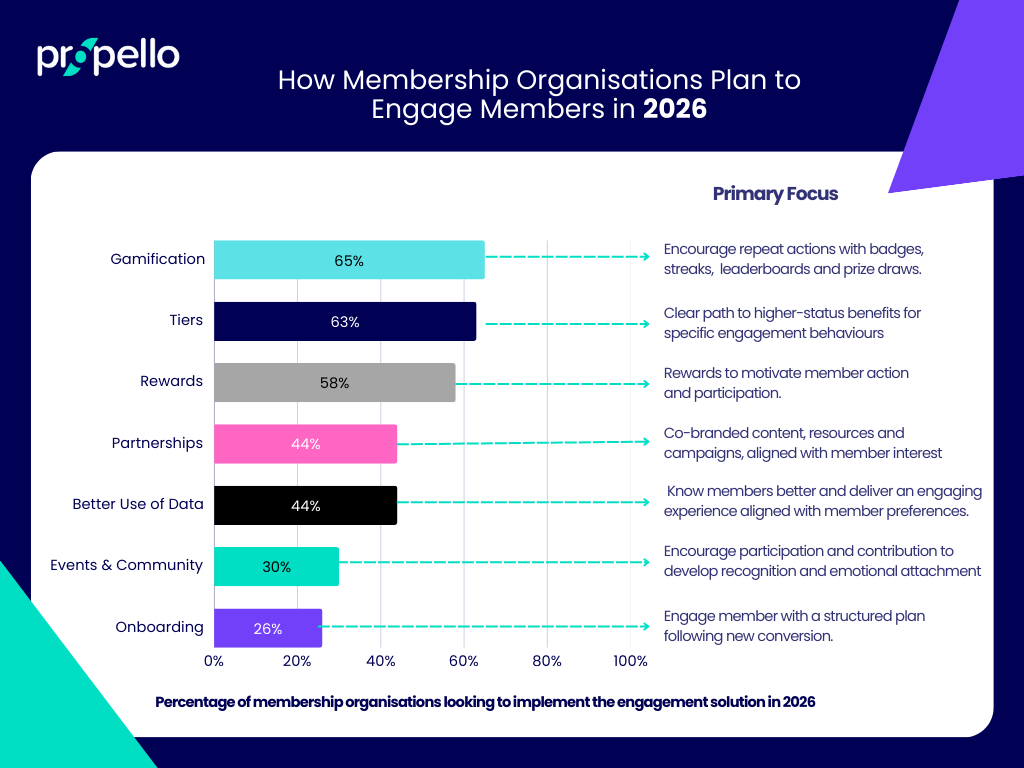
To close the engagement gap, membership organisations said they are looking to clarify value exchange, improve datasets, and promote a sense of community at key touchpoints to lift satisfaction and, by extension, renewal rates.
But how does that look?
65% plan to test gamification. People enjoy interactive elements like progress indicators and achievement badges. In addition, gamification encourages habit-building.
63% expect to review their tiered membership structure. Not only do tiers lay down clearer paths towards higher status benefits, but they also actively compel organisations to improve datasets for more accurate segments.
58% are looking at rewards to motivate specific behaviours. This presents opportunities for promoting participation in the community.
44% will strengthen partnerships. Co-branded content, resources and campaigns have a much better chance to align with a variety of member interests.
44% want better use of data. Again, accurate data allows for refined segments, aligning experiences, rewards, and wider value propositions to member preferences.
30% are targeting events and community initiatives. What’s better at driving participation in an organisation’s community than events and initiatives that lead to member interaction and collaboration?
26% plan on improving onboarding. This sets the tone for newcomers, giving membership organisations a fast win opportunity with highly engaging and exciting welcomes.
No single tactic above works in isolation. Organisations are combining several of these approaches into a connected strategy, using digital platforms and rewards programmes as the infrastructure that links them together.
2) What Is Driving the Focus on New Member Acquisition?
Member acquisition ranks as the second-highest priority due to natural attrition constantly eating away at membership bases. Rising operational costs hinder growth, which also adds pressure on revenues generated by membership fees.
Organisations need fresh members to achieve growth targets, diversify their demographics, and maintain long-term sustainability.
What are the causes of poor member acquisition?
Poor acquisition performance is due to three core failures: a value proposition that doesn’t answer “why join now?”, a sign-up journey with too much friction, and targeting that’s too broad to convert. If prospects can’t quickly see what they gain, they won’t commit.
To summarise the main causes of poor acquisition:
Unclear or generic value propositions that give prospects no compelling reason to join today.
Overly complex sign-up journeys that introduce friction at the point of highest intent.
Broad, untargeted campaigns that reach the wrong audiences with the wrong message.
Limited social proof: no testimonials, case studies, or tangible member outcomes to build trust.
Over-reliance on short-term discounts that attract price-sensitive joiners who rarely stay long.
Our insights: What does the data tell us about member acquisition in 2026?
While large membership organisations are certainly focusing on acquisition, it’s often done so alongside engagement and retention. This indicates membership organisations are adopting a mature and balanced approach, rather than panicked growth-at-all-costs strategies.
With this in mind, we expect to see emphasis on acquisition continue as organisations look to offset churn and drive sustainable growth that sees them through 2026 and beyond.
Our research found that 82% of membership organisations rank acquisition as a high priority, with 24% citing it as their biggest priority.
Strong member acquisition strategies lead to other benefits, including:
Offsets natural attrition to protect membership volume and dues revenue
Diversifying the member base by attracting younger demographics
Increasing referrals (boosting organic growth and reducing CAC in the process)
Improving the acquisition pipeline; reducing an over-reliance on lower membership fees or discount-driven retention
How are membership organisations attracting new members?
Our research reveals a clear shift towards reducing acquisition costs, broadening reach, and quickly communicating value to new members.
49% plan to introduce referral programmes. Advocacy is one of the most cost-effective acquisition strategies. Marketing campaigns are expensive and not always successful. Referrals, on the other hand, tap into the existing trust between your members and people in their personal networks. More often than not, that’s more than enough for people to sign up.
32% expect to use recruitment events and community forums. Peer validation reinforces positive behaviours. When prospects interact with your existing members, that personal conversation goes a long way in building trust and reassurance.
29% are exploring low-barrier entry points. Freemium tiers widen the acquisition pool by levelling the playing field for potential members with limited funds or resources.
27% will form partnerships with complementary organisations. Partnering with another brand broadens your reach because it puts you in front of their audiences. Plus, member access to exclusive offers from your partners improves overall member value propositions (MVPs).
27% will introduce immediate welcome rewards. Similar to some engagement strategies, this instantly sets a positive tone. Welcome gifts or other incentive types can be that extra hook to successfully pull in new members.
20% plan to run win-back campaigns. This underused tactic is a great way of reactivating dormant or lapsed members.
Together, these strategies show the potential of fully optimised acquisition cycles. With the right solution, membership can bring each of these into a cohesive system, using various touchpoints in the acquisition phase that provide instant gratification and drive referrals.
3) Why is Member Retention Still Key to Sustainable Growth?
Retaining existing members is considerably more cost-effective than acquiring new ones. Plus, successful retention tends to lead to renewals, which provide a recurring revenue base for organisations that need stability.
Effective retention also improves the value of acquisition. Organisations with high retention, after all, enjoy a higher member lifetime value. So each new member brought on board has the potential to generate value during longer tenures. In a climate of rising acquisition costs, that’s huge.
What causes poor member retention?
Retention challenges often arise when organisations fail to deliver sustained value beyond the initial sign-up. If members don’t feel a strong connection, see ongoing benefits, or achieve progress toward their goals, they are more likely to lapse at renewal.
To summarise:
Value feels static when benefits don’t evolve with changing needs
Few signals of progress (no milestones, recognition, or “you’re getting more from this” moments) harm retention
One-way communications that just broadcast updates instead of nurturing relationships
Disjointed journeys across web, app, events and support make value hard to find
Limited peer connection, mentorship, or contribution pathways also limit retention rates
Data blind spots prevent early intervention with at-risk members
Costs may be clear, but ongoing outcomes aren’t, resulting in a value mismatch
Our insights: What does the data tell us about member retention in 2026?
Our discussions with membership organisations revealed that 78% of membership organisations rank retention as a high priority, with 20% naming it their single biggest focus. Yet only a fraction have structured strategies for measuring churn risk or intervening before members lapse.
Organisations that take proactive steps towards retention (such as predicting risk and proving value all year round) will improve revenue and lifetime value.
How are membership organisations retaining members?
There’s a shift towards proactive retention: identifying at-risk members earlier, making value visible throughout the year, and building thriving communities.
69% are considering member tiers. Tiered structures better fit evolving needs, increasing stickiness and organisational buy-in.
46% are exploring conditional rewards. These help promote desired behaviours, e.g., renewals. Plus, they provide everyday savings which offset the cost of membership.
41% are establishing stronger partnerships. These are usually centred around accredited learning, CPD and mentorships that drive professional and personal value.
33% will focus on events and community initiatives. A great way of building a sense of belonging and professional and personal relationships between members that are difficult to leave.
28% plan to enhance onboarding. New members quickly understand, connect with and gain value from their membership early on when the organisation offers an unforgettable welcome.
Across all five strategies, the underlying principle is the same: make value impossible to ignore, and renewal becomes the obvious choice.
4) How Can Membership Organisations Enhance Member Value?
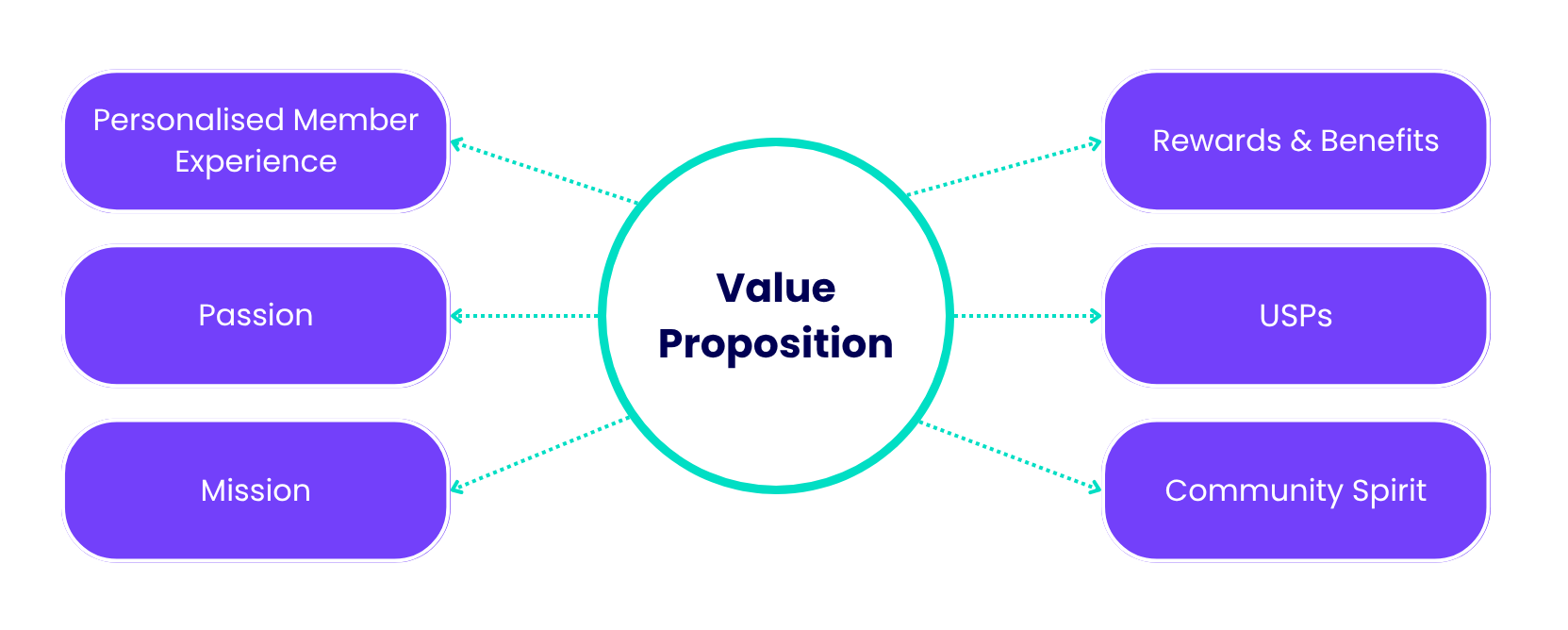
The most effective way to enhance member value is to make your benefits tangible, relevant, and easy to understand. A compelling member value proposition (MVP) supports acquisition, drives engagement, and keeps members renewing year after year.
When your benefits align with member interests and your mission feels personal, everything from sign-ups to retention improves.
What are the causes of poor member value delivery?
A lack of perceived value is often the result of misaligned benefits and weak communication. If members can’t clearly see how the fee translates to professional development or belonging, they’re quick to disengage.
Outdated benefits, poor onboarding, and fragmented technology also undermine value by hiding the true ROI of membership.
The most common causes are:
Outdated member value propositions that don’t resonate with changing member demographics, needs or requirements
Benefits that no longer reflect member needs
A heavy focus on offers built around price reductions rather than professional development or mission alignment
Limited or unclear onboarding journeys
Fragmented technology with member data, benefits, and communications sitting in separate systems
The foundations for delivering member value successfully start with your MVP. Read more in our article: How to Craft a Compelling Member Value Proposition for Retention.
Our insights: What does the research say about member value?
Member value is now a baseline expectation. Our research found that 72% of membership organisations rank delivering member value a high priority. The cited reason behind this interest is that many lack the tools to quantify or showcase value at renewal.
That gap matters. Organisations that can’t prove value at the moment it counts most, the renewal decision, are leaving churn to circumstance rather than tackling it. With just 12% citing value delivery as their single biggest priority, the rest may be underestimating the problem.
How are membership organisations enhancing member value in 2026?
The most effective approach is to make value visible and measurable throughout the membership lifecycle, not just at sign-up. When organisations consistently highlight usage data, savings, and career outcomes, renewal rates improve and churn falls.
The leading strategies identified in our research show:
44% aim to offset the cost of membership with closed-user-group perks and reward programmes that generate tangible savings.
36% will create greater value through actionable insights. Events, communities, and member discussions surface what members actually care about, which feeds directly back into benefit design and communication.
31% aim to improve onboarding, which has emerged as a near-universal fix across multiple membership challenges. Getting members to value faster reduces early-stage churn before it starts.
33% of membership organisations plan to extend their value stack through third-party partnerships that broaden their offerings without building everything in-house.
33% will package benefits into tiered bundles, increasing perceived value and giving members a reason to upgrade, without necessarily increasing cost per redemption.
What stands out is how consistent these strategies are across the sector. Membership organisations largely agree on the direction. The gap between those succeeding and those struggling usually comes down to execution and tooling.
5) How Can Membership Organisations Diversify Revenue?
Membership organisations can diversify revenue by moving beyond dues to include affiliate partnerships, premium tiers, paid add-ons, and events.
Relying mainly on dues leaves organisations exposed to volatile renewal swings and unforeseen macro events. A broader spread of revenue insulates organisations from these threats.
Partners, premium tiers, paid add-ons, and events help to generate revenue streams across multiple touchpoints. When done well, diversification turns engagement into revenue (and vice versa), funds better services, and stabilises budgets without leaning on blanket fee hikes.
Our insights: What do membership organisations say about revenue diversification?
Revenue diversification is moving up on the agenda, with 66% of organisations now looking to broaden their income from just core membership fees.
“In fact, according to MemberWise’s Influence 100, subscription fees only cover half an organisation’s operational costs. Which is why they highly recommend a portfolio approach to de-risk income.” (Propello Cloud in, MemberWise, July 2025)
The organisations we spoke to acknowledged the risks of relying too heavily on renewals or other single revenue streams, more so in the face of rising costs and member churn.
Also worth noting, organisations currently experimenting with affiliate partnerships, closed user-group discounts, and paid add-ons (like CPD modules and specialist clubs) see diversification as a way to strengthen value, not just financial insurance.
How will membership organisations diversify revenue in 2026?
Investments in revenue diversification are heading mainly toward partners and affiliates, premium tiers, cross-sells and upsells.
73% plan to monetise partners and affiliates. Organisations are using reward-programme offers (CPC/CPA) and sponsored content/newsletters to create new income streams.
52% will introduce or expand premium tiers. In this capacity, organisations can use tiers to charge more for access to exclusive benefits of higher value.
48% are looking to cross-sell and upsell opportunities. The main points in our discussions were paid add-ons. For example, an e-learning platform in specialist clubs.
39% expect more paid events and community formats.
15% anticipate broad price increases. This shows favouring towards value-led diversification over across-the-board hikes.
Selling branded reports, research guides, or merchandise
Affiliate Marketing
+ Generates commission income
+ Low overhead to implement
– Reliant on affiliate performance
Can include both affiliate links on your site and commission from rewards programme partners
Affiliate links in newsletters or commissions from retailer sales via the member rewards platform
How can organisations maximise revenue beyond membership fees?
The table below outlines strategies, including tiers, add-ons, and bundles that increase value and income. Membership fees will remain the primary income source for most organisations, but there is real room to grow that revenue without raising prices.
Revenue Strategy
Pros & Cons
Considerations
Example
Tiered Membership Levels
+ Appeals to different budgets
+ Upsells members into higher value
– Risk of excluding lower-income groups
Ensure each tier has clear, differentiated benefits
Standard, Gold, and Platinum tiers with increasing access
Add-On Services
+ Generates incremental revenue
+ Flexible for members
– Requires clear communication of value
Price add-ons fairly and avoid confusing the core offer
Extra cost for access to premium research or specialist clubs
One-Off Upgrades
+ Quick boost in revenue
+ Creates exclusivity
– Not sustainable if overused
Use sparingly to avoid member fatigue
VIP event tickets available at additional cost
Automatic Renewal / Multi-Year Discounts
+ Improves cashflow & retention
+ Reduces admin costs
– May be a barrier for price-sensitive members
Offer discounts that encourage commitment without eroding overall value
2-year membership at a reduced annual rate
Bundled Packages
+ Increases perceived value
+ Encourages higher spend
– Risk of over-complicating choices
Bundle services that members already value together
Membership + conference pass + publication at a package price
6) How Will Personalised Experiences Improve Member Relationships?
Personalised experiences transform member relationships by making members feel valued. Members have grown accustomed to streaming, retail, and banking platforms that anticipate their needs. They expect the same from their membership organisation.
When communications feel tailored, benefits reflect their stage of life or career, and the timing of offers is spot-on, people feel recognised. That sense of being “known” by the organisation deepens their loyalty to it.
What causes poor personalisation for members?
Personalisation often fails not because organisations dismiss its importance, but because their systems and processes aren’t set up to deliver it.
Data is often trapped in silos, meaning teams can’t see a complete view of the member. As a result, communications default to generic and neutral messaging. These simply don’t resonate.
Some organisations we spoke to acknowledge their own missed opportunities to act in the moment. It’s because they lacked behavioural triggers or automated workflows to nudge members at the right time.
In practice, the same failure points come up again and again:
Siloed systems block joined-up member views
Broadcast comms instead of segmented, needs-led journeys lead to generic messaging that doesn’t resonate
Static benefit bundles rather than flexible options fail to shape desired behaviour at critical stages
Lack of triggers or automation to deliver time-bound incentives often results in missed opportunities
Limited testing and iteration due to skills or gaps in the tech stack hold back organisations
Our insights: What does the research say about member personalisation?
Going into 2026, 58% of organisations rate member personalisation as a high priority. The challenge is no longer convincing boards it matters, but enabling teams to deliver it consistently.
Many recognise that relevance drives engagement, but fragmented systems and legacy platforms still stand in the way.
A handful of frontrunners are moving beyond demographic targeting into behavioural segmentation. Their focus is on using activity signals, lifecycle models and data around preferences to shape content, events and rewards.
Organisations that have implemented this are seeing higher engagement rates. The consensus in feedback from members is that they feel “understood” rather than “marketed to.”
The gap between the personalisation leaders and the rest of the sector is stark. Closing it will be critical in 2026 for any organisation hoping to reduce churn and secure long-term loyalty.
How are membership organisations delivering personalised experiences in 2026?
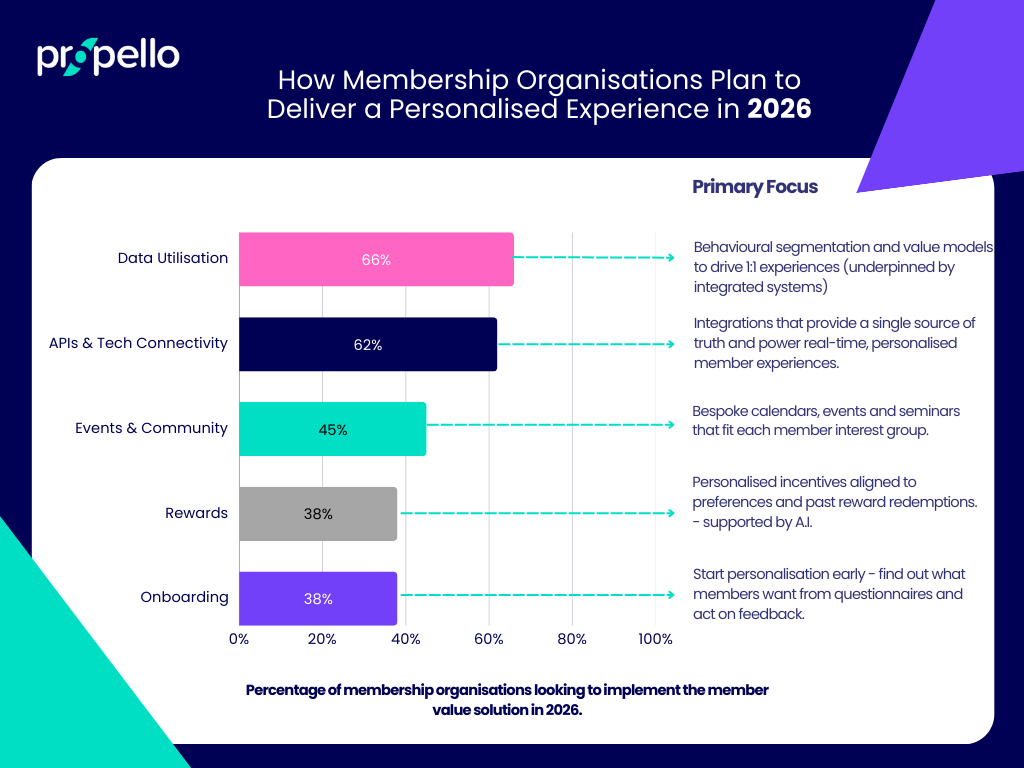
Organisations plan to bring personalisation to life in 2026 using five core strategies. Our 2025 Membership Trends Report breaks them down as follows:
66% will focus on data utilisation. Using behavioural segmentation and value models to deliver 1:1 experiences which are underpinned by integrated systems.
62% are investing in APIs and tech connectivity, creating a single source of truth that powers real-time member experiences.
45% want personalised events and community activities. Designing calendars, seminars, and groups around specific member interests.
38% plan to start early with onboarding. As we’ve seen in previous examples, clearly communicating organisational benefits captures new members. In terms of personalisation, it presents a chance to understand what new members want and act on that feedback.
35% will fine-tune rewards. AI-supported incentives, aligned with past redemptions and personal preferences, support personalisation efforts.
These initiatives show personalisation moving from abstract strategy to daily practice. With better data foundations, integrated systems and dynamic benefits, membership organisations can make every interaction feel more relevant and more valuable.
7) Why Are Tech Integration and Digitisation Critical to Membership Growth?
Tech integration and digitisation are critical to membership growth because they enable data to flow across systems, driving engagement, acquisition, and retention. Both power the seamless, mobile-first experiences members now expect.
For many organisations, legacy tech, clunky user journeys, and complex integration hold back that progress. Effective integration, usable data, and mobile-first UX reduce friction and help personalise member journeys.
What tech integration challenges do membership organisations face?
The barriers aren’t only technical. There are also strategic and operational implications. Organisations know what needs to be done. Unfortunately, resource constraints, competing priorities, and legacy infrastructure slow execution. The result is disjointed journeys that frustrate members and weaken conversion.
The most common barriers fall into five areas:
Development bottlenecks where APIs are deprioritised due to limited tech resources.
Fragmented systems that prevent data from flowing between CRMs, apps, and rewards platforms.
Cumbersome user experiences with too many verification steps or unclear redemption paths.
Outdated portal or WebView journeys that feel disconnected compared to modern app-first experiences.
Security and compliance concerns are slowing down the adoption of SSO and token-based authentication.
Our insights: Are systems and member experience keeping pace?
64% of organisations now rate system integration as a high priority. 56% are focusing on UX and mobile-first delivery.
The gap shows a misalignment. Data is being connected, but the front-end experience isn’t improving fast enough for members to notice.
How can membership organisations improve mobile UX?
Membership organisations are rethinking mobile user experience to remove friction and make everyday engagement seamless. Four core strategies are emerging:
Frictionless sign-up. Many are moving toward password-free logins and pre-defined journeys. This lowers barriers at the very first touchpoint, helping members get started in seconds.
Embedding rewards and benefits. Rather than relying on static portals, organisations are integrating rewards and perks directly into member apps. That way, benefits are always visible and accessible where members spend their time.
Instant redemption. QR codes, digital wallets, and tap-to-claim functionality are becoming standard. Members expect real-time gratification, and instant redemption keeps rewards relevant and engaging.
App-first communities. Portals are giving way to app-first community spaces. These drive daily usage by combining social features, event access and peer exchange in a single, mobile-native environment.
What Other Solutions Are Trending for Membership Organisations in 2026?
Moving on from the core priorities that take precedence in our research, we’ll now look at other trends to expect in 2026 for the membership organisation sector. Many of these have shown up as go-to solutions across several challenges.
Gamification
Partnerships across the membership lifecycle
Referrals as an acquisition channel
Events and community as an engagement lever
Tiers as an engagement strategy
Rewards as a growth and engagement lever
We’ll look at each in turn and where it’s having the most impact.
8) How Will Gamification Turn Passive Members into Habitual Participants?
Gamification turns sporadic use into steady participation by making progress fun and rewarding. Actions as small as logging in, completing profile set-up, booking events and completing modules unlock visible gains and quick payoffs.
Members who feel momentum tend to come back, try new features, and build routines that last beyond initial interaction. Once the mechanics are in place, they keep nudging the right behaviours without needing constant new content or campaigns.
Data from the 2025 Membership Trends Report by Propello Cloud shows that 65% of organisations are exploring gamification to boost ongoing engagement, using consumer-style mechanics (progress cues, prize draws) to make member areas feel active and worth returning to.
How are membership organisations using gamification in 2026?
Smart organisations are adding clear progress cues, pairing priority actions (event attendance, profile completion, CPD) with immediate outcomes, and running short, time-boxed activations to spark revisits.
The mechanics doing the work tend to be familiar ones:
Progress meters and achievement badges
Daily/weekly “rhythm” goals with light perks
Tasks that unlock benefits as you go
Short participation drives (e.g., event sprints)
Status steps that open higher-value access
The primary outcomes are fast feedback, low friction, and rewards that align with the behaviours the organisation values most.
9) How Can Organisations Leverage Partnerships Across the Membership Lifecycle?
The real strength of partnerships is their versatility: a single relationship can serve different goals at different points in the member journey.
One partner might open a revenue stream through affiliate deals, deepen engagement through co-hosted events, then support retention through everyday discounts. That flexibility is why partnerships show up against every priority in our research.
Our 2025 Membership Trends Report shows how organisations plan to put partnerships to work in 2026:
Use Case
%
Example
Revenue Diversification
73% of organisations plan to use partners to diversify revenue.
41% of organisations will leverage partners to drive member retention.
Everyday essentials discounts (supermarkets/fuel), exclusive access, insurance/financial services at member-only rates to offset fees and reduce churn.
Value
33% of organisations plan to form alliances with partners to enhance member value.
Partner-funded discounts/vouchers plus specialist content, toolkits and reports that extend the value stack.
Acquisition
27% of organisations will increase the use of partners to acquire new members
Co-marketing/reciprocal partnerships widen reach, partner-funded referral incentives, and student/corporate routes to reach pre-qualified audiences.
What types of partnerships are available to membership organisations?
Two leading membership organisations (NASUWT and ISM) strengthen member value by combining everyday savings with lifestyle benefits.
Benefit and rewards programmes
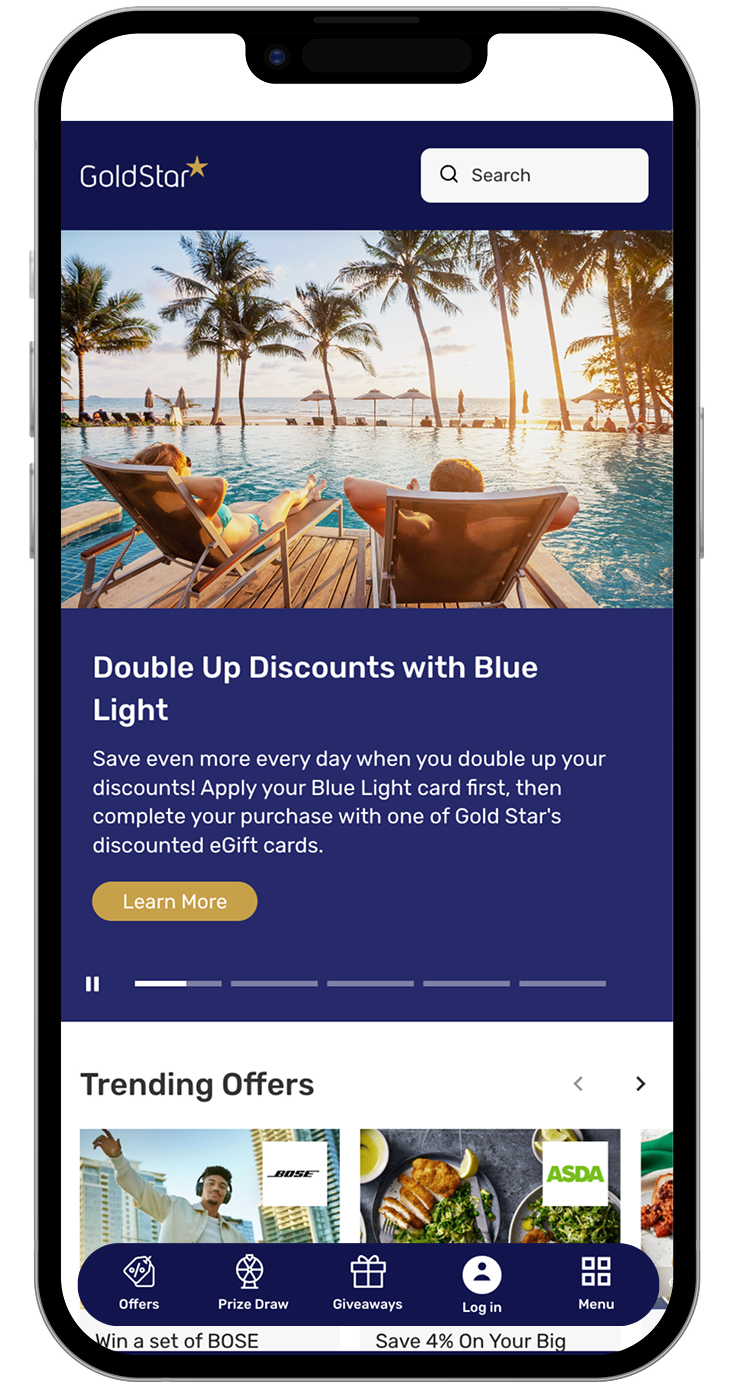
NASUWT Gold Star
NASUWT (National Association of Schoolmasters Union of Women Teachers) offers its members a multi-partner loyalty programme.
The programme features hand-picked lifestyle partnerships to enhance members’ work-life balance, offering savings on everyday essentials such as groceries, health and fitness, beauty, and leisure.
Alongside the discounts, a £20 referral credit is awarded to both the referrer and new member, creating an additional incentive to grow the community.
Partners include Airbnb, lastminute.com, WHSmith, Acer & Currys.
ISM’s Discount Plus
ISM (Independent Society of Musicians) provides its members with a partnership loyalty programme, ISM Discount+, offering savings across everyday essentials and lifestyle categories.
Members can access discounts on groceries, dining, travel, health and fitness, entertainment, and technology, helping reduce the cost of both work and leisure.
The platform features well-known partners including Tesco, Sainsbury’s, Currys, Apple, Cineworld, and Booking.com. A wide range of relevant offers helps support members’ professional and personal lives.
Both programmes succeed because they add real value to memberships. Their partners provide relevant rewards and benefits for higher member engagement. Members also get more from their membership without having to pay extra.
Event sponsorships
Event sponsorships give membership organisations a powerful way to generate revenue while improving the member experience. Partnering with aligned brands allows you to subsidise or upgrade events, thereby reducing costs and enhancing value for members.
Sponsors gain visibility with a targeted audience, and your organisation strengthens its role as a connector between members and the wider industry.
Example: The National Trust works with corporate partners like Cotswold Outdoor to support conservation, walking festivals and member events.
Advertising in publications
Advertising in membership publications turns existing communication channels into revenue streams. Corporate partners pay to reach a highly targeted audience, while members benefit from relevant offers and industry insights.
For the organisation, it monetises existing assets without additional overhead, reinforcing the publication’s role as both an information hub and a valuable platform for engagement.
Example: CIPD’s People Management offers advertising across the website, newsletters and events.
Corporate/strategic partnerships
Corporate and strategic partnerships allow membership organisations to deliver benefits that extend beyond their own resources. By collaborating with aligned companies, they can offer exclusive discounts, services, or insights that enhance membership packages.
At the same time, these partnerships generate predictable income for the organisation and foster long-term relationships that strengthen its financial stability.
Sponsored research and campaigns help membership organisations showcase thought leadership while generating additional income. External partners fund projects that align with shared priorities, such as industry reports or advocacy campaigns.
Members receive credible insights and representations, while the organisation gains both financial support and increased influence in shaping sector-wide discussions and policies.
Training and CPD partnerships expand professional development opportunities without paying the full cost of content creation. Collaborating with trusted providers, they can offer accredited courses or workshops at discounted rates.
Members gain access to high-quality education, while the organisation benefits from a new revenue stream and a stronger position as a career development leader.
Job boards and recruitment advertising partnerships connect members with career opportunities while driving revenue for the organisation. Employers pay to list vacancies in a trusted, sector-specific space, increasing relevance and visibility.
Members get exclusive access to roles aligned with their skills, while the organisation monetises its position as a professional hub and career gateway.
Example: RICS Recruit offers recruiter advertising packages and featured listings.
10) Why Are Referrals a Key Acquisition Channel?
Referrals are one of the most cost-effective ways to acquire new members. Unlike paid campaigns, they convert prospects who already trust the referrer, making them more likely to join and stay.
For organisations facing rising acquisition costs and weaker marketing channels, referrals provide a scalable, authentic path to growth, turning satisfied members into advocates who bring in others.
What triggers poor referral performance?
Without simple tools and instant gratification, referrals risk becoming a vanity project. The usual culprits are easy to spot once you look:
Incentives that arrive too late or feel underwhelming
One-sided rewards that don’t benefit both referrer and friend
Referral journeys hidden deep in platforms, not visible in-app or mobile
Lack of social sharing integrations (WhatsApp, Facebook, etc.)
Weak fraud prevention leading to abuse or mistrust
Our insights: What does the data say about referrals?
Referrals consistently outperform traditional channels on cost and conversion.
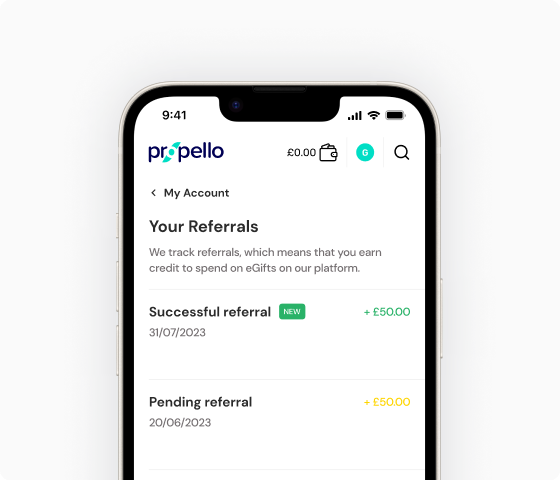
Our 2025 Membership Trends Report found that 49% of membership organisations are considering or reviewing their referral programmes.
This reflects the growing recognition that acquisition isn’t just organic; it can be engineered with the right tools and incentives.
How are membership organisations using referrals in 2026?
Our research shows that organisations are making referrals central to acquisition by modernising their tools and incentives. Many are introducing the following:
Dual-sided offers where both referrer and referee benefit, i.e., credits, free months, and cash rewards
Real-time fulfilment is replacing delayed vouchers, with platforms issuing instant credits or discounts
Integrations with apps and social channels make referrals frictionless, while gamified campaigns (bonus points for five referrals, milestone rewards, etc.) add momentum
GDPR-compliant systems with fraud controls build on trust and sustainability
These approaches will turn referrals from static back-page features into dynamic, always-on acquisition engines.
11) Why Are Events & Community a Core Engagement Lever?
Events and community initiatives are one of the strongest drivers of belonging. Unlike discounts or static benefits, they create shared experiences, relationships, and professional growth that members can’t easily find elsewhere.
Propello Cloud’s 2025 Membership Trends Report reveals that organisations are investing here, with 30% engagement-focused, 33% retention-focused, and 36% member value-focused.
Clearly, events and community are a cross-cutting priority for acquisition, engagement, and retention alike.
What leads to low event & community engagement?
Events and community efforts underperform when they are treated as bolt-ons. Our research highlights several recurring challenges:
Over-reliance on large annual events with little follow-up
Communities launched without moderation, structure, or active facilitation
Poor digital experiences that make forums clunky or inaccessible
Lack of integration between events, community, and other engagement channels
Our insights: What separates thriving membership communities from flat ones?
Organisations that succeed design events and communities as ecosystems, mixing flagship conferences with regular micro-events, online workshops, and always-on forums.
They combine these elements with tools that target non-attenders and encourage members to explore. As one told us, loyalty functionality lets them single out cohorts and actively draw in members who haven’t attended events before.
Investment here is rising, reflecting a recognition that belonging is one of the stickiest forms of member value. It also shows that shared experiences drive loyalty, advocacy, and retention in ways other channels can’t.
How are membership organisations using events & community in 2026?
Organisations are evolving their approach by blending in-person, digital, and community-first models. Instead of isolated events, they’re building ecosystems of engagement where members can connect, learn, and share year-round.
These are the key strategies identified during our discussions.
Use Case
%
Example
Member acquisition
32%
Member open days; Virtual meet ups & micro-events as low-barrier tasters; interactive content (live polls/Q&A) during open sessions; always-on community spaces with guest access; tiered event access with pre-sale invites for prospects; CPD taster workshops.
Member Engagement
30%
Seasonal micro-events to build cadence; tiered event access (VIP lounges/premium sessions); online member community platforms to keep conversations active between events; progress-linked educational tracks to sustain momentum.
Member Retention
33%
Member-only tiers at events (VIP areas, pre-sales) as renewal perks; micro-communities that deepen belonging; CPD milestones proving ongoing value; interactive sessions that recognise long-tenure members.
Member value
36%
Educational programmes mapped to qualifications; always-on community for peer support and mentoring; tiered event access that unlocks premium experiences; virtual meet ups for frequent, practical value; interactive formats to surface member wins and feedback.
Personalised member experience
45%
Interest-based micro-events and community groups; targeted educational pathways with CPD recognition; interactive Q&As tailored to cohort needs; tiered access reflecting status/tenure; always-on platforms with curated feeds by role/interest.
Revenue diversification
39%
Paid events or premium/paid event tiers (VIP bundles, pre-sale upgrades); sponsored micro-events and workshops; paid educational programme with accreditation; community subscriptions for specialist groups.
12) Why Are Tiers a Core Engagement Strategy?
Tiers give members visible progression, status, and exclusivity. As we’ve already seen, unlike flat models (where every member gets the same benefits), tiers reward loyalty, incentivise upgrades, and make participation feel like part of a journey.
When do tiers not work?
Tiers can fall flat when they are poorly structured or overly complex. If members can’t see what they gain from moving up, or if the value gap between free and paid feels too narrow, adoption stalls.
Similarly, if tiers are just “labels” without meaningful differences, members disengage. From our analysis, the recurring pitfalls are:
Free tiers that capture sign-ups but fail to convert to paid
Premium tiers that don’t offer clear, aspirational benefits
Confusing or opaque rules for progression
Gated content that feels punitive rather than rewarding
Over-reliance on discounts instead of diverse, high-value perks
Our insights: How should organisations structure their membership tiers?
Organisations that succeed with tiers design them as ladders of value: free entry points to widen the funnel, gated milestones that reward consistent activity, and premium tiers that create aspiration.
Out of the organisations we spoke to, 63% are focusing on tiers for engagement, 69% for retention, and 33% on value. These investment patterns make tiers one of the most widely adopted levers across the lifecycle.
How are membership organisations using tiers in 2026?
Organisations are consciously moving from static price bands to dynamic engagement journeys. Members are not simply paying more without reason. Progression, reward unlocks, and achieving higher status strengthen their loyalty and reduce the chance of churn.
These are the main use cases for tiers among organisations identified in the 2025 Propello Cloud Membership Trends Report.
Use Case
%
Example
Retention
69% of organisations plan to use tiers to drive retention
Status-only benefits, renewal accelerators, rolling qualification, save offers for at-risk tiers, and priority service.
Paid premium tiers, dual pricing for members and VIP bundles.
Member value
33% plan to use tiers to enhance value
Tier-based discounts and rates, premium content and tools, service upgrades, early access, and concierge support.
Member acquisition
29% plan to use tiers for acquisition
Free entry tier with upgrade path, trial to paid upgrade, starter boosts to reach the first tier, and referral fast track to higher status.
13) Why Are Rewards a Core Growth & Engagement Lever?
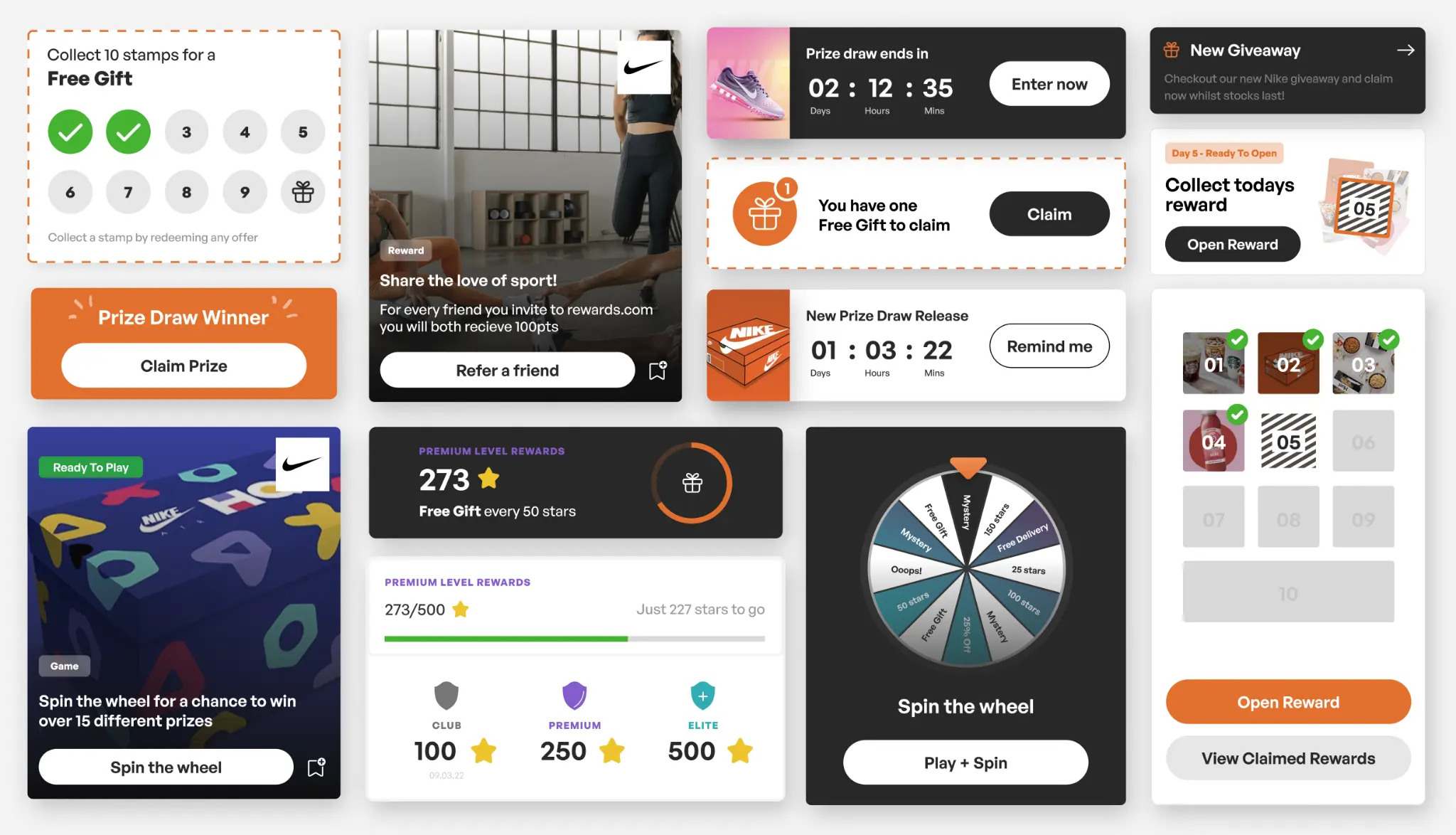
Rewards create immediate reasons to act, from joining and logging in to attending, learning, referring, and renewing. Conditional rewards take the concept even further by directly encouraging positive member habits. Unlike static perks, conditional rewards unlock only when members complete meaningful actions, aligning value with behaviour.
In our2025 Membership Trends Report, rewards show up as a viable solution across several challenges.
58% of engagement-focused organisations use rewards to reinforce target behaviours
46% of retention-focused programmes use rewards to lift renewals and curb churn
44% position everyday savings as tangible member value
38% personalise incentives to preferences and context
22% deploy non-referral sign-up incentives to drive acquisition.
When does membership reward performance stall?
These are the common pitfalls we observed in our research:
One-off welcome perks with delayed fulfilment (e.g., slow voucher drops) that fail to build habits.
Generic or one-sided incentives that feel unfair or irrelevant.
Over-discounting at acquisition that spikes early sign-ups but drives later drop-off.
Poor visibility in-app, with journeys hidden behind logins and no prompts to engage.
Lack of fraud controls and measurement, making ROI unclear.
No staging or expiry rules, so value is claimed without meaningful action.
Our insights: What do effective membership rewards programmes do differently?
The difference comes down to discipline. Effective programmes don’t give value away freely; they tie it to action, release it in stages, and keep it visible so members always know what’s next.
And rather than footing the whole bill, organisations lean on partner-funded offers to keep variety high and costs down, then use member data to target each incentive where it will actually have impact.
How are membership organisations using rewards in 2026?
Organisations are moving from blanket perks to conditional, real-time, and personalised incentives. We’re seeing five dominant patterns:
Use Case
%
Example
Member acquisition
22%
Acquisition incentives like welcome packs, credits, upfront discounts, and giveaways; first-purchase value to prove proposition quickly; time-based hooks (e.g., free box after 3 months) to convert fence-sitters.
Member value
44%
Everyday savings via closed-user-group discounts, cashback, and lifestyle perks; tier-based offers that make membership cost-neutral; dual pricing and premium perks to bank value month-to-month.
Member Retention
46%
Renewal credits and milestone unlocks; time-boxed offers to curb early churn; attendance-driven rewards; win-back campaigns with targeted discounts; loyalty tracks to extend tenure.
Member Engagement
58%
Gamified rewards paired with progress cues; conditional incentives tied to priority actions (profile completion, event attendance); campaign-led unlocks like prize draws and challenges; status-linked benefits to sustain usage.
Personalisation
38%
Data-driven incentives based on cohort, locale, or behaviour; segmentation (e.g., parents vs teens, branches, tiers); location-based offers; progress-led targeting for specific areas; tailored content unlocks tested for impact.
What Are the Emerging Trends Shaping the Membership Sector?
Beyond our research, a few broader shifts stand out across the membership sector. These sit outside the core priorities but are worth watching closely in 2026:
AI in membership management
Demographic shifts (engaging younger members)
While both might be early-stage for many organisations, each is already starting to reshape how the others on this list get delivered.
14) Is AI Now Mandatory for Effective Membership Management?
Artificial intelligence isn’t mandatory yet but is fast becoming unavoidable. According to Memberwise, 100% of membership bodies agree AI’s influence on memberships will grow over the next three years, yet only 16% of associations feel “ready” for future tech demands.
That gap looks worrying at first, but it’s really an opening for forward-thinking organisations. As exploration of AI use cases accelerates, the associations leading it are already seeing gains in operational efficiency, member retention, and engagement.
Where does AI have the greatest impact on membership organisations?
The biggest gains are showing up wherever AI can remove manual effort or sharpen relevance at scale. Six use cases stand out:
Member support automation offers instant responses to basic queries 24/7
AI-driven loyalty programmes can serve relevant rewards to members based on their past redemptions and behavioural data.
Predictive member analytics identifies the content that will resonate with specific member groups
Content personalisation engines tailor content (emails, newsletters, etc.) according to members’ reading history and click patterns
Immersive experience platforms offer virtual networking and training events
Smart onboarding workflows adjust the pace and complexity of the signup process depending on engagement level and completion rate
While the remaining 84% of associations try to catch up, early adopters are already creating memorable member experiences. They’re delivering the exceptional value proposition that members expect and deserve.
15) How Are Demographic Shifts Reshaping Membership Strategies?
They’re forcing a generational rethink. In the UK, Millennials and Gen Z now make up most of the workforce, and they expect something older membership models often weren’t built to give. If you’re not speaking their language, you’re leaving real growth on the table.
AsMustard Research puts it, “Younger members demand AI-driven, flexible, digital-first offerings that provide immediate value.”
Meeting that demand means clearing real barriers, from building digital-first experiences to re-evaluating the whole value proposition. But the size of the prize makes younger members a priority through the rest of 2025 and into 2026.
How can organisations engage their younger members effectively?
It’s about four moves: understand them, meet them in the digital space, build in flexibility and give them something to belong to.
Understanding your audience: Gather preferences through surveys, feedback, and monitoring social channels. Insights into younger members’ needs help shape services that resonate.
Commit to digital: Younger members also expect a strong digital presence, from user-friendly websites to meaningful interaction via social media. Content should reflect generational preferences: image-led for Millennials, video and interactive formats for Gen Z, along with webinars, podcasts and e-learning.
Make flexibility non-negotiable: With subscription models dominating their daily lives, rigid membership structures risk alienating digital natives. Offering variety, adaptability, and personalised options will drive uptake and retention.
Build community: Younger members want purpose-driven spaces where they can share values, grow their networks, and progress their careers. Delivering on these expectations can transform membership organisations into vibrant, future-focused communities.
The membership ecosystem will continue to evolve. Thriving organisations monitor changing membership trends and take proactive steps to provide ongoing value for their members.
Join their ranks today by:
Embracing real-time engagement and rewards programmes that scale value delivery and prioritise your members’ needs
Personalising the member experience to promote participation and long-term loyalty
Diversify your revenue streams before economic pressure forces your hand
Build inclusive, tech-driven micro-communities where members can connect, collaborate, and learn from each other
Start acting on these trends today, and you could lead your industry next year.
FAQs
What are the biggest challenges for membership organisations in 2026?
Falling member engagement, rising acquisition costs, and weak retention dominate. Members expect mobile-first, real-time engagement and personalised experiences. Clearer membership value propositions and digital transformation are vital to sustain long-term growth and trust
Which strategies most improve member retention?
Document an engagement strategy, then layer gamification, tiered membership, and behaviour-linked rewards. Use data analytics to flag churn, trigger timely saves, and quantify value. Always-on online communities and hybrid events deepen belonging and lift renewals and lifetime value.
What’s the fastest way to boost member engagement?
Reduce friction and offer flexibility: mobile-first journeys, passwordless sign-in, and in-app rewards. Run micro-communities, interactive content, and hybrid and virtual events. Use real-time engagement nudges and cohort targeting to keep members engaged between major touchpoints.
How should organisations personalise experiences at scale?
Blend declared preferences with behavioural signals to segment journeys. Trigger AI-powered recommendations for content, events, and rewards in real time. Personalise onboarding and renewal prompts. Measure lift with data analytics, member feedback, and controlled experiments.
How can events and community enhance outcomes?
Blend in-person, hybrid events, and virtual events with always-on forums. Use live polls and Q&A to convert content into interaction, and curate networking opportunities by interest. Track participation to improve member learning, professional development, and overall satisfaction.
What role do partnerships play across the lifecycle?
Partners extend revenue streams and membership value propositions. Co-marketing aids membership acquisition, while partner perks and CPD deepen engagement. Sponsored content supports content creation, and data sharing improves targeting
What metrics best evidence ROI for leadership?
Track active users, repeat logins, event attendance, course completions, and referral rate. Link these to renewals, NPS, and lifetime value. Attribute gains to interventions using A/B tests, predictive analytics, and cohort reports to prove how engagement drives retention and revenue.
Which emerging technologies are worth piloting now?
AI-powered personalisation, augmented reality for training, and mobile wallet passes for instant redemption. Explore community platforms supporting micro-communities and social media integration. Prioritise secure APIs and single sign-on to unify membership sites and improve reliability.
Mark Camp
Mark is the Founder and CEO of Propello Cloud, an innovative SaaS platform for loyalty and customer engagement. With over 20 years of marketing experience, he is passionate about helping brands boost retention and acquisition with scalable loyalty solutions.
Mark is an expert in loyalty and engagement strategy, having worked with major enterprise clients across industries to drive growth through rewards programmes. He leads Propello Cloud’s mission to deliver versatile platforms that help organisations attract, engage and retain customers.
Start your customised Propello Cloud journey today
Explore the platform’s scalability, features and customisation options and get answers to your unique questions.



.png)
 Our 2025 Membership Trends Report found that 49% of membership organisations are considering or reviewing their referral programmes.