Partnership marketing gives businesses a way to grow faster by combining strengths with complementary brands. There are ten main types of marketing partnerships — from loyalty and affiliate to barter, white label and strategic B2B.
Mark Camp
CEO & Founder at PropelloCloud.com
Contents
Key Takeaways
Loyalty partnerships extend the value of your rewards programme by giving customers access to benefits across complementary brands.
Barter exchange lets businesses acquire goods or services without cash by trading excess inventory or spare capacity.
Affiliate marketing delivers cost-effective, measurable acquisition by paying partners only for the results they generate.
Distribution partnerships create access to established networks and logistics, getting your product to market faster.
White label partnerships offer the quickest route to launching new products without investing in development from scratch.
Referral partnerships drive high-quality leads at low cost through trusted, word-of-mouth recommendations.
Sponsorship partnerships build emotional brand association by connecting you with events and causes your audience cares about.
Strategic B2B partnerships combine complementary strengths to unlock markets and capabilities neither business could reach alone.
Social responsibility and charity partnerships strengthen brand reputation while creating genuine, visible community impact.
Product placement puts your brand in front of audiences during moments of high engagement within popular media content.
Each model suits different goals, resources and customer journey stages. This guide breaks down how each one works, what it costs in time and money, and how to decide which fits your programme.
According to Propello Cloud’s 2025 Loyalty Uncovered Report, 84% of enterprise brands now rank strategic brand partnerships as a top investment priority — equal first alongside personalisation. That stat tells you something important: partnerships are no longer a nice-to-have. They are a core mechanic of modern loyalty strategy.
But with ten distinct models to choose from, the question isn’t whether to partner. It’s which type of partnership actually fits your goals, your team’s capacity and your customers’ journey.
Before comparing models, four principles apply across all of them:
Aligned values and goals — both parties need complementary audiences and clearly defined objectives from the start
Legal and contractual clarity — IP, exclusivity and confidentiality should be addressed early
Agreed KPIs and communication cadence — open reporting keeps both sides accountable
Built-in flexibility — every partnership needs room to evolve as circumstances change
With those foundations in place, here is what distinguishes the ten models.
How Do the 10 Types of Marketing Partnerships Compare?
Partnership marketing is a broad category. The ten models below sit across a spectrum from low-effort, low-cost quick wins to high-effort, high-differentiation strategic investments. Use this table as a starting framework before reading the full breakdown.
Key consideration: According to Propello’s research, 67% of enterprise brands cite partnership management complexity as a significant challenge. Choosing the right model upfront dramatically reduces that operational burden.
What Is a Loyalty Partnership?
A loyalty partnership is a collaboration between two or more businesses that combine their loyalty programmes or rewards to offer customers shared benefits. Rather than each brand operating its programme in isolation, the partnership creates a joint experience where customers earn and redeem rewards across both brands.
This is the highest-priority partnership model for enterprise brands focused on retention. Propello’s 2025 research found that 84% of enterprise brands rank strategic brand partnerships as a critical investment — with retail brands leading adoption at 88%. The reason is straightforward: loyalty partnerships let brands co-create personalised rewards that neither could deliver alone, deepening emotional connection without proportionally increasing cost.
Which goals does a loyalty partnership serve?
Loyalty partnerships are best suited to brands that already have an existing programme and want to increase its perceived value. They are particularly strong in:
Health and Fitness — gyms partnering with nutrition or sports retail brands
Retail and Ecommerce — expanding incentives across complementary product categories
Financial Services — banks and credit card providers linking rewards to merchant partners
Travel and Hospitality — cross-redemption across airlines, hotels and car hire
Entertainment and Media — streaming platforms bundling with subscription memberships
Image: starbucksbenefits.com
The collaboration between Starbucks and Spotify highlights the possibilities of merging digital loyalty programmes from beverage brands with music streaming services. As younger demographics increasingly use smartphones for content, the integration of cross-partnership rewards can attract them to join loyalty programmes that offer combined benefits.
What are the trade-offs?
The main advantages are increased retention through emotional connection, enhanced customer experience across brands, and expanded visibility through partner networks. The risks are implementation complexity, potential brand dilution if partner values misalign, and data-sharing protocols that need careful legal structuring.
The critical success factor: seamless integration and user experience. A loyalty partnership that creates friction at the redemption stage destroys the value it was designed to deliver. Brands should also ensure partner offerings are complementary rather than competing.
Propello insight: According to our 2025 report, brands using outsourced loyalty platforms with pre-built partner networks can cut partnership integration timelines significantly — Lebara expanded from 15 to over 100 brand partnerships after moving to a specialist platform, while reducing operational costs by 3x.
What Is an Affiliate Marketing Partnership?
An affiliate marketing partnership is an arrangement where one business (the affiliate) promotes another’s products or services through their own channels, earning a commission for each successful referral or sale. Unlike most partnership models, affiliate performance can be precisely tracked through digital programme metrics, making it one of the most accountable forms of partner marketing.
Choose affiliate if your primary goal is scalable, measurable acquisition. You only pay for results, which makes it low-risk to test and easy to scale by adding more affiliates as you grow.
What makes affiliate partnerships work?
Performance-based model — you pay for actual results, not exposure
Scalability — add affiliates as your programme grows without proportional overhead
Diversified acquisition — reduces dependency on any single channel
Data-driven — every referral, click and conversion is trackable
The model works across almost every sector. Ecommerce and retail brands partner with content creators and influencers. Financial services firms work with comparison sites and finance bloggers. SaaS companies use referral links through review platforms and newsletters.
What are the risks?
Revenue can be unpredictable because it depends on affiliate performance. You also have limited control over how affiliates represent your brand, which creates compliance risk — particularly around advertising standards and data protection regulations. Varied commission structures can complicate financial planning.
Expert view: Lee Metters, Brand Partnerships Client Partner at Awin, notes that measuring ROI in traditional partnership campaigns is difficult because “brands are reliant on partner brands passing back performance data — this is time-consuming and brands are less flexible to react and optimise campaigns in real-time.” Affiliate networks with built-in attribution solve this directly.
Best for: performance-driven marketing teams, ecommerce brands, and any business that needs to diversify acquisition channels without upfront media spend.
What Is a Referral Partnership?
A referral partnership is an agreement where each party refers potential customers to the other, typically in exchange for financial compensation, commissions, reciprocal referrals or other rewards. The distinguishing feature is trust: referrals arrive pre-warmed by a recommendation from a source the prospect already trusts.
Referral partnerships generate higher-quality leads at lower cost than most acquisition channels. Leads from warm introductions convert at higher rates and tend to have stronger long-term retention because the relationship started with trust, not a cold pitch.
Where referral partnerships perform best
Referral works in any sector where personal recommendation carries weight in the buying decision:
Financial Services — banks and investment firms referring complementary services
SaaS and Technology — existing users referring others in their network
Fitness and Wellness — gym members bringing in friends for membership growth
Hospitality and Travel — existing customers earning rewards for booking referrals
What are the risks?
The main risks are dependency, control and consistency. If a referring partner’s business declines or the relationship ends, your referral volume drops with it. You also have limited control over how partners describe your product. And at scale, tracking and crediting referrals accurately becomes operationally complex.
The fix for all three: clear incentive structures for both sides, complementary audience overlap confirmed before launch, and referral tracking integrated directly into your existing customer journey.
Best for: businesses in high-trust sectors, brands with strong NPS scores, and teams looking for cost-effective acquisition without media spend.
What Is a White Label Partnership?
A white label partnership is an arrangement where one company produces a product or service and another sells it under their own brand. The white label provider handles production; the partner focuses on marketing and sales. It is the fastest route to expanding your product range without investing in development from scratch.
Choose white label when speed to market matters more than differentiation. The product already exists, the infrastructure is already built, and your team can focus on what it does best.
The core advantages
Fastest route to market — no development cycle, no infrastructure build
Significant cost savings — R&D, production and equipment costs are the provider’s problem
Focus on core competencies — your team stays on marketing, sales and customer experience
Scalability — flex capacity up or down without capital investment
White label is particularly common in technology (software and apps), financial services (payment gateways, banking apps), ecommerce (own-brand product ranges) and health and wellness (supplements and branded equipment).
What are the risks?
Limited differentiation is the primary downside — if competitors use the same provider, your product looks identical. You are also dependent on the provider’s roadmap, reliability and pricing, which reduces your long-term control. Revenue sharing reduces margins compared to proprietary offerings.
The key question to ask before signing: does the provider offer enough customisation and branding flexibility to make the product genuinely feel like yours? And do the pricing terms allow a competitive margin?
Best for: brands looking to launch a new product category quickly, teams without in-house development capacity, and businesses that want to test a new market before committing to a build.
What Is a Distribution Partnership?
A distribution partnership is a collaborative agreement where a manufacturer or supplier partners with a distributor to sell their products or services. The distributor handles marketing, sales and logistics, leveraging their networks to reach more customers and expand market reach.
Choose distribution when market access is the bottleneck, not product quality. These partnerships are most valuable for entering new geographies, reaching specific retail segments, or accelerating speed to market using infrastructure that would take years to build independently.
Distribution partnerships typically take two forms:
Cross-marketing — joint advertising campaigns and co-branded materials to reach each other’s customer segments
Bundling — combining complementary products or services into a single offering, increasing perceived value and cross-sell potential
What are the trade-offs?
The upside is clear: expanded reach, faster speed to market, access to local expertise, and cost efficiency through shared logistics. The downside is a loss of direct customer relationships, dependency on the partner’s reputation and performance, and profit sharing that reduces margins.
The critical consideration: balance the reach you gain against the control you lose. Establish clear exit strategies before signing, and ensure your distribution partner’s reliability and track record are verified independently.
Best for: product businesses entering new markets, brands without established retail or logistics infrastructure, and companies where geographic reach is the primary growth lever.
What Is a Strategic B2B Partnership?
Strategic B2B partnerships are collaborative relationships between two businesses that leverage each other’s strengths, resources and expertise to achieve shared goals. These go beyond simple supplier-buyer arrangements — they involve deeper collaboration such as joint ventures, co-development projects, content partnerships or shared market access.
This is the highest-effort, highest-reward model. Strategic B2B partnerships create differentiation that competitors genuinely struggle to replicate. But they require significant management bandwidth and carry higher stakes if the relationship breaks down.
Where strategic B2B delivers most value
These partnerships work best in sectors where growth, innovation or market access depends on combining capabilities no single business can easily build alone:
Technology — software companies partnering with hardware manufacturers on R&D
Healthcare and Pharmaceuticals — joint clinical trials and drug development
Professional Services — combining expertise for comprehensive client solutions
What are the risks?
Cultural differences between organisations can create friction in decision-making. Sharing capabilities with a partner who later becomes a competitor is a genuine risk. Dissolving a deep strategic partnership carries complex legal and financial consequences. And maintaining the relationship requires ongoing communication that strains teams with limited capacity.
The non-negotiables before committing: compatibility of working styles and culture, crystal-clear roles and decision-making processes, and explicit provisions for exit if objectives diverge.
Best for: mature businesses seeking genuine market differentiation, organisations that need capabilities they cannot build in-house within a reasonable timeframe, and brands willing to invest in a long-term relationship rather than a transactional arrangement.
The Remaining Four: Barter, Sponsorship, Social Responsibility and Product Placement
These four models are less commonly the primary partnership strategy for enterprise brands, but each serves a specific purpose depending on your goals and resources.
What Is a Barter Exchange Partnership?
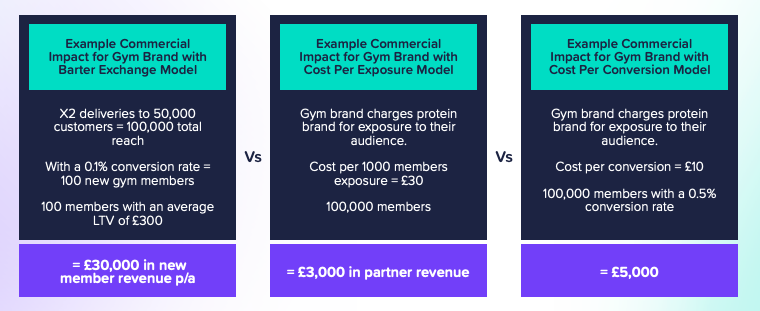
Barter exchange is a trade system where goods or services are swapped directly between two parties without using money. Businesses trade excess inventory or spare capacity for things they need, avoiding cash expenditure.
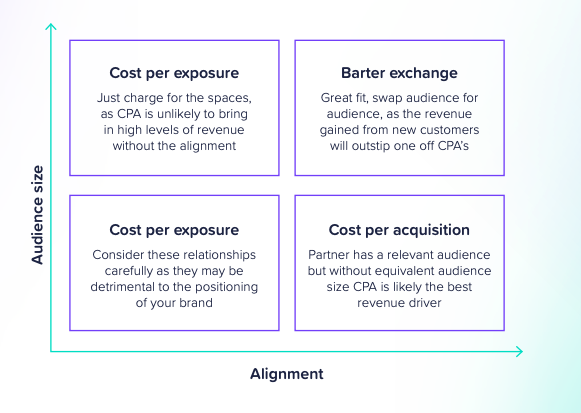
When does it make sense? When you have underutilised assets — hotel rooms during off-peak periods, advertising space, surplus stock — and a clear counterparty with something of equivalent value. The main challenges are establishing fair value equivalence upfront and tracking transactions without a monetary benchmark. Detailed record-keeping and agreed valuation methods are essential before any exchange begins.
What Is a Sponsorship Partnership?
A sponsorship partnership provides financial or material support to an event, organisation or individual in exchange for promotional benefits. The sponsor gains brand exposure and audience access; the sponsored party gets resources to operate or grow.
Best suited to: brands building emotional association with a specific audience, community or cause. Sports, technology, financial services and health and wellness are the most active sponsorship sectors. The primary risks are high upfront cost, difficulty attributing direct ROI, and reputational exposure if the sponsored party attracts controversy. An activation plan beyond logo placement is essential — sponsorship without activation rarely delivers.
What Is a Social Responsibility and Charity Partnership?
Social responsibility partnerships are collaborations between businesses and nonprofit organisations or charitable causes. They address social or environmental issues while strengthening brand reputation, employee engagement and customer loyalty.
The primary benefit is genuine social impact that reinforces brand values in a way purely commercial activity cannot. The risks include financial commitment, reputational exposure if the cause partner faces scrutiny, and the difficulty of measuring ROI. Authenticity is the deciding factor — the cause must genuinely connect to your brand, not feel like a marketing exercise.
What Is a Product Placement Partnership?
Product placement integrates a brand’s products into media content — films, TV shows, music videos, games or online content — to create recognition and generate consumer interest without interrupting the audience with a traditional advertisement.
Best suited to: consumer brands in entertainment, automotive, fashion, technology and travel where visual association with popular culture creates natural brand affinity. The risks are high cost for prominent placements, limited control over how the product is portrayed, and the possibility of the placement feeling inauthentic if the fit is forced. Natural fit within the content is non-negotiable — forced placements backfire.
How to Choose the Right Type of Marketing Partnership
Choosing the right model comes down to three questions. Answer these honestly before approaching any potential partner.
1. What is your primary goal?
Goal
Start here
Reduce churn and increase retention
Loyalty partnership
Acquire new customers at low cost
Affiliate or referral
Enter a new market quickly
Distribution or white label
Build brand awareness and emotional association
Sponsorship or product placement
Unlock capabilities you cannot build in-house
Strategic B2B
Reduce costs using existing assets
Barter exchange
Strengthen brand reputation and culture
Social responsibility
2. What are your resources and constraints?
Speed-to-market and resource capacity are the two most common reasons partnerships fail to launch. Propello’s 2025 research found that 69% of enterprise brands prefer outsourced loyalty solutions specifically because they launch faster and scale more easily than in-house builds. The same logic applies across partnership types: the more complex the model, the more internal resource it consumes.
If your team has limited capacity, start with lower-effort models (affiliate, referral, white label) and build toward higher-effort ones (loyalty, strategic B2B) once you have the infrastructure in place.
3. Where is your customer in their journey?
Early-stage customers respond best to referral and affiliate — they arrived through a trusted recommendation and need to see value quickly
Engaged customers benefit from loyalty partnerships and barter-style rewards that extend the value of what they already have
At-risk customers are best retained through loyalty partnerships with real-time rewards and personalised incentives
Key takeaway: The right partnership type is the one that solves your most pressing business problem with the resources you actually have — not the most sophisticated model you could theoretically build. Start there, prove the model, then expand.
Ready to Master Brand Partnerships?
Choosing the right type of marketing partnership matters, but the real key to success is making sure the relationship benefits both sides. When risks and rewards are shared equally, both parties remain invested in sustaining a productive, lasting partnership.
If you are ready to build a thriving partner ecosystem — identify strategic partners, structure relationships for long-term success, and avoid the most common reasons partner programmes fail — our Partnership Marketing Playbook is the right next step.
FAQs
What are the main types of marketing partnerships, and how do they differ?
Marketing partnerships span from co-branding partnerships and sponsorship marketing to content marketing partnerships and channel partnerships. Each type serves different goals – some focus on product integration, others on lead generation or reaching new audiences.
How can marketing partnerships benefit businesses of different sizes?
Partnerships help businesses solve pain points regardless of size. Small companies gain credibility through association, while larger firms can test new markets cost-effectively. Both benefit from shared marketing budgets and expanded customer bases, making partnerships valuable for any business model.
What are the key steps to forming a successful marketing partnership?
Start by identifying clear objectives and finding partners with aligned values. Create detailed agreements covering roles and expectations. Develop a landing page showcasing partnership benefits. Establish communication channels and metrics for success. Build trust gradually through open dialogue.
How do you evaluate the potential success of a marketing partnership?
Examine potential partners’ track record through case studies. Assess audience overlap and brand alignment. Review their approach to building trust with loyal customers. Consider financial stability and resource compatibility. Evaluate their commitment to partnership growth and shared success.
What are the most common challenges in marketing partnerships, and how can they be resolved?
Common challenges include misaligned expectations and inconsistent communication. Partners may struggle with different business cultures or competing priorities. The solution lies in clear agreements, regular check-ins, defined responsibilities, and mutual respect for each partner’s contribution.
How can you measure the ROI of a marketing partnership?
Track specific metrics like revenue growth, lead generation quality, and customer acquisition costs. Monitor conversions and shared campaign performance. Measure audience engagement and brand sentiment. Compare results against pre-partnership benchmarks. Assess ROI through multiple data points.
What legal or contractual considerations are essential for marketing partnerships?
Create comprehensive agreements covering revenue sharing, intellectual property rights, and termination clauses. Address content ownership, data protection, and confidentiality. Define dispute resolution processes. Ensure compliance with industry regulations. Include clear performance expectations and review periods.
How can businesses find the right marketing partner?
Research potential partners’ values and reputation. Network at industry events and through channel partnerships. Evaluate their content marketing partnerships and customer relationships. Consider cultural fit and business model alignment. Look for complementary strengths and shared target audiences.
What role does trust play in sustaining a marketing partnership?
Trust forms the foundation of successful partnerships. It develops through consistent delivery on promises, transparent communication, and shared commitment to growth. Partners must demonstrate reliability, protect shared interests, and maintain honest dialogue about challenges and opportunities.
Can small businesses and startups benefit equally from partnerships as large corporations?
Yes, startups can leverage partnerships effectively through creative collaboration. While they may lack big marketing budgets, small businesses often bring innovation, agility, and engaged customer bases. Success depends on finding partners who value these unique strengths.
Mark Camp
Mark is the Founder and CEO of Propello Cloud, an innovative SaaS platform for loyalty and customer engagement. With over 20 years of marketing experience, he is passionate about helping brands boost retention and acquisition with scalable loyalty solutions.
Mark is an expert in loyalty and engagement strategy, having worked with major enterprise clients across industries to drive growth through rewards programmes. He leads Propello Cloud’s mission to deliver versatile platforms that help organisations attract, engage and retain customers.
Start your customised Propello Cloud journey today
Explore the platform’s scalability, features and customisation options and get answers to your unique questions.