Loyalty Programme Analytics: Turning Insights into Action
25 min to read
Published: February 13, 2024
Updated: August 3, 2026
In this blog, I’ll explore how loyalty programme analytics can provide you with the holistic picture that you need to craft compelling and personalised customer experiences that can transform your customers into lifelong brand advocates.
Mark Camp
CEO & Founder at PropelloCloud.com
Contents
Key Takeaways
Emotionally connected customers are worth more than merely satisfied ones. Analytics shows you who is forming that attachment, so you can protect it.
Engagement is a spend signal, not a soft metric. The customers who genuinely engage are the ones who buy more and stay longer.
Sentiment data catches silent churn. A frustrated member rarely complains, they just go quiet, and analytics flags them while you can still act.
Loyalty analytics and retention analytics are not the same thing. One looks forward to predict what customers will do, the other looks back to explain what already happened.
Relevance is what makes a reward work. Segment first, then personalise, so each customer gets the incentive they actually value instead of a generic perk.
While challenges like data quality and privacy compliance exist, investing in the right tools and processes sets your loyalty programme up for long-term success and improved customer retention.
What Is Loyalty Programme Analytics?
Loyalty programme analytics is the practice of turning the data your programme already collects, every purchase, redemption and piece of feedback, into decisions you can act on. Done well, it tells you who your best customers are, why they stay, and where the next pocket of growth is hiding. Most teams collect all of it and read almost none of it.
You already collect the data. Every business running a loyalty programme does. Analytics is just the discipline of reading it properly.
Every purchase, every reward redeemed, every piece of feedback is a signal about what a customer values and what they will do next.
Taken one at a time, those signals are noise. Read them across your whole base and the patterns come up hard: who buys what, when, how often, and which customers are quietly packing to leave.
That is the raw material behind every personalised experience worth building, and the best programmes treat that reading as a habit, not a quarterly report.
What insights can loyalty programme analytics give you?
Dig in and four kinds of insight come out, each worth chasing for a different reason.
Purchase behaviour
Start with transaction data, because it is the layer that never lies. It tells you what customers buy, when they buy it, and how often.
That alone drives the moves most programmes fumble: cross-sell the product that actually pairs with the last one, upsell the tier a customer is already behaving their way into, and time a promotion for the week a segment genuinely buys rather than the week your calendar says.
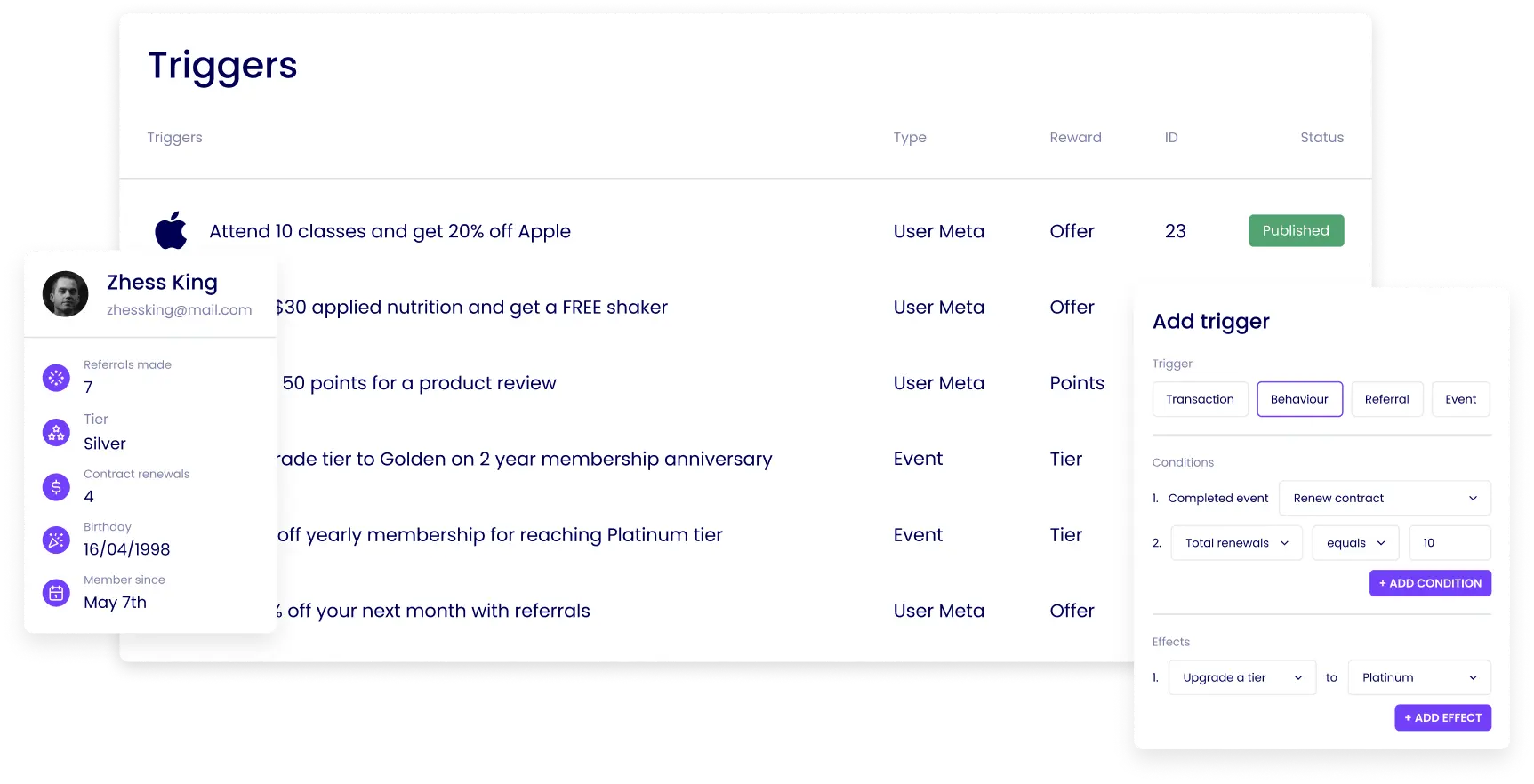
Then it goes further. Trigger a reward off a specific action, a bigger subscription in exchange for a perk worth having, and the programme stops recording behaviour and starts shaping it.
Your most valuable customers
Purchase behaviour points you to the customers who matter most.
Run lifetime value, what a customer is worth to you across the whole relationship, and purchase frequency across the base and a top slice separates out. These are people who spend more, stay longer, and cost a fraction of what you would pay to replace them.
Point your best rewards at them, the exclusive perks, the early access, the small signals that tell them they are seen, and you defend the revenue you can least afford to lose.
Customer sentiment
Behaviour tells you what customers did. Sentiment tells you how they felt about it, and the two do not always agree.
Feedback, reviews and the things people say on social pull that feeling into view. The redemption journey they abandoned halfway, the rewards catalogue they scrolled straight past, the small frustrations that never make it into a formal complaint.
Those are cheap to fix once you can see them and expensive to ignore, because a frustrated member rarely complains. They go quiet, they stop redeeming, and one renewal later they are gone.
Sentiment analytics catches them while you can still do something about it.
Growth opportunities
The first three insights explain the present. This one gets ahead of it.
Track behaviour and preferences over time and the data starts to lean forward: a segment drifting toward sustainable rewards, a category quietly gaining pace, a habit forming across your base that you could build an offer around.
That might mean widening the rewards you offer, or a new line built around demand your own data spotted before the market did. Either way, the programme has stopped looking backward.
What Are the Benefits of Loyalty Programme Analytics?
The honest answer is five, and they are connected. Analytics lifts lifetime value, engagement, experience, retention and programme ROI, and the gains reinforce each other.
Increased customer lifetime value (CLV)
One key benefit of using loyalty programme analytics is the potential to increase customer lifetime value (CLV). Analytics provide insights that allow you to serve customers better and strengthen their emotional connection to your brand.
A customer’s lifetime valueincreases by 306% when they develop an emotional connection to a brand.
Improved customer engagement
By leveraging customer engagement analytics, you can create a loyalty programme that not only rewards your customers but also keeps them engaged. Rosetta found that actively engaged customers make90% more purchases, spend 60% more per transaction, and are more likely to choose the brand again.
Improved customer experience
Behaviour patterns show you where the experience quietly breaks: the tier nobody climbs, the reward nobody claims.
See the friction clearly and the fix stops being guesswork, whether that means a better service team or a reward structure that worked on a whiteboard and nowhere else.
You do not have to take the mechanism on trust. Lebara runs its rewards programme on exactly this loop:
“Propello Cloud provides us with data insights on our most engaged offers, which helps us to build a unique member rewards experience and informs incentives we employ to maintain high levels of customer retention.” Dominic Emery, Commercial Product Manager, Lebara.
The data shows which offers land, the rewards follow the data instead of a hunch, and the retention follows the rewards. That is the whole chain, described by someone running it.
Reduced customer churn
Churn rarely announces itself. It shows up as a dip first: fewer logins, a skipped renewal, a reward left unredeemed. Analytics reads those signals and flags the customer while you can still act, not at the cancellation screen when the mind is already made up.
The cheapest customer to keep is the one who has not yet decided to leave, and your satisfaction data finds them before they go quiet for good.
Increased programme ROI
But perhaps the most compelling reason to embrace loyalty programme analytics is the potential for increased ROI.
By focusing your efforts on your most valuable customers and creating personalised experiences that keep them engaged, you can boost loyalty programme ROI and long-term growth for your business.
What’s the Difference Between Loyalty Analytics and Retention Analytics?
Loyalty analytics takes the wide view, the whole customer journey, and leans forward to predict what customers do next. Retention analytics takes the narrow view, the factors behind churn, and looks back at what already happened.
Both come out of the same loyalty data, so people treat them as one thing. They are not. The table shows where they split.
Aspect
Customer Loyalty Analytics
Customer Retention Analytics
Focus
Customer behaviour across the entire customer journey
Specific factors contributing to customer retention
Data Scope
Holistic view of customer interactions and preferences
Narrower focus on retention-related metrics
Data Sources
Loyalty programme data, purchase history, customer interactions, etc.
Customer lifetime value, churn rate, customer satisfaction scores, etc.
Insights
Trends, patterns, and preferences that drive customer loyalty
Factors that contribute to customer churn and retention
Predictive Capabilities
Uses data to predict future customer behaviour and trends
Primarily focuses on analysing historical data to identify patterns
Goal
Creating personalised experiences to increase customer loyalty
Identifying and preventing customer churn
Approach
Proactive, predicting customer needs and preferences
Reactive, addressing issues that may lead to customer defection
Outcome
Increased customer loyalty, engagement, and lifetime value
Improved customer retention rates and reduced churn
Helps maintain and protect existing customer relationships
The biggest split is predictive power.
Loyalty analytics doesn’t just explain the past, it uses it. Track customer data over time and patterns start pointing forward: notice that buyers of one product tend to reorder within a set window, and you can build a campaign that lands right when they are ready to buy again.
That is analytics working as a forecast, not a post-mortem.
Retention analytics plays the other role. It digs into what already happened, the churn you can now explain, and that is genuinely useful for fixing what broke. But it tells you where you have been, not where a customer is heading.
You want both.
The wide, forward-looking read of loyalty analytics and the sharp, backward-looking focus of retention metrics answer different questions. Run them together and you get the full picture of what your customers are about to do and what to fix so more of them stay.
How Do You Use Loyalty Programme Analytics?
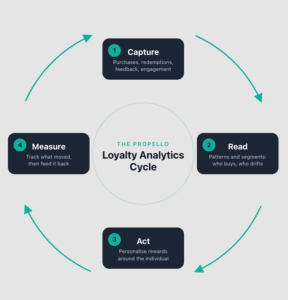
Most teams treat analytics as a report: pull the numbers, read them once, move on. The programmes that improve run it as a loop instead. We call it the Loyalty Analytics Cycle, and it turns on four stages that feed each other:
Capture the data your programme already generates: purchases, redemptions, feedback, engagement.
Read it for patterns and segments: who is buying, who is drifting, who is worth knowing by name.
Act on what you find, building rewards and offers around the individual rather than the average.
Measure what moved, then feed that straight back into the next capture.
The point is the arrow back to the start. One turn of the cycle sharpens the next, so the programme gets smarter each time round instead of resetting every quarter.
The five steps below are how you run each stage in practice.
Segment the data,
personalise off the back of it,
track the metrics that matter,
wire it into your other systems, and
keep the customer journey in view throughout.
Step #1: Analyse and segment customer data
Start by pulling everything the programme knows into one place: transaction histories, reward redemptions, lifetime value, demographics. On their own these are just fields in a database. Together they start to describe actual people.
Then split those people into groups that behave alike.
Segmentation turns a spreadsheet into a map, and it surfaces patterns a single-customer view would bury. You might find one segment chasing experiential rewards, early access, events, the money-can’t-buy stuff, while another just wants cold hard cash off the next order.
That distinction matters.
Reward both groups the same way and you underwhelm one while overpaying the other. Segment first and you give each type the incentive it actually values, not a compromise that lands for nobody.
Step #2: Personalise rewards and offers based on data
Segmentation gets you to the group. Personalisation gets you to the person, and that is where the return sits.
Use the data to shape recommendations, offers and messages around the individual, not the average, so that what a customer sees actually reads as if it were meant for them.
The payoff is measurable. Bond’s Loyalty Report found that success in personalisationleads to a6.4x increase in programme satisfaction among members.
Step #3: Monitor key metrics for programme optimisation
Going live is the start of the work, not the end of it. The programmes that improve get measured on a schedule: performance tracked, feedback gathered, the findings fed straight into the next round of changes.
Track more than the obvious loyalty numbers.
Customer Effort Score is the one most teams miss. It measures how hard a customer has to work to get value out of your programme, and effort is one of the biggest predictors of whether they stay.
Read it against your other metrics, such as redemption rate, engagement rate, or customer satisfaction score, and it earns its place. If the customers with high effort scores are also the ones with low redemption or engagement, that is your programme telling you it is too much like hard work.
The friction shows up in the numbers before it shows up in your churn. Fix the effort and the rest tends to follow.
Step #4: Integrate with existing systems
Analytics only works if the data seamlessly connects with your other customer-facing systems.
Your loyalty programme should feed and read from the systems around it, CRM, POS, marketing automation, so activity lands in one connected view instead of a dozen disconnected ones.
Step #5: Keep the customer journey front and centre
None of this is really about data. It is about the experience the data lets you build.
Map the customer journey end to end, mark the moments that actually decide whether someone stays or goes, and use what analytics tells you to sharpen each one.
Do that and the numbers stop being a report you read after the fact. They start shaping the experience while the customer is still in it.
What Are the Challenges of Loyalty Programme Analytics?
There are only a handful, and each is worth planning for before you start:
Data quality and integration issues.
Ensuring data privacy and security compliance.
Overcoming data silos and fragmented systems.
Dealing with unstructured data like customer feedback and social media interactions.
Attributing revenue and ROI to specific loyalty programme initiatives.
Balancing personalisation with scalability and efficiency as the total number of customers in your programme increases.
Keeping up with rapidly evolving customer expectations and market trends.
Analytics is not plug and play, and pretending otherwise is how programmes stall six months in.
The gains are real. But so are the obstacles, and most of them are practical rather than technical. Which means they are solvable.
Organise your data into one place and the silos, fragmentation and attribution headaches ease together.
Set clear privacy rules early, treat analytics as a habit rather than a one-off, and the list above stops reading like a set of blockers and starts reading like a setup checklist.
Ready to Unlock the Full Potential of Your Customer Data?
Loyalty programme analytics earns its place when it stops being a dashboard you glance at and starts driving what you do: sharper personalisation, better-aimed spend, relationships that deepen instead of drift.
If you are building a loyalty programme or reworking one to get more from the data you already hold, we will walk you through what that looks like in practice. Book your discovery call and we will start with your numbers.
FAQs
What is loyalty programme analytics?
Reading the data your loyalty programme generates to understand what keeps customers coming back. It tracks how members earn, redeem and respond to rewards, then uses that to shape what you offer next. Done well, it moves a programme from guesswork to evidence.
How can loyalty programme analytics increase customer retention?
By showing you who is about to leave before they go. Analytics spots the dip in activity, the unredeemed reward, the falling engagement, and flags the customer while you can still act. Intervene early with something relevant and you keep members you would otherwise have lost quietly.
What key metrics should businesses use to measure customer loyalty?
Start with Net Promoter Score, which tracks how likely members are to recommend you, plus repeat purchase rate and customer satisfaction score. Add Customer Effort Score, which tracks how hard members work to get value and predicts churn better than most. Together they show not just whether customers stay, but why, and where the programme is leaking.
Why is understanding purchase behaviour crucial in loyalty analytics?
Because it tells you what customers actually value, not what they say they value. Patterns in what they buy, when and how often let you time offers, cross-sell what fits, and reward the behaviour you want more of. It is the base layer every other insight builds on.
How does customer feedback influence loyalty programme strategies?
Feedback tells you how members feel, which behaviour data alone cannot. It surfaces the frustrations, the rewards nobody wants, the friction that quietly drives people away. Act on it and the programme stays relevant. Ignore it and you optimise a scheme members have already stopped caring about.
Can analysing customer segments improve loyalty programmes?
Yes, because one reward rarely fits everyone. Segmenting members by behaviour lets you match incentives to what each group actually wants: experiential perks for one, straight discounts for another. The result is communication and rewards that land, instead of a compromise that underwhelms the lot.
What role does the customer retention rate play in loyalty analytics?
It is the headline measure of whether the programme works. Retention rate tracks how many customers stay over time, so a rising number means your loyalty efforts are landing and a falling one is an early warning. It is the outcome most other loyalty metrics are trying to move.
How can businesses use loyalty analytics to reward customers?
Use it to find your most engaged members, then reward them deliberately rather than evenly. Analytics shows who is worth a personalised offer, early access or an exclusive perk, so your best rewards reach the people most likely to respond. Even spend is wasted spend.
What is the significance of the repeat purchase rate in loyalty programmes?
It shows whether customers come back, which is the whole point of loyalty. A high repeat purchase rate means the programme is giving members a reason to return rather than shop around. Track it over time and it tells you fast whether a change helped or hurt.
How can loyalty analytics help to improve customer experiences?
By showing you where the experience works and where it breaks. Behaviour and feedback data pinpoint the tier nobody reaches, the reward nobody claims, the step that loses people. Fix those and you are improving the experience on evidence, not guesswork, exactly where members feel it.
Mark Camp
Mark is the Founder and CEO of Propello Cloud, an innovative SaaS platform for loyalty and customer engagement. With over 20 years of marketing experience, he is passionate about helping brands boost retention and acquisition with scalable loyalty solutions.
Mark is an expert in loyalty and engagement strategy, having worked with major enterprise clients across industries to drive growth through rewards programmes. He leads Propello Cloud’s mission to deliver versatile platforms that help organisations attract, engage and retain customers.
Start your customised Propello Cloud journey today
Explore the platform’s scalability, features and customisation options and get answers to your unique questions.