8 Membership Incentives Ideas to Drive Engagement & Retention
22 min to read
Published: October 30, 2023
Updated: November 3, 2026
The membership incentives that drive engagement and retention give members a reason to show up between renewals. The eight that deliver results are reward programmes, exclusive experiences, personalised content, career development, social responsibility initiatives, member-driven innovation, appreciation events and referral programmes.
Mark Camp
CEO & Founder at PropelloCloud.com
Contents
Key Takeaways
Membership incentives give people reasons to join, engage and renew, turning an annual fee into value members can feel.
The strongest offers balance tangible perks that attract new members with intangible perks that keep existing ones.
Reward programmes, personalised content and career development deliver everyday value members actually use.
Exclusive experiences and appreciation events build the emotional connection that stops members drifting away.
Social responsibility, member-driven innovation and referrals give loyal members a real part to play in the organisation.
Making a referral tends to deepen the referrer’s own loyalty, so promote referrals early in the membership.
Test incentives with members before launch, track how they’re used afterwards and report back on what changed.
What Are Membership Perks?
Membership perks are the tangible and intangible benefits that make up your value proposition. Tangible perks are the ones members can count, like discounts, job boards and early access to publications. Intangible perks are the ones they feel, like belonging, influence and prestige.
Tangible perks do the recruiting. They’re easy to quantify, easy to put on a sign-up page, and easy for a prospective member to weigh against the fee.
Intangible perks do the retaining. Belonging to a professional community, a say in where the industry goes next, the quiet prestige of a membership worth putting on a CV. They’re harder to measure, and they’re often the reason people renew year after year.
Tangible perks
Intangible perks
What they are
Benefits members can count
Benefits members feel
Examples
Discounts, job boards, event tickets, early access to publications
Community, influence on the industry, prestige
Main job
Attracting new members
Keeping existing members
How to track them
Redemption and usage
Renewals, engagement, survey sentiment
An offer that leans too hard on either one wobbles.
All tangible, and you become a discount club that loses members to the next cheaper deal. All intangible, and prospects can’t see what they’re paying for.
The mix is the strategy.
Why Are Incentives Important for Membership Organisations?
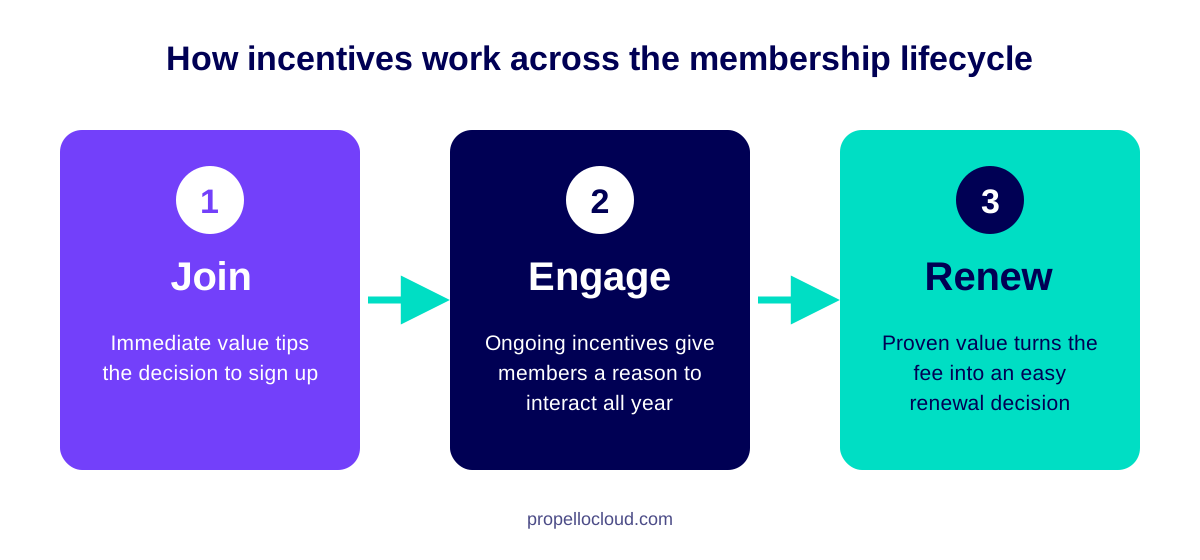
Incentives give people a reason to join, a reason to engage and a reason to renew. For membership organisations and associations, they turn the annual fee from a cost into proof of value, and that proof is what keeps members committed long after the welcome email.
They attract new members
A prospective member weighs the fee against what they’ll get back, and an immediate benefit tips that calculation.
Incentives sharpen your value proposition and make it easier to attract new members who might otherwise hover on the fence.
They drive engagement and renewals
Members who joined for a discount won’t stay for one.
Ongoing incentives, from exclusive content to event invites, give members a reason to interact month after month, and that steady member engagement is what gets them to renew their memberships.
It also builds something no discount can buy: a genuine sense of belonging.
Every incentive a member redeems tells you something about what they value, and incentives tied to surveys or polls sharpen that picture further, giving you the data to personalise what comes next.
What Are the Best Membership Incentive Ideas?
The best membership incentive ideas lift member lifetime value by matching what you offer to what members actually want from you.
Reward programmes, personalised content and career development deliver value members use every week.
Exclusive experiences and appreciation events build emotional connection.
Social responsibility, member-driven innovation and referrals give loyal members a role in the organisation itself.
No organisation needs all eight at once. The smart move is starting with the gap that costs you most.
If prospects hesitate at sign-up, lead with tangible value. If renewals are slipping, invest in the experiences and recognition that make members feel part of something.
1. Membership reward programmes
A membership rewards programme pays members back for the things you want them to do: renewing, attending, referring and engaging. It delivers value members notice every month, which makes the organisation easier to join and harder to leave.
The rewards themselves have to land.
A generic discount catalogue gets ignored. Rewards matched to the member get redeemed, like money off a renewal, an invite to the right event or content tied to their role.
Most organisations can’t build that catalogue in-house, which is why a rewards platform that hosts your own perks alongside third-party offers is often the practical route.
A well-run programme produces results in three other ways:
Premium tiers with exclusive rewards open a new revenue line.
Gamification, through points, badges and milestones, makes engagement feel like progress.
Every redemption also adds to your picture of what members value, so the next reward is better targeted than the last.
2. Exclusive experiences
Behind-the-scenes tours, VIP sessions, and small-room networking with industry leaders offer members access to something money alone can’t buy.
Experience-based incentives make the membership feel scarce in the best sense, and scarcity is a strong reason to renew.
They also answer a worry I hear from most membership organisations: the base is ageing, and younger professionals aren’t joining fast enough. The data backs up the worry, though it’s more nuanced than the headlines.
Marketing General Incorporated’s 2025 benchmarking research found Baby Boomers still account for 27% of association members, down from 32% two years earlier.
Younger generations are coming through. Just not fast enough for organisations whose income still leans on members heading for retirement.
A discount on publications won’t fix that. An invite to an event worth talking about might.
Connection is what people join for. In MGI’s 2024 report, networking with others in their profession was the top reason members signed up, cited by 67%.
In-person formats deliver that best. Virtual sessions widen the net, so members who can’t travel still get the access.
The test of a good experience is whether a member would mention it to a colleague. If they would, it’s doing double duty as an acquisition channel.
3. Personalised content and recommendations
Personalised content gives each member material that fits their role, interests and stage of membership. It shows members the organisation knows who they are, and being known is one of the most reliable foundations for loyalty.
It works across the whole member journey:
A new member gets onboarding content built around why they joined.
An established member gets recommendations based on what they’ve read and attended.
A member approaching renewal gets an offer that reflects how they’ve actually used the membership.
Recommendations carry extra weight because they’re grounded in behaviour. An invite to an event a member is likely to attend lands far better than a blanket email to the whole list.
The usual barrier is technology.
Many membership organisations still run on systems that can’t segment members or track engagement properly. Modernising the data comes first. Personalisation follows.
Member-generated content is worth adding to the mix.
Case studies, guest posts and community Q&As written by members feel more relevant to their peers, and they take some of the load off your content team.
4. Skill and career development
Skill and career development gives members something that grows in value the longer they stay: training, certification, mentoring and a route to their next role.
For most professional bodies, it’s also the incentive closest to the core mission.
It ranks high among the reasons people join. In MGI’s 2024 benchmarking report, continuing education came second, cited by 42% of members, behind only networking.
The formats are familiar. Workshops, webinars and training sessions. CPD tracking for members who need to log their hours. Mentoring that pairs early-career members with senior ones.
A job board takes it a step further. Sharing roles across your sector shows members you care where their career goes next, well beyond the renewal fee.
The payoff runs both ways. Members get support they’d otherwise pay for elsewhere. The organisation gets members with a practical reason to stay, and nobody walks away from a qualification halfway through.
5. Social responsibility initiatives
Social responsibility initiatives provide opportunities for members to do good through the organisation they already belong to.
Volunteer programmes, community outreach and charity partnerships show you stand for more than your own growth, and they give members a shared purpose that deepens their connection to you.
They work for any membership body. But they work best where the mission already has a social edge.
The formats can be simple:
Volunteering days with a partner charity.
Pro bono schemes where members lend their professional skills to community groups.
Give-back models where part of each fee supports a cause members vote on.
The National Trust shows what happens when the cause is the membership. More than 2.6 million memberships fund the conservation of the very places members visit, so every renewal is a visible contribution to heritage and nature.
Volunteering adds a hands-on layer, from rangers creating wildlife habitats to guides in historic houses.
The lesson for everyone else is to make the impact visible. A cause members can’t see becomes a line in the annual report. A cause they can touch becomes a reason to stay.
6. Member-driven innovation
Member-driven innovation brings members into decisions about what the organisation offers next. It produces services designed from the member’s side of the table, and it gives the people involved a stake in the result.
Your members already live the problems you’re trying to solve. They know which benefits get used, which get ignored and what’s missing entirely.
Bringing them in can take a few forms.
A member advisory panel that reviews new benefits before launch.
A pilot group that tests new features and reports back.
An open ideas board where members suggest and vote on what gets built.
The insight is valuable. The ownership is worth more. Members who helped shape a new benefit tend to use it, promote it and defend it, because part of its success is theirs.
The one rule is closing the loop.
Tell members what you built from their input, what you didn’t build and why. An organisation that asks for ideas and then goes quiet turns its panel cynical fast.
7. Member appreciation events
Member appreciation events thank members for their support in a way they’ll remember. They range from awards evenings and anniversary dinners to an invite-only drinks reception, and their job is to turn an annual transaction into an emotional connection.
That connection matters more than it looks. In my experience, members rarely leave over a single missing benefit. They drift when the organisation stops feeling like theirs.
Recognition doesn’t need a big budget. Milestone awards for long-serving members, a member spotlight in your newsletter or on social media, and a member-of-the-month feature all send the same message: we noticed.
The British Red Cross runs its Values in Action awards on a principle worth borrowing. Anyone can nominate a volunteer or colleague at any time of year, and recognition ranges from a quick thank you to a national honour.
Those awards are for staff and volunteers rather than members, but the model translates directly. Make recognition a year-round habit instead of a once-a-year event, and let peers do the nominating.
A thank you from the organisation is welcome. A thank you from fellow members is worth more.
8. Referral programme
A referral programme rewards members for bringing in new ones. It turns satisfied members into a recruitment channel, and because you only reward successful sign-ups, it tends to cost less than paid campaigns.
Referrals work because of trust. A recommendation from a colleague carries weight no advert can match, and the prospect already knows someone who gets real value from the membership.
The less obvious win is what referring does to the referrer.
In a Journal of Marketing field experiment at a global mobile provider, Garnefeld, Eggert, Helm and Tax found customers who made a referral saw their own defection rate fall from 19% to 7% within a year. Their monthly spend rose 11.4% against a matched control group.
The authors put it down to commitment and consistency. Once someone has put their name to a recommendation, walking away undermines it.
The effect was strongest among newer customers. That makes the first year of membership the best time to promote your referral programme.
A few things make a referral programme work in practice:
Rewards on both sides, such as money off a renewal for the advocate and a reduced first-year fee for the newcomer.
A process that takes seconds, like a personal link or code.
Recognition for your top referrers, which ties neatly into your appreciation events.
Tracking that goes beyond referrals made, to how long referred members actually stay.
How Do You Know Which Membership Incentives Will Work?
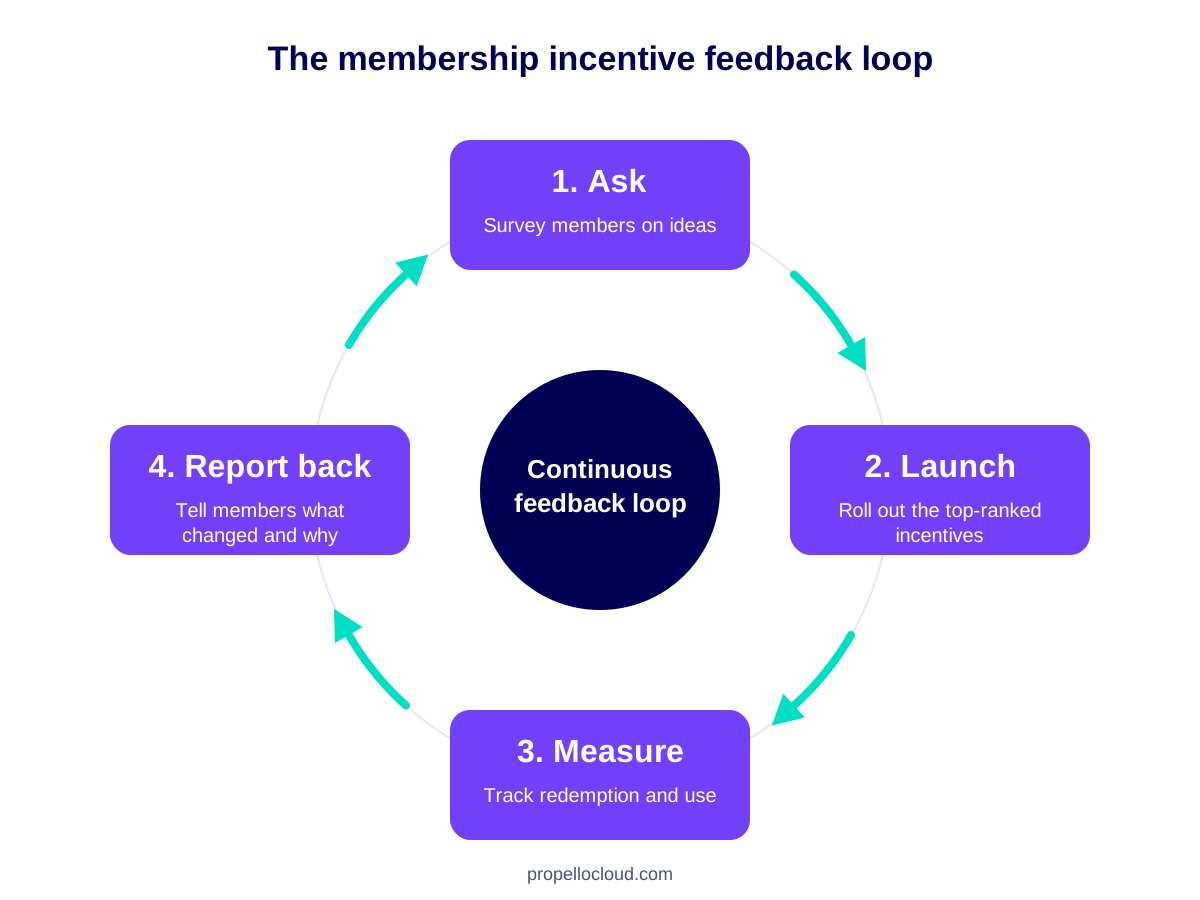
You find out which membership incentives will work by asking members before you build anything and measuring how they use it after launch. A continuous feedback loop of surveys, usage data and follow-up keeps your incentives matched to what members value, even as their needs change.
Every membership base is different. An idea that transforms engagement at one organisation can fall flat at another, so test before you commit budget.
Start with a short survey. List the incentives in this article as possible new benefits and ask members to rank them. The ones that score highest show you where to begin.
Thencheck what members actually do. Redemption rates, event attendance and content engagement reveal which incentives are pulling their weight once they’re live, and which ones only sounded good on paper.
Finally, report back. Tell members what you heard and what changed as a result. That one step makes the survey a conversation, and it’s the natural starting point for the member-driven innovation covered above.
Build a Member Value Proposition People Renew For
The eight ideas in this article each do a different job. Reward programmes and career development give members something to use. Exclusive experiences and appreciation events give them something to feel. Referrals, member-driven innovation and social responsibility give them a part to play.
The strongest offers draw on all three. Start with the gap that costs you most, test it with members and keep listening.
Delivery is where most organisations stall. Rewards, tiers, referrals and engagement data often sit in separate systems, if they exist at all.
Leading platforms like Propello Cloud bring them together in one white-label programme, so members see one coherent offer and you see what’s working.
If you want to know where member expectations are heading next, we’ve mapped the shifts in our membership trends guide.
FAQs
How do you incentivise people to join a membership?
Lead with value they can feel straight away, such as a welcome reward, a reduced first-year fee or immediate access to exclusive content. Make the benefits easy to see on your sign-up page, and ask existing members to invite colleagues, since a personal recommendation often persuades more than any offer.
What is the difference between a membership perk and a membership benefit?
The terms often overlap. A membership benefit is usually a core part of what members pay for, such as training, accreditation or representation. A perk is an extra on top, such as partner discounts or event invites. Strong offers use benefits to justify the fee and perks to make membership feel generous.
What are low-cost membership incentive ideas?
Recognition costs little and lands well, from member spotlights to milestone awards. Partner discounts let other businesses fund the reward. Early access to content, members-only webinars and online community spaces add value without large overheads. It’s best to focus budget on the few incentives members use most.
Should you offer discounts to new members?
A first-year discount can tip a hesitant prospect, but it shouldn’t carry the whole offer. Members who join purely on price often leave when the discount ends. Pair any introductory offer with benefits that show their value early, so the full renewal fee feels earned.
How do you structure membership tiers to encourage upgrades?
Give each tier a clear, meaningful step up in value, and keep core benefits available to everyone. Reserve exclusive perks, such as premium events or priority access, for higher tiers. Letting members progress through engagement, or trial a higher tier for a short period, makes upgrading feel like a reward.
How do you promote membership benefits?
Create one clear, categorised benefits page and link to it from your sign-up and renewal journeys. Highlight different perks through email, social media and newsletters, timed to when they’re most relevant. Remind members of benefits they haven’t used, since unused perks are easy to forget at renewal time.
How often should you refresh membership incentives?
Review incentives at least once a year, ideally before your main renewal period. Retire perks members don’t use, add ones they ask for and refresh partner offers so the catalogue feels current. Usage data and member feedback should drive the changes rather than a fixed calendar alone.
How do you win back lapsed members?
Start by asking why they left, through a short exit survey or a personal call. Then make a targeted offer that addresses the reason, such as a reduced return fee, a free trial period or access to a new benefit. Reaching out quickly, while the relationship is still warm, gives the best chance of success.
Do membership incentives work for trade associations?
Yes, though the incentives look different. Trade association members are businesses, so they value commercial benefits such as supplier discounts, market insight, representation and networking with buyers. Recognition, such as awards and accreditation badges, also works well because member businesses can use it in their own marketing.
Can small membership organisations run a rewards programme?
Yes. Small organisations don’t need to build a rewards catalogue themselves. Rewards platforms can host your own perks alongside third-party partner offers, so a programme can launch without a large in-house team. Start with a handful of rewards tied to the behaviours that matter most, such as renewing or attending events.
Mark Camp
Mark is the Founder and CEO of Propello Cloud, an innovative SaaS platform for loyalty and customer engagement. With over 20 years of marketing experience, he is passionate about helping brands boost retention and acquisition with scalable loyalty solutions.
Mark is an expert in loyalty and engagement strategy, having worked with major enterprise clients across industries to drive growth through rewards programmes. He leads Propello Cloud’s mission to deliver versatile platforms that help organisations attract, engage and retain customers.
Start your customised Propello Cloud journey today
Explore the platform’s scalability, features and customisation options and get answers to your unique questions.