How to Boost Customer Retention During Economic Downturns
Published: February 27, 2025
Updated: August 14, 2026
When budgets tighten, customers don’t cut the things that clearly earn their place. They cut the things they can’t quite justify. So the whole job in a downturn is making your value impossible to miss and the cost of leaving impossible to ignore.
Mark Camp
CEO & Founder at PropelloCloud.com
Contents
Key Takeaways
Retaining existing customers is 5 to 25 times more cost-effective than acquiring a new customer (Bain & Company).
Real-time monitoring of customer behaviours helps identify pain points before they lead to customer churn.
Your customer service teams become crucial frontline defenders against churn during economic downturns.
Word-of-mouth marketing through satisfied customers proves more valuable than traditional customer acquisition methods.
Personalised loyalty programmes help increase customer retention by addressing specific target market needs.
Social media engagement and proactive customer service create stronger bonds with your existing customers.
A pause in service option meets customers' temporary financial constraints while preventing permanent customer churn.
A downturn doesn’t just shrink budgets. It puts every service a customer pays for back on trial. That sounds like bad news, and for anything easily cut, it is. But a decision being actively made is a decision you can still influence, and that is exactly what makes customer retention during economic downturns possible.
No single move gets you there. The businesses that hold their base through a squeeze layer these strategies so they reinforce each other, each one making the next harder to walk away from.
What Does an Economic Downturn Look Like?
A downturn shows up in the numbers before it shows up in the mood. Growth stalls, prices keep climbing, and both businesses and households start counting every pound. Early 2025 was a textbook run of it, worth holding up as a snapshot of what the pressure actually looks like on the ground.
Growth had flatlined.According to the House of Commons Library, the economy grew just 0.1% in Q4 2024, after no growth at all the quarter before (ONS). In its February 2025 report, the Bank of England halved its 2025 growth forecast to 0.75%.
Inflation was biting. CPI sat at 3.0% in January 2025, and the Bank forecast a climb to 3.7% by Q3. Every one of those percentage points was landing on the same household budget your subscription had to survive.
Pressure varied by sector.The Confederation of British Industry reported services firms facing falling profits and rising costs, hitting consumer-facing businesses hardest as the cost-of-living squeeze bit.
Restructuring picked up. Higher operating costs, steeper borrowing rates and increased taxes pushed more companies into cutting back.
How Does Customer Behaviour Change During Economic Uncertainty?
When money gets tight, customer behaviour shifts in predictable ways. They cut down on spending and they cancel services they perceive as non-essential. Understanding that sorting logic is what lets you land on the right side of it.
Why Do Customers Cut Spending During a Downturn?
Customers cut spending in a downturn less because they have to and more because uncertainty flips a switch: self-preservation takes over, and everything they pay for gets re-judged on whether it’s worth the risk.
It isn’t really about having less money. It’s about how people weigh value, hedge against what might go wrong, and reach for a bit of security when the ground feels unsteady.
McKinsey’s US consumer research puts numbers on that instinct. In 2024, 76% of consumers reported trading down, changing what they buy, or how much, to get more value for the money.
That’s three in four people quietly reworking the maths on everything they pay for, and your service could be somewhere on a similar list.
Your customers don’t simply cut spending across the board. Instead, they reprioritise expenses based on:
Essential versus nice-to-have needs
Immediate versus delayed value
Risk versus reward calculations
Emotional versus practical benefits
When you understand these shifts, you can reposition your offerings from “expenses to cut” to “value worth keeping.”
Why Do Customers Cancel Services During an Economic Downturn?
Several factors increase the likelihood that customers will cancel during economic downturns:
Low perceived necessity: Services viewed as “nice-to-have” rather than essential become vulnerable when budgets tighten.
Value ambiguity: Benefits that are difficult to quantify or recognise are easier for customers to eliminate.
Delayed gratification: Services whose benefits accrue over time rather than immediately often get cut first.
High visibility in budgets: Recurring charges that stand out in monthly reviews become obvious targets for cost-cutting.
Switching ease: Services with low exit barriers or many competitors make it easy for customers to leave and return later.
Directly addressing these risk factors in your retention strategies can significantly reduce customer churn.
What Are the Best Customer Retention Strategies During an Economic Downturn?
There’s no single fix. The strongest approach stacks five levers that reinforce each other: enhance your core value proposition, create memorable customer experiences, build emotional connection, offer flexible financial arrangements, and launch reward programmes. Run together, they turn “an expense to cut” into “value worth keeping.”
1. Enhancing Your Core Value Proposition
During economic hardship, customers scrutinise the fundamental value of every service they use. You need to double down on delivering your core value proposition exceptionally well:
Focus on Essential Features
Identify and enhance the critical features your customers genuinely need. In tough economic times, people zero in on core functionality and essential benefits. Ask yourself, “What’s the primary reason customers chose us in the first place?” That’s where you need to excel beyond expectations.
Example: Zoom did this brilliantly during the global pandemic. They focused relentlessly on connection reliability and ease of use, recognising these as the non-negotiable elements that customers valued most.
Develop Features That Solve Economic Pain Points
Rather than adding features just to stand out, develop new capabilities that directly address your customers’ financial concerns.
Example: Netflix built out streaming through the 2008 downturn, and by 2010 a $7.99 streaming-only plan was undercutting cable outright.
Their monthly streaming service addressed a specific economic pain point: people wanted entertainment but couldn’t afford expensive cable packages or nights out.
Position Your Product as a Money-Saver
Show how your product or service helps customers save money or increase productivity elsewhere.
Example: HubSpot emphasised how their marketing automation reduced the need for multiple full-time employees, positioning their subscription as a cost-saving measure rather than an expense.
2. Creating Memorable Customer Experiences
In economic downturns, customer tolerance for friction decreases dramatically. Companies that reduce customer effort and enhance satisfaction create “emotional switching costs” that transcend price considerations.
Reduce Customer Effort
Every interaction should become simpler, faster, and more intuitive during economic uncertainty. When money is tight, customers have less patience for complexity and frustration. They’re already stressed about finances—don’t add to their burden with complicated processes or confusing experiences.
Example: Amazon’s one-click ordering and frictionless returns policy streamline the buying process. These time-saving features create value beyond the transaction itself.
Solve Problems Before They Happen
Anticipate and resolve issues before customers experience them. Use data to identify potential friction points and address them proactively. When customers don’t have to chase solutions, they’re less likely to question the value you provide.
Example: Netflix’s system for detecting and automatically addressing streaming quality issues prevents frustration for users who might otherwise consider cancellation.
Offer Personalised Service Recovery
When problems do occur, personalised resolution becomes even more critical. Generic apologies and standardised responses feel especially hollow during economic hardship.
Example: Chewy.com’s personalised service recovery (handwritten condolence notes and surprise gifts) creates emotional loyalty that transcends price sensitivity.
3. Building Emotional Connection
Economic pressure increases the importance of having emotional connections with your customers. Demonstrating genuine care and shared values allows you to retain customers who might otherwise make purely financial decisions:
Show What You Stand For
Demonstrate commitment to causes your customers care about, even during difficult times. That’ll win their hearts faster than lowering prices.
Example: Patagonia’s consistent environmental advocacy creates an emotional connection that makes customers hesitant to switch to lower-cost alternatives, even when budgets tighten. When values align, price becomes just one factor among many.
Create Community Among Your Customers
Build connections between your customers that add value beyond your product. You want them talking about you even when you’re not in the room. Customers stay for the friendships they’ve formed through your brand.
Example: Peloton’s community features (leaderboard rankings, group challenges, and virtual high-fives during workouts) prove especially valuable during economic uncertainty. The social connections became a retention driver independent of the exercise equipment itself.
Talk Straight About Tough Times
Honest, transparent communication about economic challenges builds trust. In uncertain times, authenticity stands out.
Example: Southwest Airlines’ straightforward communication during economic downturns, acknowledging challenges while emphasising passenger-first values, has contributed to industry-leading customer loyalty through multiple recessions.
4. Flexible Financial Arrangements
Direct financial accommodation helps customers manage economic uncertainty without cancelling services entirely:
Create Affordable Tiered Service Options
Create lower-priced alternatives that maintain core value. That doesn’t mean cheapening your offering; it’s about thoughtfully deciding which features are essential and which are premium. Your goal is to keep customers in your ecosystem rather than losing them completely.
Example: Many SaaS companies introduce “lite” versions during economic downturns, allowing customers to reduce costs without leaving the ecosystem entirely. This preserves the relationship until customers can upgrade again.
Offer Flexible Payment Terms
Offer payment flexibility without discounting. Sometimes it’s not about how much they pay, but when.
Example: B2B software providers will often maintain list prices but extend payment terms from 30 to 60 or 90 days during economic challenges, easing client cash flow while preserving revenue.
Let Customers Take a Break with Pause Options
Allow temporary service pauses rather than forcing an all-or-nothing decision. The latter will likely lead to full-on cancellations. A paused customer is much more likely to return than a cancelled one.
Example: Fitness centres that introduce “membership freeze” options during economic downturns are more likely to record lower cancellation rates than those offering only binary keep/cancel choices.
Switch to Usage-Based (Pay-As-You-Go) Alternatives
Shift from fixed to variable pricing for cost-conscious segments. This approach helps customers feel in control of their spending while still accessing your product or service. It aligns what they pay with the exact value they receive.
Example: Twilio’s communication API pricing model thrived during economic uncertainty by charging only for messages sent. This meant customers could scale usage up or down based on their needs without feeling locked into fixed costs. For businesses with fluctuating demand, this flexibility became a compelling reason to stay rather than cut services entirely.
5. The Strategic Value of Reward Programmes
In times of economic hardship, reward programmes are yet another powerful tool for keeping customers. These reward systems produce a “positive sum” exchange that benefits both the customer and the business. Offering generic discounts, on the other hand, weakens margins and diminishes the value of your brand.
What Types of Reward Programmes Provide Measurable Value?
Pays a percentage back on spend, straight to the customer
Santander Edge — 1% back on household bills, up to £10/month
Tangible, quantifiable money they can drop straight into their own value maths
Membership benefit bundles
Stacks extra services into one existing fee
Amazon Prime — delivery, video, music, reading, deals
Creates “more for the same price”; the more they use, the harder leaving gets
Always-on discounts
Ongoing savings on essential, everyday purchases
Lebara Mobile — 100+ partner deals beyond the core plan
Each saving is a repeat reminder that keeping the service makes financial sense
Partner ecosystem benefits
Perks across categories via partners, not owned cost
JD Gyms — deals on supplements, gear, recovery
Feels tailored to their actual life, not just their wallet; multiplies value without multiplying spend
Cashback
Direct financial benefits have greater appeal during economic uncertainty. And for good reason. A cashback programme puts tangible, quantifiable value straight into the customer’s hands. They can effortlessly incorporate the value into their financial calculations.
Example: Santander’s Edge account pays 1% cashback on selected household bills by direct debit, up to £10 a month across council tax, energy, broadband and phone. Real money, landing every month, straight into the customer’s own value calculation.
Membership Benefit Bundles
Bundling additional services into existing subscriptions creates that “more for the same price” feeling. It’s a powerful way to offset a customer’s cancellation impulse. Why leave when you’re getting more than you pay for? The more benefits they use, the harder it becomes to walk away from your ecosystem.
Example: Amazon Prime keeps adding new services to its list of offerings, including reading, music, video, shipping, and more. Members perceive overwhelming value despite the membership fee.
Always-On Discount Programmes
Ongoing discounts on essential purchases demonstrate value repeatedly. Each saving becomes a reminder of why keeping your service makes financial sense.
Example: Lebara Mobile proves this brilliantly. Their rewards platform offers customers 100+ partner deals and discounts beyond their core mobile services. Members enjoy substantial savings across multiple product categories while paying for their regular mobile plan. This added value gives them a reason to stay, transforming the retention decision into a simple value equation.
Partner Ecosystem Benefits
Strategic partnerships multiply the benefits you offer without multiplying your costs. You create an expanded value network where customers receive relevant perks across multiple spending categories. They make your offering feel tailored to your customers’ actual lives, not just their wallets.
Example: JD Gyms leverages a powerful partner ecosystem with health-focused brands offering substantial discounts on nutrition supplements, workout gear, and recovery products.
Members get deals on protein powders and meal prep services they’d likely purchase anyway. These everyday savings effectively offset their monthly membership cost while supporting their fitness journey.
The alignment between the gym experience and complementary health products creates a comprehensive wellness ecosystem that members find increasingly valuable and difficult to leave.
The Maths of Value Perception
For reward programmes to effectively prevent cancellations, customers must clearly see the mathematical proposition: the benefits received outweigh the costs retained.
When reward values equal or exceed subscription costs, the decision to retain becomes logical rather than emotional. Companies should make this equation transparent to customers through regular value summaries.
How Do You Implement a Customer Retention Strategy During Economic Uncertainty?
Building a crisis-resistant customer retention strategy comes down to four steps: assess your vulnerabilities, audit what customers actually value, align your rewards with their economic reality, and make the net cost of staying impossible to ignore.
Conduct a Holistic Vulnerability Assessment
Examine your current business through the lens of economic pressure. Which customer segments might feel financial strain first? What aspects of your customer experience create “must-keep” value? Where do customers encounter friction that could feel amplified during financial stress?
Don’t forget to assess the emotional connections with your brand. These often become deciding factors when customers are reviewing expenses. Also consider what competitive alternatives exist at lower price points.
This assessment will reveal where to focus your retention efforts across multiple dimensions.
Audit Current Customer Value Perceptions
Before rolling out new rewards, take time to understand what your customers actually value. You might be surprised by what matters most to them—especially during economic uncertainty.
Conduct value surveys: Ask customers to rank the benefits they most value. Their answers often reveal priorities you hadn’t considered. These insights help you focus your limited resources where they’ll have the greatest impact.
Analyse usage patterns: Identify which features see the highest engagement. They’re the ones worth emphasising and enhancing during tough times.
Monitor cancellation reasons: When customers leave, pay close attention to their economic concerns. These exit interviews reveal vulnerability points you need to address.
Segment vulnerability: Not all customers face the same economic pressures. Identify which segments are most likely to cancel during downturns and prioritise your retention efforts accordingly.
Align Rewards with Economic Realities
Your reward programme needs to address the economic challenges your customers are facing. During tough times, their priorities shift dramatically.
Focus on essentials: Provide rewards for necessary purchases over luxuries. This practical approach shows you understand their situation.
Emphasise immediate redemption: Reduce minimum thresholds for benefit access. A reward that takes months to earn feels irrelevant during economic uncertainty. Quick wins create tangible value that reinforces the relationship.
Increase transparency: Clearly communicate savings and benefit values. Spell out the pounds and pence value of each benefit so they can easily see what they’re saving.
Create predictability: Help customers budget by making rewards consistent. Predictable rewards become part of their financial planning.
Offer flexibility: Allow customers to choose benefits that match their specific needs. One customer might value grocery discounts while another needs petrol savings. This personalisation increases the perceived value of your programme.
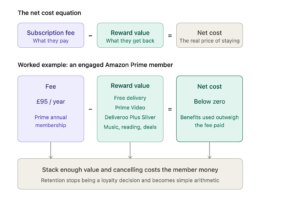
Calculate and Communicate the “Net Cost”
Show customers what your service actually costs them once the rewards are counted. That figure, not the headline price, is the one they should be weighing, and most of them have never been handed it.
Structure the rewards well and that number drops towards zero, then past it. For an engaged customer, the benefits they actually use are worth more than the fee they pay, which means walking away doesn’t save money. It costs them.
Example: Amazon Prime is the clearest example of it in the wild. The £95 annual fee buys free delivery, Prime Video, a year of Deliveroo Plus Silver, music, reading and members-only deals. Use even half of those and the fee has already paid for itself.
What Do Successful Retention Strategies Look Like in Practice?
They stack several tactics at once rather than betting on one. The businesses that achieve customer retention during economic downturns combine core-value investment, flexible pricing and community, so a customer weighing cancellation runs into three reasons to stay instead of one.
Here is how that plays out across streaming, B2B software and retail.
A Multifaceted Approach to Retention for Streaming Services
When facing subscription cancellations during economic downturns, streaming platforms have successfully retained customers through comprehensive strategies:
Netflix’s Retention Playbook: During economic challenges, Netflix implemented a multi-pronged approach:
Core Value Enhancement: They enhanced core value by increasing investment in original content while economic pressures mounted. This ensured subscribers always had new value to discover, regardless of economic conditions.
Flexible Tier Introduction: They introduced flexible pricing tiers, including ad-supported lower-priced options to prevent complete cancellations.
Enhanced User Experience: They improved personalisation algorithms to help users find more relevant content easily.
Community Features: They introduced features like live events to create social value beyond content.
Strategic Bundling: Created partnership deals with mobile carriers and ISPs to include Netflix as a “free” benefit
Enterprise software companies show us how high-touch relationship management can prevent cancellations even when budgets are being slashed.
Salesforce Recession Strategy: During the 2008 recession, Salesforce didn’t panic. They implemented a retention programme with multiple components:
ROI Documentation: They created custom dashboards showing each customer’s specific return on investment. This made it easier for their clients to justify continued spending when every expense was under scrutiny.
Success Planning: They assigned customer success managers to at-risk accounts to ensure platform utilisation.
Flexible Payment Terms: They offered extended payment schedules without discounting for cash-constrained customers. This preserved revenue while acknowledging cash flow challenges many businesses faced.
Training Investment: They provided free additional training during downtimes to increase platform entrenchment.
User Community: They strengthened peer-to-peer support communities to enhance value beyond the product itself.
Retail: Value Creation
Retail brands demonstrate how creating value across multiple touchpoints can maintain customer relationships even when they cut their spending.
Sephora’s Retention Ecosystem: Sephora uses a robust loyalty strategy targeting their customers’ practical and emotional needs to navigate economic downturns.
Experience Focus: They enhanced the in-store experience with services that discount competitors couldn’t replicate. These unique experiences gave customers reasons to visit beyond just making purchases.
Education Content: They increased free beauty tutorials and content when customers couldn’t afford new products. This kept their audience engaged even when spending decreased.
Sample Strategy: They expanded their free sample programme to maintain trial without purchase pressure. Customers could still experience new products without financial commitment.
Community Building: They strengthened online beauty communities where customers shared advice. These communities created value beyond products and nurtured connections that kept people engaged.
Reward Programme Flexibility: They adjusted their Beauty Insider programme to include more affordable redemption options. This meant even customers making smaller purchases could still enjoy meaningful rewards.
What Are the Future Trends in Customer Retention?
Several trends are reshaping customer retention: predictive customer intelligence, experience orchestration, community-based value networks, ecosystem business models, and human-centred automation. These trends will influence how successful businesses approach customer retention.
Predictive Customer Intelligence
Advanced analytics now enable businesses to identify retention risks before traditional signals appear. These sophisticated systems analyse hundreds of behavioural indicators, economic factors, and engagement patterns to predict which customers need intervention.
The most impressive part? They often spot these patterns months before customers actively consider cancellation. This extended runway for intervention makes all the difference.
Telecommunications companies using predictive models improve retention by intervening with the right offer at the precise moment when customers are most receptive. This targeted approach replaces the old method of scrambling to save customers only after they’ve expressed cancellation intent.
Experience Orchestration
Leading companies no longer treat retention as a reactive function triggered by cancellation requests. Instead, they implement systematic experience orchestration across all touchpoints throughout the customer journey.
This coordinated approach ensures consistent value delivery and relationship building from day one. Every interaction becomes part of a deliberate strategy to strengthen the customer relationship.
Healthcare providers use experience orchestration systems to reduce patient churn by ensuring consistent communication, personalised care plans, and proactive health management across all departments and touchpoints.
Community-Based Value Networks
The strongest retention strategies now incorporate community elements. Your customers derive value not just from your product but from peer relationships that you facilitate.
These communities create powerful switching barriers beyond the product itself. Before customers can leave your product, they have to consider losing the valuable relationships and shared knowledge they’ve built there.
Ecosystem Business Models
Progressive companies are moving beyond single product relationships. They create interconnected ecosystems that address multiple customer needs and create cumulative value.
These ecosystems deliver more value together than their individual parts could separately. Each additional connection to your ecosystem increases switching costs and perceived value.
Apple’s integrated ecosystem of devices, services, and experiences creates retention rates above 90% for many products. Own the phone, the watch, the laptop and the earbuds, and leaving stops being a purchase decision and starts being a demolition job.
Human-Centred Automation
The most effective retention strategies now combine AI-powered efficiency with human connection at critical moments. This “high-tech, high-touch” approach allows for personalised relationships at scale.
You don’t need to choose between automation and human interaction. Forward-thinking brands now use technology to handle routine tasks while freeing human talent for high-value customer experiences.
Start Building Resilient Customer Relationships
When you address customer needs across multiple dimensions—functional, financial, experiential, and emotional—you build relationships that withstand economic pressure.
The most successful approaches share common elements you can implement in your business:
Value centricity: Ensure your core product or service delivers exceptional value that customers can clearly recognise. In tough times, this fundamental promise matters more than extra bells and whistles.
Emotional connection: Build relationships based on shared values and authentic interaction. These emotional bonds often become the deciding factor when customers review expenses.
Financial flexibility: Provide options that accommodate changing economic circumstances. Sometimes it’s not about lowering your price but adjusting how and when customers pay.
Reward reinforcement: Use a strategic reward programme to highlight and enhance value perception. A well-designed reward structure can transform how customers perceive the value of your offering.
Implement these principles, and you’ll stand a chance to survive economic challenges and emerge with stronger, more loyal customer relationships.
FAQs
What are effective customer retention strategies during an economic downturn?
Focus on the customers you already have. Solve their specific pain points, sharpen the value they can see, and give them flexible ways to keep paying rather than a binary stay-or-go. That costs far less than chasing replacements, and it holds revenue steady while acquisition dries up.
How can businesses maintain customer loyalty when budgets are tight?
Make the value of staying obvious and the cost of leaving high. Flexible payment terms, honest communication about what’s changing, and rewards that offset the monthly spend all give customers a reason to stay when they’re auditing every expense.
What role does communication play in retaining customers during challenging economic times?
It is how you catch problems before they become cancellations. Regular, straight-talking contact surfaces frustration early, and proactive outreach by email and on social shows customers you are paying attention to them, not just their payment.
How can loyalty programmes be adapted to suit economic downturns?
Reward more than just spending. Recognise engagement, offer exclusive content and community, and lower the thresholds so benefits land quickly. A reward that takes six months to earn feels irrelevant to someone counting this month’s pennies.
What are the benefits of offering flexible payment options to customers during a recession?
Flexibility stops a temporary cash-flow problem from hardening into a permanent cancellation. Letting customers pause, spread payments, or pay only for what they use meets them where they are, and a paused customer returns far more often than a cancelled one.
How can businesses leverage customer feedback to improve retention in tough economic climates?
Turn it into action, fast. Real-time monitoring shows you where value perception is slipping, and moving quickly on what you hear proves you are listening, which is exactly the reassurance customers want when deciding what to keep.
What are some cost-effective ways to enhance customer engagement during a downturn?
Lean on community and content, not spend. Social conversation, virtual events and user-generated content build genuine engagement cheaply, strengthening the bond with existing customers while drawing new ones in behind them.
How can companies identify at-risk customers and prevent churn during economic hardships?
Watch behaviour, not just outcomes. Falling usage and slipping engagement flag a wobbling customer well before they cancel, and an early, well-judged intervention resolves the concern while there is still a relationship to save.
What strategies can small businesses employ to retain customers when facing economic challenges?
Play to your strengths: personal service and close community ties. Knowing your customers well enough to tailor what you offer them creates targeted, low-cost retention that larger competitors cannot easily copy.
How important is product or service quality in retaining customers during an economic downturn?
It is decisive. Customers scrutinise value hardest when money is tight, so consistent quality alongside responsive service is what keeps them from trading down. Let quality slip during a squeeze and you hand them the reason to leave.
Mark Camp
Mark is the Founder and CEO of Propello Cloud, an innovative SaaS platform for loyalty and customer engagement. With over 20 years of marketing experience, he is passionate about helping brands boost retention and acquisition with scalable loyalty solutions.
Mark is an expert in loyalty and engagement strategy, having worked with major enterprise clients across industries to drive growth through rewards programmes. He leads Propello Cloud’s mission to deliver versatile platforms that help organisations attract, engage and retain customers.
Start your customised Propello Cloud journey today
Explore the platform’s scalability, features and customisation options and get answers to your unique questions.