Why is Digital Customer Engagement the Key to Brand Loyalty?
22 min to read
Published: March 15, 2024
Updated: August 19, 2026
The modern customer wants more than a good product. They want to be engaged, consistently, on the channels they already live on. That shift has quietly rewired how loyalty gets built. The brands that prioritise digital customer engagement are the ones they stop drifting away from.
Mark Camp
CEO & Founder at PropelloCloud.com
Contents
Key Takeaways
Effective digital engagement helps create emotional connections that transform customers into loyal advocates.
Every digital touchpoint that uses personalisation based on behaviour patterns and preferences makes customers feel valued and understood.
Digital engagement initiatives that employ loyalty programmes enhance customer retention and average spend.
Measuring engagement through the right metrics lets you enhance strategies and prove clear ROI to stakeholders.
What Is Digital Customer Engagement?
It refers to all the ways your brand interacts with customers online, utilising digital channels and technologies. This covers every experience the customer has along the way, from the first click on your website to an email follow-up after purchase.
Digital engagement, essentially, is about creating relationships that make people feel valued via memorable interactions.
Effective online engagement is a matter of being strategically present in the channels that matter to your customers and where they expect to hear from you.
What is the difference between digital customer engagement and traditional engagement?
The difference comes down to speed and data. Traditional engagement runs on physical touch-points and moves in days or weeks. Digital engagement happens in or near real time, and it hands you something the old model never could: a clear, actionable read on how customers actually behave, not just a record that they bought something.
Traditional engagement
Digital engagement
Channels
Face-to-face: store visits, printed mailers, phone calls
Real-time or near-real-time, so you can intervene in the moment
Data
Limited insight into how customers actually behave
Detailed, actionable signal on every interaction
What Are the Key Components of Effective Digital Engagement?
Effective digital engagement rests on five components: consistency across every channel, relevance to the individual, responsiveness that respects the customer’s time, a fair value exchange for their attention and data, and an emotional connection underneath it all.
Get the first four right and you have a competent operation. Get the fifth and you have loyalty.
1) Consistency
The foundation of digital engagement. Your brand voice, values and service should feel consistent across each channel.
2) Relevance
Makes every interaction meaningful to the customer. This would include knowing their preferences, purchase history, and their stage in the customer journey.
3) Responsiveness
Makes customers feel that you respect their time. This could be either via an automated chatbot’s instant reply or email follow-up right on time.
4) Value exchange
Makes interactions worthwhile and memorable for all parties. In exchange for their attention and their data, customers expect something of value — information, entertainment, solutions, or special offers.
5) Emotional connection
Emotional connection is what converts transactional relationships into loyal ones. Digital tools make it easier for people to engage, but finding ways to add authentic human elements like empathy and understanding is crucial.
Why Is Digital Customer Engagement Important?
Digital customer engagement matters because it moves three things that decide whether a business grows: how much customers spend, how long they stay, and whether you can still be told apart from everyone else.
Together they are the difference between a customer base that builds on itself and one you have to keep refilling from the top.
How does customer engagement increase revenue?
Engaged customers spend more. According to Gallup, fully engaged customers have a 23% higher profitability, share of wallet, and revenue than the average. Flip that number over and the same research finds actively disengaged customers cost you 13%.
Digital engagement is also useful for finding upsell and cross-sell opportunities through customer behaviour. The information that you collect enables you to better target your offers and thus increase conversions.
Savvy engagement strategies bring down the cost of acquisition by activating your customers as advocates. Happy customers spread the word for you, bringing in customers that you didn’t have to spend anything extra to acquire.
Why do engaged customers stay loyal?
Consistent, meaningful exchanges build an emotional connection, and an emotionally connected customer thinks twice before switching. They also get less price-sensitive the longer you serve them.
If your brand understands who they are, they will pay a little more to keep that than go hunting an extra 10 or 20% off somewhere colder.
Engagement is also an early-warning system. Watch the metrics and the churn signals show up before the customer goes quiet, while you can still do something about it.
When does engagement create a competitive advantage?
In a market crowded with near-identical products, experience is what separates you. When price and features have converged, the brand that engages well is the one still standing out.
And the companies that read real-time signals move first, spotting a shift in what customers want before it shows up in the quarter’s numbers.
What Are the Key Digital Customer Engagement Channels?
The most effective channels for digital customer engagement will vary depending on your market and customers. However, here are some of the common channels present across several industries and use cases.
Social media platforms: Broadcast to audiences, have one-on-one conversations, then use social listening to drive brand conversations
Live chat: Optimise conversions with live chat that provides immediate support.
Email: The versatile workhorse that offers readers substantial time and space to absorb detailed information while still feeling personally relevant to their needs
Mobile platforms: Where most brand interactions occur today. Push notifications and offline functionality make it easier to stay connected even when customers aren’t actively browsing.
Interactive content: Interactive aspects of your website, such as quizzes, ROI calculators, and polls, can help turn passive browsers into active participants
But don’t silo these channels like they’re separate. They should be a connected series of touch-points in your customer’s relationship with your brand.
What Are the Best Practices for Digital Customer Engagement?
Best practices for lasting customer engagement include omnichannel experiences, personalisation, self-service options, loyalty programmes, virtual events, gamification, online communities, and automation. Combine several of these and track the net impact over time.
Robust omnichannel engagement
An omnichannel strategy empowers your customers to enjoy seamless experiences across all digital and physical touch-points. This way, they can start a conversation on Twitter, pick it up in email, and finish it on your website without repeating themselves.
Aberdeen Group’s research found brands that excel at creating an omnichannel customer experiencekeep 89% of their customers, against 33% for the weakest.
That is not a rounding error between two strategies. That is two different businesses, one holding on to nearly everyone and the other losing two in three.
The secret is centralised data that evolves with the customer, not disconnected information that becomes repetitive. Your systems need to know who customers are, no matter where or how they connect with you.
This is because customers do not think in “channels.” They just want to engage with your brand when and how it makes sense for them to do so.
Personalisation tactics
Personalisation done well is what turns attention into revenue. McKinsey’s Next in Personalisation research found the percentage is significantly higher for fast-growth businesses, with 40% more of their revenue generated from personalised efforts than their slower counterparts.
The market has caught up to that. In the 2025 Propello Cloud Loyalty Uncovered Report, personalisation and data utilisation topped enterprise investment priorities at 84%, level with strategic partnerships.
Brands are looking to deliver content, recommendations, and experiences that are customised to personal tastes, life patterns, and demands.
That could mean displaying different content to first-time visitors vs. repeat visitors on a website. Or changing email send times depending on the time of day people generally open emails.
Personalisation needs to be natural rather than invasive. It should make the customer experience better without people noticing the behind-the-scenes data collection that enables it.
Self-service options
Today’s customers prefer to solve simple issues alone, even if it means avoiding support. Self-service tools allow this while also saving your team time.
Extensive knowledge bases, how-to videos and FAQs give customers the power to discover answers fast. These materials must be searchable, well organised, and written in plain language.
Proactive engagement
When you’re reactive, you serve the customer only when they ask for something: a question, a complaint, or a service request. While necessary, this method leaves you constantly playing catch-up.
Proactive engagement prepares for customers’ needs before those needs are made known. That might include sending maintenance reminders, recommending reorders ahead of when products will run out, or providing helpful content around recent purchases.
Hyper-relevant loyalty and reward programmes
Running a loyalty programme means customers get rewarded for their ongoing loyalty to a brand. Digital rewards enable you to tailor your offers to different needs and buying habits.
The best programmes are rewarding more than transactions and are differentiating across types of engagement. These might be actions such as following brand accounts on social media, consuming content, or even contributing feedback.
74% of shoppers would interact more with brands if they had the option to progress through tiers based on yearly spend. People like to see themselves getting somewhere. Tiers give the relationship a direction of travel.
Virtual events and webinars
Virtual events are shared experiences that build a community around your brand. These online sessions create a level of direct interaction that one-way content just can’t achieve.
Webinars, live streams and virtual product launches provide the opportunity for you to demonstrate expertise and receive instant feedback. Add in the interactive elements (slide shows complete with log-on-and-answer prompts, polls and direct chat) and participants feel listened to and valued.
Gamified elements
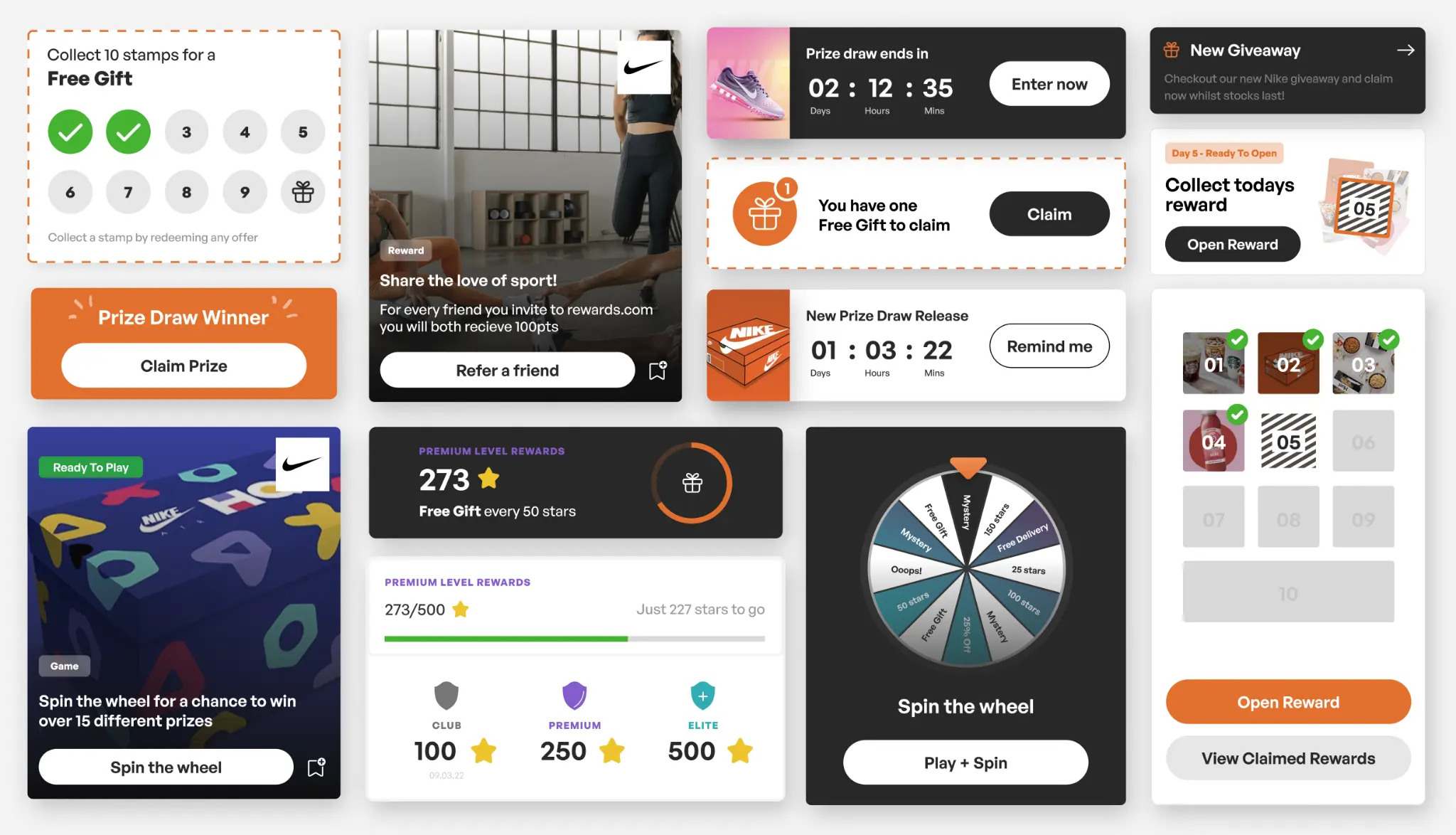
Gamification uses game design elements in non-game contexts to generate fun and increase user engagement. In a gamified loyalty programme, you generally have progress bars, achievement badges, or a spin-to-win wheel for a more immersive experience.
Enterprises are moving on it too, with gamification drawing a 65% investment priority in our 2025 Loyalty Uncovered Report.
Providing gamified experiences taps something older than any loyalty programme. It works because people are wired to chase mastery, completion and recognition. Climbing leaderboards or clearing a prize draw hands the customer a small, real sense of achievement and attaches it to your brand.
Building an online community
Online communities turn one-to-many broadcasting into many-to-many conversations. These spaces (forums, social groups, standalone platforms) are where your customers interact with one another and with your brand.
The most valuable communities are self-sustaining ecosystems in which customers answer one another’s questions, exchange advice and create content. Your role changes from content producer to conversation enabler.
Leveraging AI and technology
The days of smart tech being limited to tech giants are over. Today’s AI-based tools make sophisticated digital engagement available to all businesses.
AI-powered chatbots handle the routine enquiries the moment they land, and analytics turn stored data into a read on what customers actually need.
It is where the enterprise money is heading, with AI and machine learning drawing a 62% investment priority in our 2025 Loyalty Uncovered Report.
The gain is consistency at scale: automation holds the experience steady and lightens the load on your team, while machine learning surfaces patterns faster than a person watching manually ever could.
It’s also worth pointing out that AI in loyalty programmes can deliver an engaging experience through hyper-relevant rewards based on customer insights and behaviour.
How Do You Measure Success in Digital Customer Engagement?
You measure it across three families of metrics: engagement, conversion and satisfaction. Engagement tells you who is paying attention, conversion tells you whether that attention turns into action, and satisfaction tells you whether they will come back. Track all three and the picture stops being a guess.
Monitor how customers interact with your digital footprint using:
Time spent on your sites and mobile apps
Pages viewed per visit
Social media engagement rates
Email opens and click-through rates
Video completion rates
Conversion metrics also show you how engagement influences certain outcomes. Track how active your engaged customers are at:
Completing purchases
Subscribing to newsletters or demos
Downloading resources
Sharing content with others
Customer lifetime value reveals the long-term impact of engagement. More engagement generally results in customers who make more frequent purchases and spend more per purchase.
Which analytics frameworks are useful for digital customer engagement?
Attribution models enable you to identify which touch-points are driving decisions. Look at every interaction in the customer journey, and not just the last click before a purchase.
Cohort analysis also indicates how engagement habits change for various customer segments over time. This gives you an idea of whether your strategies work better or worse for newer customers.
Last but not least, journey mapping bridges analytics with lived experiences by focusing on:
Strong engagement points to reinforce
High churn areas requiring attention to increase sales
Unexpected routes customers take
How can you track customer satisfaction?
Monitor your Net Promoter Score (NPS), the probability of your customers recommending your brand to their friends. Just one question, “How likely is it that you would recommend us?” offers powerful insight into the emotional connections present in digital interactions with customers.
Beyond that, Customer Satisfaction Score (CSAT) takes things one step further by measuring immediate reactions following specific touch-points. Track these metrics across your digital channels to determine which user experiences bring joy to your customers and which need to be polished.
Meanwhile, the Customer Effort Score (CES) focuses on how easy the service was rather than how satisfied the customer felt. This metric recognises one basic truth of digital interaction: customers want zero-friction experiences. And the fewer issues customers face, the more likely they are to come back.
What Are the Common Digital Customer Engagement Challenges and Their Solutions?
Well-planned digital engagement strategies face obstacles like overloaded channels, poor user experiences, data silos, privacy, and even digital fatigue. Here are some ways to help overcome the most common obstacles that derail your efforts:
Channel overload: Prioritise platforms where your target audience spends their time. Quality interaction on three channels is better than mediocre presence on ten.
Disconnected user experience: You need to have a single brand voice style guide, and your team members need complete clarity of how this should be delivered across channels. Keep alignment alive through regular cross-team meetings.
Data silos: Create a cohesive customer data platform that consolidates information from all touch-points. Tearing down these walls is typically what leads to discoveries that are otherwise obscured.
Privacy: Be transparent about data use and put your customers in control of their information. Transparent opt-in policies and preference centres build trust and maintain your compliance with the rules.
Measurement challenges: Begin with a small set of meaningful metrics aligned directly to business goals, as opposed to monitoring every data point you can find. Focus on trends over time, not individual numbers.
Resource constraints: Optimise routine engagement tasks to keep your team focused on high-value interactions. A lot of modern budget tools are also providing a level of automation that was really only available to enterprise brands.
Digital fatigue: Be deliberate with each point of contact and provide value. Respect your customers’ time and privacy by contacting them only when you have something really worth saying.
Staying ahead of new technology: Rather than chasing every new platform or tool, assess innovations in terms of their ability to address the specific pain points your customers experience.
Building Digital Relationships That Last
Digital engagement is no longer transactional but rather an ongoing conversation for brands. The companies that win tomorrow will blend technology with authentic human connection.
And your digital engagement strategy is that much stronger when it:
Adjusts to evolving customer needs
Generates emotional ties beyond the rational gains
Emphasises quality of interactions over quantity
Evolves through robust tracking data and customer input
The tools will continue to change, but the principles won’t: listen before you talk, think before you respond, focus on continuously improving and always deliver value.
FAQs
What is digital customer engagement?
It is a sum of all the interactions that your customers have with your brand on your online channels, including your website, social interactions, email, and apps. It covers all meaningful communication channels that influence their purchase decision.
Why does digital customer engagement matter in building brand loyalty?
Compelling digital engagement turns casual browsers into repeat customers who spend more and stay longer. It both lowers customer acquisition costs and fosters customer loyalty while also giving you valuable information for increased customer satisfaction.
Which factors contribute to a successful strategy for digital customer engagement?
A good mix of personalisation, omnichannel communication, self-service opportunities, and the building of community is crucial to your digital strategy. Applying customer data responsibly, delivering the right blend of automated and human interaction, and ensuring consistent messaging make for a great user experience.
How does personalisation enhance digital customer engagement?
Personalisation demonstrates your understanding of your customer’s needs. You can harness this by analysing behaviour patterns and preferences to deliver tailored content, suggestions and offers that speak directly to what is relevant – and even provocative – increasing engagement and sales.
What role does social media play in digital customer engagement?
Social media enables two-way conversations through which customer service teams can build relationships. These are the places to show your personality, solicit feedback, address concerns publicly, and drive customers toward more meaningful connections.
How long does it take to see results from digital customer engagement?
Early signals like open rates, session time and social response show up within weeks. The metrics that actually matter, retention, lifetime value and share of wallet, take a quarter or two to move, because they measure a change in behaviour rather than a single interaction. Judge the strategy on the slow metrics, not the fast ones.
What are a few of the key issues you see with digital customer engagement strategies?
Businesses often battle with data silos, inconsistent messaging across channels, and privacy concerns. Even established companies struggle with technical integration issues, limited resources, and evolving customer expectations. Small businesses also face added budget constraints.
What is the difference between multichannel and omnichannel engagement?
Multichannel means you are present on several channels that each run separately. Omnichannel means those channels share one memory of the customer, so a conversation started on social can finish on your site with nothing repeated. The channels are not the point. The continuity between them is.
What are the key technologies for enabling digital customer engagement?
A strong technological foundation includes a powerful customer experience (CX) platform, loyalty programme, and data analytics tools. The provision of advanced cloud-based solutions also allows for efficient customer service and automation of common tasks in order to improve customer satisfaction.
What is the most common reason digital engagement strategies fail?
Disconnected data, more often than not. When each channel holds its own fragment of the customer and nothing joins them, the experience feels repetitive and impersonal no matter how good any single channel is. Fix the data foundation first and most of the other problems shrink.
Mark Camp
Mark is the Founder and CEO of Propello Cloud, an innovative SaaS platform for loyalty and customer engagement. With over 20 years of marketing experience, he is passionate about helping brands boost retention and acquisition with scalable loyalty solutions.
Mark is an expert in loyalty and engagement strategy, having worked with major enterprise clients across industries to drive growth through rewards programmes. He leads Propello Cloud’s mission to deliver versatile platforms that help organisations attract, engage and retain customers.
Start your customised Propello Cloud journey today
Explore the platform’s scalability, features and customisation options and get answers to your unique questions.