
An insurance referral programme rewards existing customers when they refer friends or family to your company. It creates win-win incentives that boost loyalty, generate new leads, and reduce acquisition costs for insurers.
Ever wondered why referral programmes work so well in insurance? It’s because they’re built on the very thing insurance is supposed to provide: trust.

An insurance referral programme rewards your existing policyholders for introducing new ones, and it works because insurance is, at heart, a trust product. You pay now and the insurer pays out later, so the whole thing rests on belief.
Nothing builds that belief faster than a customer telling a friend the claim got paid without a fight. So the strongest advertising an insurer has isn’t an ad at all. A personal recommendation carries weight no campaign can buy because it comes from someone with no reason to lie and every reason to care.
This guide covers the mechanics for building an insurance referral programme:
The payoff is a referral engine that lowers acquisition costs, deepens loyalty, and strengthens the relationships insurers spend years trying to build.
Referral programmes bring down customer acquisition costs, convert warmer leads at a higher rate, deepen loyalty among the people doing the referring, and put your name in conversations no ad could reach.
Each benefit traces back to the same root: people trust people more than they trust marketing.
Lower Customer Acquisition CostsTraditional marketing is expensive, and in insurance it’s brutal. Buyers shop around constantly, they get lured in by cheaper sign-up costs, and they tune out the same tired campaigns everyone else is running. Referrals cut through all of it by turning happy customers into your marketers. The word goes out at a fraction of what a paid channel costs. For a leaner team, that’s a way to grow that scales without torching the budget. |
Higher Conversion RatesA recommendation from a friend does something an ad never can. It speeds up the decision because the lead arrives already pre-qualified by someone they trust. That’s the difference between hot and cold. A cold call feels like a sale. A warm introduction from someone in your corner feels like a friend looking out for you. People say yes to that far more readily than to a stranger with a quote. |
Enhanced Customer Loyalty and RetentionReferrers stick around longer, and it makes sense that they would. A customer only puts their name behind a brand they’re happy with, and a happy customer is a retained one. Writing in the Journal of Marketing, Schmitt, Skiera and Van den Bulte tracked roughly 10,000 bank customers over three years and found referred customers churn less than non-referred ones, with the gap persisting rather than fading. There’s a deeper pull too. Once someone has recommended you, they’re invested in being right about you. Schmitt and colleagues put the payoff in hard terms: a referred customer is worth at least 16% more than a comparable non-referred one. The “at least” is the point; the differential runs higher in some segments than others. That personal stake lifts their own loyalty, raises their lifetime value, and builds exactly the kind of relationship insurers spend years chasing. |
Increased Brand Awareness and TrustEvery referral drops your name into a conversation you’d never have bought your way into. People tune ads out on reflex. A personal endorsement they lean into, because it comes from someone they already trust. Friends and family recommend you because they want the person to get the service they got. There’s social currency in it too, the quiet satisfaction of pointing someone towards something good. Both forces widen your reach and lift what your brand is worth in the eyes of the people who matter most. |
Design is where a referral programme is won or lost. Get the planning right and the rest follows: clear objectives; the right audience; rewards people actually want; and a structure that fits how your customers behave.
Done right, your programme will become a natural extension of the trust you’ve already built with customers.
Define Clear Objectives and Goals |
Decide what the programme is for before you build it. Acquisition, revenue, or breaking into a new market each pull the design a different way.
Pick the goal that matters most, put a number and a date on it, and let it shape every reward and rule that follows. |
Identify Your Target Audience |
Not every happy customer is an equally valuable referrer.
That same Schmitt study reached a blunt conclusion for programme design: because the value of a referred customer varies so much across segments, firms should be selective rather than reward everyone the same. So start with your promoters. An NPS survey flags them fast. The customers scoring you nine or ten are already inclined to recommend you, and they’re where your incentives earn the most. Win them first, then widen the net. |
Choose Referral Incentives and Rewards |
Costing a reward is easy. Choosing one your policyholders actually want is the hard part. Gift cards and policy discounts are popular because they’re simple, but the incentives that move people are the ones tailored to the cover they hold. Dig into your own data. What are they insured for? What would make that policy cheaper or more valuable? A home insurance customer may respond harder to a discount on anti-theft devices than to a generic voucher, because one speaks to their actual risk and the other doesn’t. The more relevant the reward, the more it drives action. |
Determine the Programme Structure |
Structure is where strategy becomes mechanics. A few choices decide the shape of the whole thing.
Immediate reward or delayed? One-time or tiered? One-sided or shared between referrer and referred? Each answer pulls on the others, and the right combination balances how simple the programme feels to use against what you actually need it to achieve. There’s no single correct format, so we’ve mapped out the ten types of loyalty programmes, each with its fit by business goal, audience, sector and the practical snags to expect. |
Design gets the programme built. Execution decides whether it works. The software you pick, the number of steps to make a referral, the moment you choose to ask, these are the details that separate a programme people use from one they ignore. Three of them matter most.
Do You Need Referral Software?Almost certainly, yes. Manual tracking works for a handful of referrals and falls apart at scale: dropped rewards, missed sign-ups, no clear view of what’s actually converting. The moment your programme starts to matter to the business is the moment a spreadsheet stops being enough. Good referral software does three jobs. It tracks every referral from share to sign-up, automates reward payouts so nobody waits, and shows you in real time what’s working. It should run quietly in the background for your team and feel effortless for your customers. Leading loyalty platforms like Propello Cloud fold referral tracking into the wider retention picture, so you’re not relying on a standalone tool that only ever sees half the journey. |
How Can You Increase Referral Programme Participation in Insurance?Strip out the friction. People refer when it’s easy and give up when it isn’t, so participation is mostly a design problem, not a motivation one. If a customer can’t work out how to join or how to send a referral, they won’t bother. Keep the language plain and the path short. Test the interface on real people, cut the number of steps to the bare minimum, and make the reward obvious at every stage. Every extra click is somewhere a referrer quietly drops out. The simpler you make it, the more people finish, and the more of those referrals convert. |
When Should Insurers Ask for Referrals?At the moments your customer is happiest with you. Timing does more work here than most insurers expect. Ask at the wrong point and even a delighted customer says no, so watch for the peaks. For insurers, those peaks are specific: just after a claim is settled smoothly, following a piece of positive feedback, or at renewal when the customer has actively chosen to stay. Ask then and the request feels natural, an easy yes rather than an interruption. The old assumption that high retention is itself a standing invitation to refer misses this. Retention is the opportunity. The right moment is what turns it into a referral. |
A great referral programme needs more than good design. It needs to be seen, and that comes down to effective promotion. Visibility is what turns a well-built programme into an active one: easy to find, simple to share, worth acting on.
Four levers do most of the work.
Boost Visibility Across ChannelsVisibility starts with integration. Every channel your company has, from your website and social media channels to landing pages and emails, should feature your referral programme. Your policyholders should see references to your referral programme across all touchpoints. The more naturally it shows up in the customer journey, the more likely people are to notice and act. |
Turn Your Staff Into AdvocatesYour team talks to policyholders every day, often at the exact moments trust runs highest, straight after a resolved claim or a helpful call. Train them to mention the programme then, and the offer arrives from a person rather than a banner. That personal nudge converts because it doesn’t feel like marketing. |
Lead With Social ProofHesitant customers move when they see other people already benefiting. Put testimonials, success stories and real rewards earned where prospective referrers will see them. Proof that the programme actually pays out does more to convince a waverer than any promise you make about it. |
Craft Compelling Referral MessagingSpell out what’s in it for both sides. Good referral messaging is clear, short and benefit-led, and it never makes the reader do sums. Show how easy it is to share the link, what the referred friend gets, and what the referrer gets back. When both people can see their win at a glance, the referral feels like a favour worth doing, not a task. |
Treat it as a loop, not a launch. A referral programme is never finished, it’s measured, adjusted, and measured again. The insurers who get the most from theirs treat it as a living system, watching what the data says and moving with it rather than setting it live and walking away.
Four things to keep your eye on:
For a fuller breakdown of the metrics and methods that matter, read this article where we talk about Measuring and Optimising Referral Programme Success.
Momentum, not launch buzz. Any insurer can spark a wave of referrals with a fresh offer. Keeping that wave rolling is the harder, more valuable skill, and it rests on three things: an experience worth recommending, advocates who feel genuinely valued, and rewards structured to keep people reaching.
Get those right and long-term growth stops being something you chase and becomes something the programme produces on its own.
Why Does Customer Experience Drive Referrals?Because nobody recommends a company they’re merely tolerating. Every referral starts with a customer who’s genuinely happy, which makes experience the foundation the rest sits on. Keep three things tight:
Customers who enjoy dealing with you don’t need persuading to recommend you, they do it unprompted. Keep investing in the experience and referrals become more natural, more frequent, and more credible over time. |
How Do You Reward Your Top Referrers in Insurance?Make your best advocates feel like insiders, not entrants. Your top referrers are already doing your marketing for you, so the reward should mark them out from the crowd. A few structures work well:
Recognition matters as much as the reward itself. Publicly valuing your advocates builds a sense of community around the brand, and that community is what turns steady referrers into long-term ones. Reward advocacy properly at scale and you lift retention and referral volume together. |
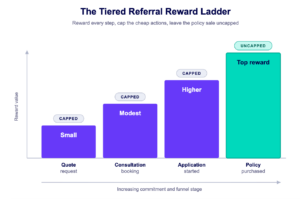
What Referral Actions Should You Reward?Limiting rewards to closed policies leaves easy referrals on the table. Pay out for the earlier steps too, a requested quote, a booked consultation, a started application, and you lower the barrier to referring while feeding your funnel more leads and better data. The catch is gaming. If a quote request earns a full reward, someone will generate a hundred junk ones to farm it. So cap the low-commitment actions: a small reward, with a limit on how many times an advocate can claim it. Then reserve your most valuable rewards for the moment that actually matters, when the referred lead buys a policy, and leave those uncapped.
A real sale is always worth paying for, so your advocates always have a bigger prize to aim at. Widening what counts as rewardable lowers the barrier to entry, opens more paths to conversion, and tells you far more about how referrals move through your funnel. |
Insurance is shifting from chasing new customers to keeping the ones it has, and referral programmes sit right at that pivot. They turn a satisfied policyholder into your most credible marketer, at a fraction of what paid acquisition costs, on the one currency insurance has always run on: trust.
The case is simple. Lower acquisition costs, warmer leads, and advocates worth at least 16% more over their lifetime than the customers you chase down. In a market where everyone else competes on price, that’s a real differentiator.
If you want a deeper playbook to build from, our Referral Marketing handbook walks through it step by step, and when you’re ready to put the mechanics in place, we’re happy to talk it through.
An insurance referral programme rewards existing customers when they refer friends or family to your company. It creates win-win incentives that boost loyalty, generate new leads, and reduce acquisition costs for insurers.
They’re built on trust, which is central to insurance. Personal recommendations reduce the perceived risk of switching and improve lead quality, which lifts profitability and retention.
By replacing costly ad spend with peer-driven recommendations, referral programmes reduce customer acquisition costs while improving lead conversion across lines of business.
The most effective incentives are tailored to the policy a customer holds, a discount on anti-theft devices for a home policyholder, say, rather than a generic voucher. Cash and gift cards can work, but relevance is what drives action, and the reward should fit both customer needs and your margins.
Expect a slow build rather than an overnight spike. Early referrals appear within weeks, but meaningful volume tracks your renewal and satisfaction cycles, so the first full picture usually takes a few quarters. Consistent promotion and asking at the right moments shorten the runway.
Yes. Regulatory restrictions vary by region. Incentive limits, licensing, and disclosure rules all apply. Legal review is vital before launch to avoid challenges.
Track referral volume, conversion rate, customer acquisition cost, and customer lifetime value. These metrics measure programme success and impact across distribution channels.
Rotate incentives, run seasonal campaigns, and spotlight top referrers. These tactics keep your programme engaging and adaptable to shifting customer expectations and emerging risks.
Yes. Referred customers tend to stay longer and are more profitable, and active referrers often show stronger loyalty to the brand themselves, which lifts overall retention.
Use referral software integrated with CRM systems to automate tracking, manage rewards, and monitor real-time performance. It ensures smooth operations and data-driven optimisation.
Explore the platform’s scalability, features and customisation options and get answers to your unique questions.