Exploring Loyalty Program Regulations: A Must-Read Guide
25 min to read
Published: March 12, 2024
Updated: August 21, 2026
Loyalty program regulations are the web of data protection, consumer protection and stored value laws that every rewards scheme has to sit inside. Get it right and your programme drives retention. Get it wrong and it drives legal bills. This guide walks the rules that matter, so you build compliant from day one.
Mark Camp
CEO & Founder at PropelloCloud.com
Contents
Key Takeaways
Be transparent about what you collect, how you use it and who you share it with. Get opt-in consent and give customers real control over their data.
Be honest about how rewards are earned, redeemed and restricted, and give fair notice of any changes. Misleading members isn't just bad practice, it's unlawful.
Disclose expiry, fees and restrictions clearly. Unredeemed points are a liability on your books, and aggressive expiry can be challenged as unfair under the Consumer Rights Act 2015.
Define clear eligibility and odds for prize draws, award prizes as advertised, and keep thorough records.
Run a trade mark search before co-branding, and secure permissions for any partner IP. Back it with a documented, legally compliant complaints process.
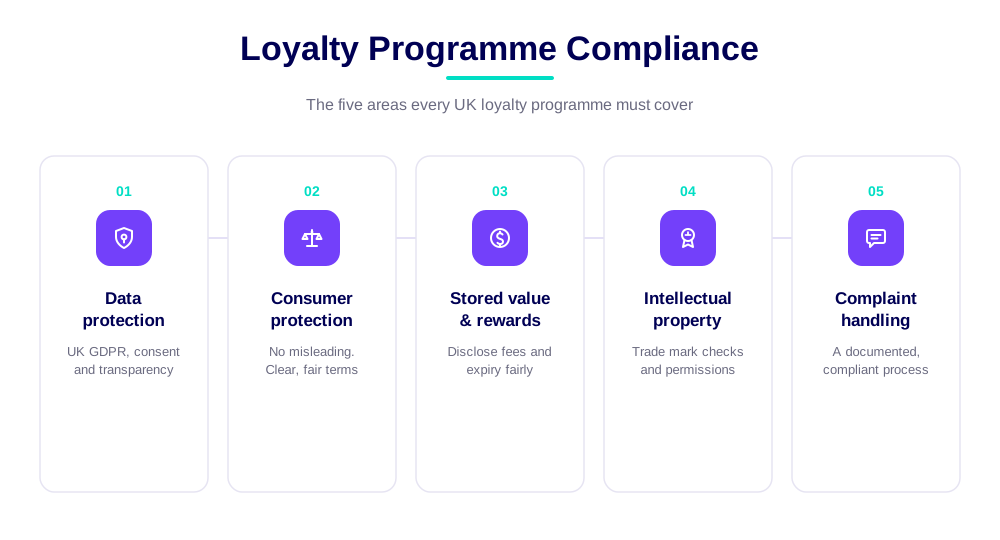
Loyalty program regulations break down into five areas: data protection, consumer protection law, stored value rules, intellectual property, and complaint handling. Miss one and the programme you built to win customers can quietly become the thing that lands you in front of a regulator.
I’ve watched good schemes stall over compliance nobody scoped at the start. So I’ll cover each area in turn to help you build a programme that engages and holds up in law.
What Is the Legal Framework for Customer Loyalty Programmes?
The legal framework starts with data. A loyalty programme runs on customer information, and that puts data protection law at the centre of compliance from day one. Get the data foundation right and the rest of the legal picture gets easier. Three areas set the baseline.
Data protection law
Data protection law is where it starts. The rules tightened for good reason: customer data is yours to look after, not to treat casually.
Under GDPR in the EU, and its equivalents elsewhere, that means being straight about three things. What you collect. How you use it. Who you share it with.
Get those three right and you are not just compliant, you have given the customer a reason to trust you with more.
GDPR compliance
Speaking of GDPR, make sure you get explicit opt-in consent from customers before collecting their data. You also need to be clear about how you’ll use their data. Not forgetting the fact that customers should have the right to access, correct, or delete their information whenever they want.
It sounds like a lot, but it’s worth it. Doing the above not only keeps you on the right side of the law; it shows your customers that you respect their privacy by ensuring it’s protected. In my eyes, when it comes down to it, that should matter to every business.
Local data privacy laws
General Data Protection Regulation (GDPR) is the headline, not the whole story. For a UK programme, your baseline is UK GDPR and the Data Protection Act 2018. Operate into the European Union (EU) and you pick up EU GDPR on top. Every new market adds its own rule book, with its own definitions and duties.
It fragments further below national level. The US is the clearest example. There is no single federal privacy statute, so you are dealing with state law: the California Consumer Privacy Act (CCPA), the Colorado Privacy Act (CPA), and a growing list of others, each with its own thresholds.
Operate across borders and compliance is not one box to tick. It is one box per jurisdiction. The baseline that travels well across all of them comes down to four habits:
Communicate with customers in clear, plain language.
Keep your privacy policy and terms current and easy to understand.
Be specific about what data you collect, why you need it, and how you use it.
Give customers real control over their data, so they can opt out or delete it whenever they want.
Practising these basic principles puts you on solid ground in most markets. I would treat them as the floor, not the ceiling.
Which Consumer Protection Laws Govern Loyalty Programmes?
Consumer protection law comes down to one rule: you cannot mislead the people in your programme. That covers how you describe rewards, how customers earn and redeem them, and how you flag changes. Break it and you are not just losing trust, you are breaking the law.
Misleading and unfair practices
You’ve got to make sure you’re not misleading your customers or engaging in any business practices that could be perceived as shady. That means being honest about your loyalty programme benefits, their restrictions or limitations, and how customers earn and redeem rewards.
Believe me when I say, businesses that try to pull a fast one on their customers only shoot themselves in the foot. Customers won’t hesitate to call out bad actors.
Positive referrals take time to nurture. Bad news on the other hand spreads like wildfire.
Staying the right side of that line comes down to your terms. They should spell out exactly what customers get, in plain language, with nothing important buried in the fine print.
And if you’re making any changes to your programme, make sure you give customers plenty of notice and explain what’s changing and why.
Online or offline solutions
Depending on how you’re running your loyalty programme, you might need to consider different legal requirements. If you’re running an online programme, for example, you’ll need to comply with e-commerce regulations and make sure your website is secure and protected against data breaches.
You’ll also need to provide customers with clear information about how to opt-out of your programme or unsubscribe from marketing communications.
If you’re running an offline programme, on the other hand, you’ll need to comply with any local laws or regulations around physical rewards, such as gift cards or vouchers.
Make sure your staff are properly trained for explaining the programme to customers and handling any complaints or disputes that might arise. Handling any issues that arise quickly and fairly is an integral part of effective communication.
What Legal Rules Apply to Loyalty Points and Rewards?
Once a reward carries value, the law starts treating it like value. That pulls loyalty points and rewards into three areas of rules: stored value and how you disclose it, prize draws and how you run them, and unredeemed points you carry as a liability.
Payment instruments and stored value
Stored value is where a loyalty programme brushes up against financial regulation. The moment points or credits can be redeemed for something, they carry value, and value comes with obligations: expiry limits, fee disclosure, clear terms. How strict those obligations get depends on where you operate.
Four steps keep a stored value programme on the right side of the rules:
Disclose everything attached to your points or credits, including expiry dates, redemption restrictions and any fees. Put it somewhere customers can actually find it.
Check your stored value system against the law in every jurisdiction you run in. This is the point where local legal advice earns its fee.
Track balances, expiry dates and redemption activity properly, so issues surface early rather than at audit.
Lean on an established loyalty provider that has handled stored value rules before. Platforms like Propello Cloud carry that compliance load, so your marketing team does not have to.
Handle the reward currency with the same care as the money it stands in for, and stored value stops being a liability and starts being an asset you control.
Prize draws and competitions
Prize draws and competitions come with their own rules: who can enter, the odds of winning, and how prizes get awarded. Get these wrong and a promotion meant to build goodwill starts to look unfair or deceptive instead.
Territory matters here more than almost anywhere else. In the UK, sales promotions fall under the Committee of Advertising Practice (CAP Code), enforced by the Advertising Standards Authority. Run into other markets and the rules shift again, with the US layering state and federal law on top.
These guidelines keep a promotion fair wherever it runs:
Clearly define the rules and eligibility requirements for each promotion, including any restrictions based on age, location, or other factors. Make sure these rules are easily accessible to all participants.
Be transparent about the odds of winning and how winners will be selected. If using a random drawing, ensure it is conducted fairly and impartially. If judging entries, establish clear criteria and use qualified, unbiased judges.
Ensure that all prizes are awarded as advertised and within the stated time frame. If any changes need to be made to the prizes or delivery schedule, communicate this to participants promptly and transparently.
Keep thorough records of all aspects of the promotion, including participant entries, winner selection, and prize fulfilment. This documentation can be invaluable in the event of any legal challenges or audits.
Consult legal experts familiar with promotion and prize draw regulations in every jurisdiction you run in. They can steer you through the specifics and keep you compliant.
Run your promotions on transparency and proper records, and prize draws build engagement instead of legal exposure.
Unredeemed points and expiry
Not every reward gets claimed, and the ones that don’t still count. Unredeemed points are not free money. They sit on your balance sheet as a liability, because each one is a promise you have committed to honour. Marketers forget this until finance reminds them.
Expiry looks like the obvious fix, and it is a legitimate tool. But it has limits.
Under the unfair terms rules in the Consumer Rights Act 2015, a forfeiture clause buried in the small print or set aggressively short can be challenged as unfair, which means unenforceable. Set expiry clearly, give fair notice, and apply it consistently.
What Other Legal Risks Should Loyalty Programmes Plan For?
The big three, data, consumer protection and rewards, cover most of the ground. But a few risks sit outside them and catch programmes off guard: intellectual property, trade marks, and complaint handling. Deal with them early and they stay small.
Intellectual property infringement
When it comes to intellectual property (IP) infringement, loyalty programmes that involve co-branding or partnerships require extra vigilance. It’s crucial to ensure that your programme doesn’t infringe upon anyone else’s trademarks, copyrights, or other IP rights.
To mitigate these risks, I recommend conducting a thorough IP audit before launching any co-branded loyalty initiatives. Particularly if you’re setting up a loyalty partnership without third-party experts.
Research existing trademarks and obtain explicit permission to use any IP assets belonging to your partners.
Trade mark search
A thorough trade mark search protects your loyalty programme from infringement claims before they start. It means checking for existing marks similar to your own, so your programme name, logo or reward branding doesn’t accidentally tread on someone else’s rights. The more jurisdictions you function in, the more involved it gets.
Start with the official registers. In the UK, that’s the Intellectual Property Office (IPO). For international marks, the World Intellectual Property Organisation (WIPO) and its Global Brand Database are the reference, and the US has the United States Patent and Trademarks Office (USPTO) if you sell there.
For anything past a basic check, a solicitor specialising in IP earns their fee, particularly across multiple territories.
Customer complaints
In my experience, even the most well-designed loyalty programmes occasionally face customer complaints or disputes. That’s why a robust, legally compliant process addressing these issues is crucial for maintaining customer trust and minimising legal risks.
To effectively manage customer complaints, consider implementing the following:
A dedicated customer support team trained in handling complaints and disputes.
Clear escalation procedures for more complex or serious complaints.
A transparent, efficient system for tracking and resolving issues.
Regular reviews of complaint data to identify and address systemic problems.
Prioritising customer satisfaction and implementing a legally sound complaint handling process drives long-term customer loyalty and retention.
How Do You Structure Loyalty Programme Terms and Handle Legal Challenges?
Your terms and conditions are where a loyalty programme lives or dies legally. They set out how the programme works for the customer, and they are your first line of defence when a challenge lands. Two things decide whether they hold up: how clearly you structure the programme and its changes, and how well the terms anticipate legal risk.
Programme structure and changes
First up, let’s talk about programme structure and changes. This is where you’ll want to be crystal clear with your customers about how your loyalty programme works, what they can expect, and how things might change over time.
Here’s a quick breakdown of some key points to cover:
Point
Description
Earning and Redeeming Points
Clearly explain how customers can earn points, what actions or purchases qualify, and any limitations or restrictions. Be transparent about how points can be redeemed, what rewards are available, and any expiration dates or usage restrictions.
Sale or Transfer of Points
If your programme allows for the sale or transfer of points, make sure you have clear rules in place around how this works. Be transparent about any fees or restrictions, and make sure customers understand the implications of selling or transferring their points.
End of Cycle
If your programme operates on a cyclical basis (e.g. monthly or quarterly), make sure customers understand when each cycle begins and ends, and what happens to their points or rewards at the end of each cycle.
Changing Terms
Be transparent with customers about how and when you might change the terms of your loyalty programme. Give them plenty of notice before any changes take effect, and make sure they understand how those changes might impact their points or rewards.
Termination
Make sure customers understand the circumstances under which their loyalty programme membership might be terminated, and what happens to their points or rewards in that scenario. Be clear about any actions or behaviours that could lead to termination, and give customers a clear path to appeal if they feel they’ve been terminated unfairly.
By being transparent and upfront about these key areas of your programme structure, you can help build trust with your customers and avoid any legal issues down the line.
Legal challenges
Of course, even with the best intentions and the most transparent programme structure, there’s always a chance that legal challenges might arise.
For senior marketers or loyalty programme managers, it’s important to be aware of some of the key legal issues that can come up with loyalty programmes, and to work closely with your legal team to mitigate any risks.
Here are a few key areas to keep in mind:
Challenge
Description
Competition law
If your loyalty programme involves partnerships or collaborations with other brands, there’s a risk of breaching competition law. For instance through arrangements that could look anti-competitive.
Work closely with your legal team to keep any partnership above board.
Joint Responsibility
If your loyalty programme involves multiple partners or stakeholders, there may be questions around who is responsible for what when it comes to legal compliance and liability.
Make sure you have clear agreements in place that spell out each party’s roles and responsibilities, and work closely with your legal team to ensure everyone is on the same page.
Customer Disputes
No matter how well-designed your loyalty programme is, there’s always a chance that customers might have disputes or complaints.
Ensure you have a clear and fair process in place for handling these disputes, and work closely with your legal team to ensure that you’re following all relevant laws and regulations around customer complaint handling.
Precise and Robust Terms
Finally, one of the best ways to avoid legal challenges is to have precise and robust terms and conditions for your loyalty programme.
Work closely with your legal team to craft clear, comprehensive, and legally sound terms that cover all the key areas of your programme.
Make these terms easily accessible to customers and conduct regular reviews and updates as needed.
By keeping these legal challenges in mind and working closely with your legal team to mitigate any risks, you can help ensure that your loyalty programme is both engaging and compliant.
It may take a bit of extra work upfront, but the peace of mind and long-term success of your programme will be well worth it in the end.
Navigating the Legal Landscape: Your Key to Loyalty Programme Success
While we’ve explored a lot of the ins and outs of loyalty programme legalities, it’s important to remember that this blog is not a substitute for professional legal advice.
Every loyalty programme is unique, and the specific legal requirements and challenges will vary depending on your industry, location, and programme structure. Whilst it won’t do you any harm to follow some of the guidelines I’ve provided, I would urge you to consult legal advice.
At Propello Cloud, we pride ourselves on having a robust legal framework in place to ensure that our loyalty programmes are fully compliant with all relevant laws and regulations.
But even with our expertise and experience, we always recommend that our clients seek independent legal advice to ensure that their specific needs and circumstances are fully addressed.
So don’t let legal risk stall you from building or revamping a programme. Prioritise compliance, work closely with your legal team, and you can create a programme that engages and rewards your customers while standing up to legal scrutiny.
FAQs
Can you make marketing consent a condition of joining a loyalty programme?
Generally not, if members earn points on purchases. The ICO’s position is that where a scheme lets people collect points redeemable against future purchases, you cannot require consent to marketing as the price of joining. The narrow exception is a scheme that exists purely to send offers, where marketing is the service itself. For most points programmes, keep the reward and the marketing opt-in separate.
Do loyalty programmes need to comply with PECR as well as UK GDPR?
Yes, and they do different jobs. UK GDPR governs how you collect and process member data. The Privacy and Electronic Communications Regulations (PECR), alongside UK GDPR, set out what organisations must do when sending marketing messages. For marketing emails and texts, consent is effectively the only lawful basis under PECR, so a lawful basis for holding data does not by itself let you market to members. Treat the two as separate gates.
Are loyalty rewards taxable in the UK?
For ordinary consumers, generally no. HM Revenue & Customs (HMRC) generally treats points earned through standard public loyalty schemes as a personal reward for the individual, with no tax to pay. It changes in an employment context: if a reward is available only because of someone’s employment, for example air miles a company buys and hands to staff as an incentive, it can count as a benefit in kind. A public scheme anyone can join stays clear of that.
Can you automatically enrol customers into your loyalty programme?
No, not safely. Consent has to be active, so automatic enrolment, where someone is added just by creating an account or making a purchase, is generally not compliant, and pre-ticked boxes do not count. You also cannot bundle loyalty sign-up into a mandatory part of buying from you. Customers must be able to purchase without joining, and joining must be a choice they make.
Do referral or 'tell a friend' features carry their own legal risk?
They can. The ICO has flagged that tell-a-friend schemes can breach PECR, because the organisation has no direct relationship with the friend and so cannot obtain valid consent to message them. The safer design keeps the referrer in control of sending the message from their own account, rather than the brand sending on their behalf. Worth a compliance check on any referral mechanic before launch.
Do loyalty programmes aimed at or open to children need parental consent?
Sometimes yes. Where you offer an online service directly to a child and rely on consent to process their data, UK GDPR sets the age of digital consent at 13, the threshold fixed by the Data Protection Act 2018. Below 13, the processing is only lawful if consent is given or authorised by someone with parental responsibility, and you have to make reasonable efforts to verify that. If under-13s can realistically join your scheme, you need an age gate and a parental-consent route.
Can loyalty points count as 'stored value' that triggers financial regulation?
They can, depending on how the currency behaves. Ordinary points redeemable only for a brand’s own rewards usually sit outside e-money rules under the limited-purpose exemption. But a loyalty currency that is transferable, saleable, or exchangeable for cash can be classified as stored value or electronic money, which triggers financial-services regulation rather than only promotions law. The more your points behave like money, the more likely you cross that line, so it is worth checking the classification before you launch a tradable currency.
Do you need consent for everything, or can you rely on legitimate interest?
It splits by purpose. For running the scheme itself, such as tracking points and fulfilling rewards, your lawful basis can be consent or a legitimate business interest. For marketing messages by email or text, that flexibility disappears: PECR effectively requires consent. So you can often run the mechanics of a programme on legitimate interest while still needing a clean marketing opt-in on top.
Does a loyalty programme need a Data Protection Impact Assessment?
Often, yes. Loyalty schemes typically profile customer behaviour and process personal data at scale, which are exactly the triggers the ICO flags for a DPIA. The ICO has indicated that most direct marketers are likely to need one. Running the assessment before launch surfaces risks early and evidences your accountability if the regulator ever asks.
Do you need explicit consent to collect health or other sensitive data in a loyalty programme?
Yes. Special category data, which includes health, ethnicity and similar, carries a higher bar than ordinary personal data. If your programme collects something like a customer’s health information or ethnicity, you must obtain their explicit consent. This matters most in fitness and insurance schemes, where health data can surface as part of the reward mechanics. Collect it only if you genuinely need it, and get explicit consent when you do.
Mark Camp
Mark is the Founder and CEO of Propello Cloud, an innovative SaaS platform for loyalty and customer engagement. With over 20 years of marketing experience, he is passionate about helping brands boost retention and acquisition with scalable loyalty solutions.
Mark is an expert in loyalty and engagement strategy, having worked with major enterprise clients across industries to drive growth through rewards programmes. He leads Propello Cloud’s mission to deliver versatile platforms that help organisations attract, engage and retain customers.
Start your customised Propello Cloud journey today
Explore the platform’s scalability, features and customisation options and get answers to your unique questions.